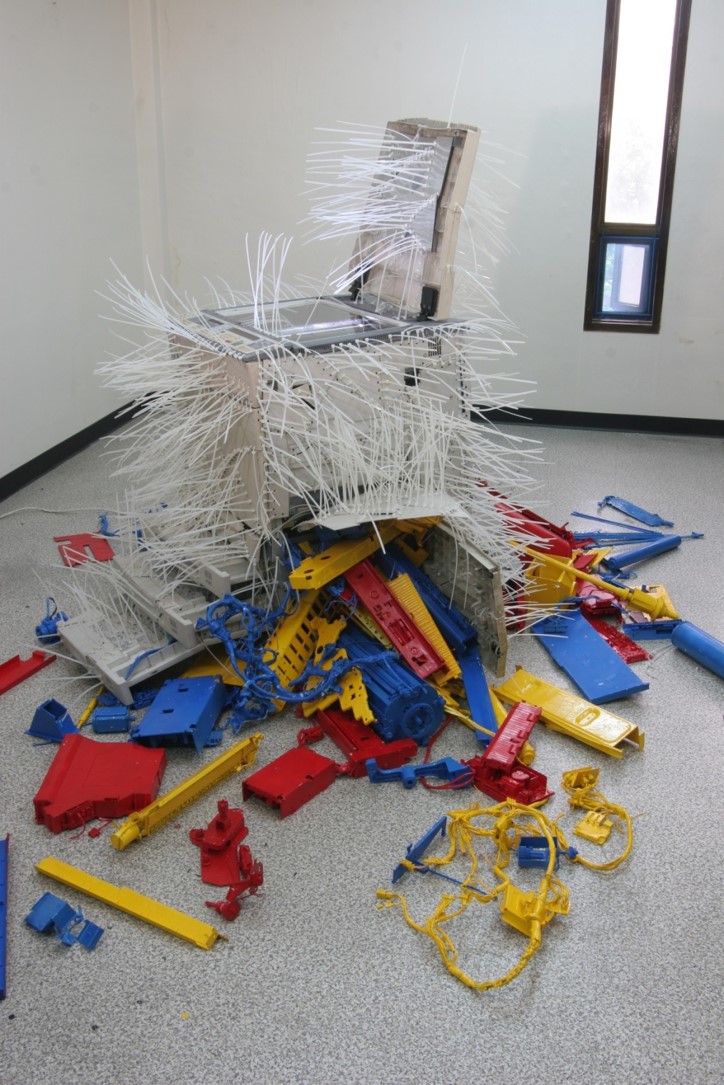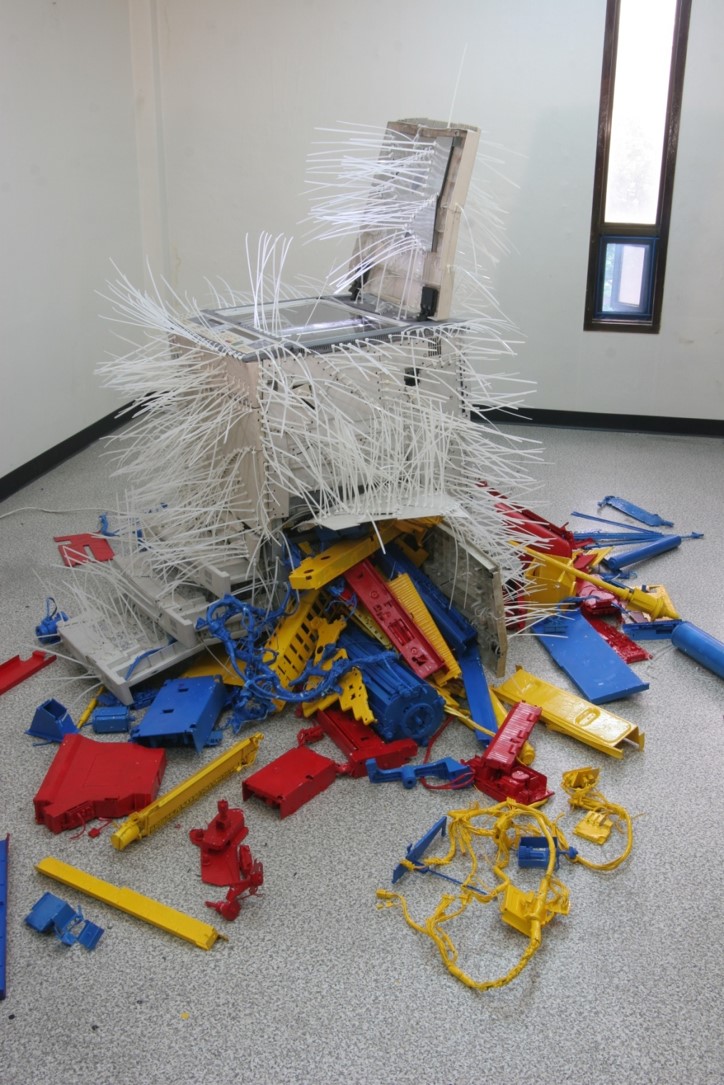

In one corner of the exhibition space, a photocopier continues to operate. Despite its internal components spilling outward, the machine remains functional, emitting light and endlessly scanning something on its own. The exposed parts, spilling out like entrails, are painted red, blue, and yellow. Though shattered, the machine has been reassembled with cable ties.

Countless cable ties densely cover its surface like fur growing from an animal's skin. Maintaining its form only moments before total collapse, it appears to be carrying out its assigned task with the last of its remaining strength. The work An Optical Illusion Of Contemporary People In Three Primary Colors originated from the fact that a photocopier contains inks in three primary colors.

Through the combination of these three colors, countless other colors can be reproduced. The work reflects a condition in which a very limited set of codes becomes the sole point of reference, while the diversity of the world is constrained through their endless combinations and reproduction.

The cable ties binding together the fractured body of the machine tighten easily, yet can never be loosened in the opposite direction. They are designed for a single use only. Frequently employed throughout Jung Seung's practice, cable ties function not merely as a means of producing visually intriguing forms.

Rather, they condense essential characteristics of contemporary civilization—convenience, disposability, constriction, and irreversibility—into a single material. In an age of convergence, where objects and systems are seamlessly connected, Jung instead stitches fragmented objects together like a patchwork repair. By applying technologies associated with digital convergence to large-scale analog machines, he amplifies their visual impact.

The act of gathering distant elements, compressing them onto a single plane, and condensing them into a unified form often serves as a measure of technological progress and a means of generating new forms of value—or profit. Yet compression and synthesis can become excessive, reaching the point of absurdity. It is precisely this condition that Jung's patched-together machines come to symbolize.

These machines no longer derive their value from their individual functions or unique characteristics. Instead, through a process of indiscriminate convergence, they produce a condition in which all things become increasingly alike.

Vast quantities of material and energy must be concentrated in order for everything to possess a little of everything else, and the resulting entities—made ever more similar—are then forced into endless competition upon the same plane. Such a tendency leads not to coexistence, diversity, or peace, but rather to boredom and conflict.

The work Flowing Water Returns As Rain combines a showerhead and a toilet into a single apparatus. Beneath the toilet, which rests upon a floor of white tiles, the structure is broken apart. Water spills through the fragments, collects below, and is continuously circulated by a motor. The murky water moving between the toilet and the shower merges the acts of cleansing and waste disposal.

One could even imagine it as a marketable invention capable of handling bathing and excretion simultaneously. The work expresses a contemporary obsession with hygiene through a doubled act of cleansing, while pushing to an extreme the desire to resolve every need within a single system. In doing so, it exposes the absurd consequences of a logic that seeks maximum efficiency and total integration.


Jung Seung, An Optical Illusion Of Contemporary People In Three Primary Colors, 2008, Printer, cable tie, 200 x 200 x 150 cm © Jung Seung

Yet what fills the time and space supposedly saved through such efficiencies is merely another frenzy of production and consumption. The machine exemplifies a condition in which the cycle connecting production and consumption has become so compressed that the two can scarcely be distinguished from one another.

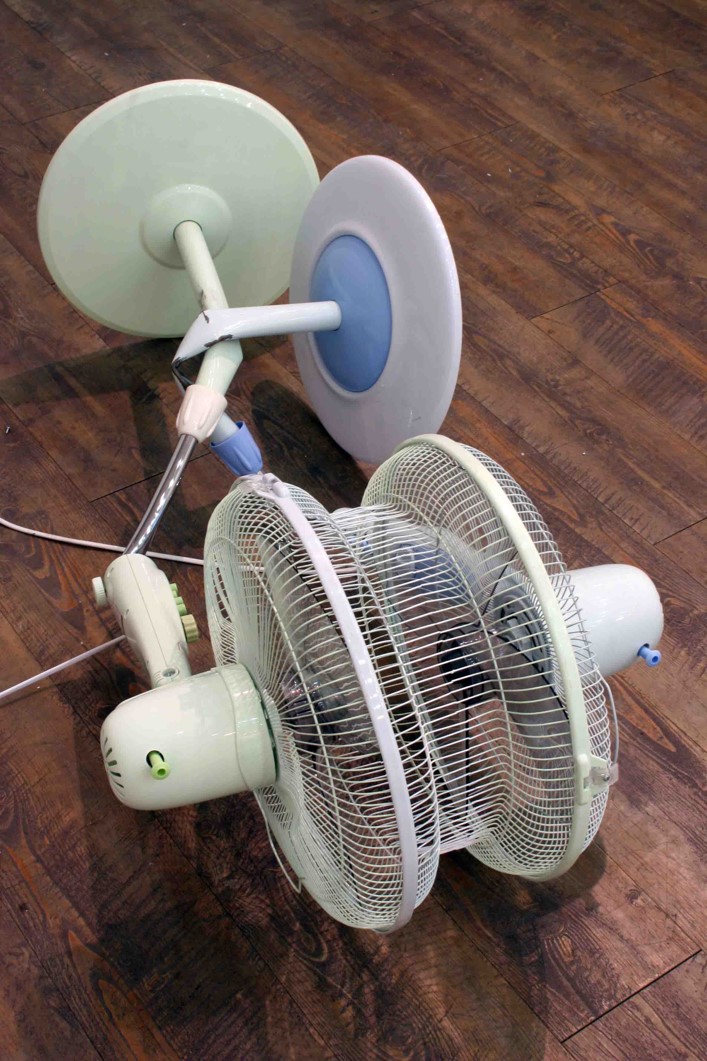
A work featuring two electric fans positioned face-to-face pushes the absurdity of convergence to its limit. As its title suggests, it is a A Struggle For Evolution. Joined at the head and entangled through their bodies, the two fans are set to rotate continuously. As they twist against one another, they emit an irritating mechanical noise.

The sight of two entities with no reason whatsoever to be connected becoming hopelessly intertwined is as unsettling as any imagined monster. The photocopiers, electric fans, toilets, and other machines featured in this exhibition all reveal variations of the mutant machines that the artist has been developing and experimenting with for years. In every case, the original functions of the objects are transformed.

Evolution for survival applies not only to living organisms but also, metaphorically, to machines. Within nature, countless experiments take place as species adapt to changing environments, and it is through these processes that transitional forms—mutations—emerge. 

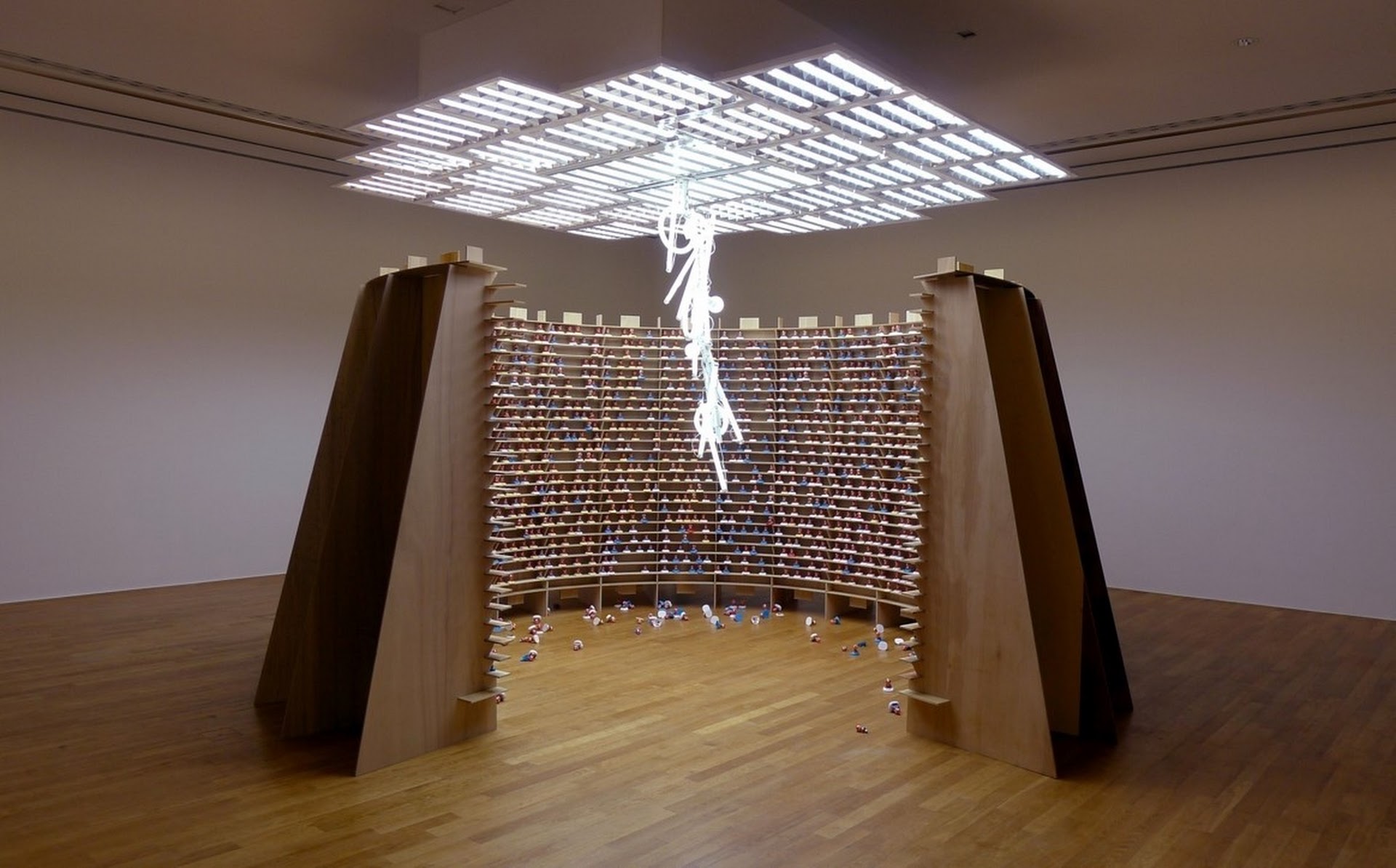
Only a tiny number ultimately develop into viable new species. What occurs within humanity’s artistic and scientific laboratories is likewise founded upon the fundamental operations of cutting apart and reconnecting. Jung extends this logic beyond individual objects to the environment itself, constructing temporary walls within exhibition spaces, breaking them apart, and rejoining them.

Conventionally, concentration and convergence are understood as means of increasing productivity. The production of a single automobile or computer requires the concentration of countless components. At the same time, it entails the concentration of labor and surplus value—that is, wealth.

Contemporary capitalist society channels diverse motivations and actions toward a single objective: productivity. It places everyone on the same level and encourages them to desire the same things. For mass production to function through concentration and convergence, desires themselves must also become standardized.

Yet the standardization of desire produces nothing more than poverty amid abundance. Embedded within indiscriminate forms of convergence, driven solely by the pursuit of greater profit, is an impulse toward self-destruction.

The act of patching together fragmented machines is less an act of repair than one of exposing seams and widening cracks. Though these fractured objects continue to function, they no longer operate in the service of normal production. Instead, their exposed ruptures reveal the instability hidden beneath the appearance of coherence.

The machines and devices Jung employs are typically industrial products designed with rigorous attention to function. Electric fans, toilets, showerheads, and photocopiers are objects stripped of ornament and excess, their forms shaped entirely by their intended purposes. They are functionalist objects in the classic sense—objects for which form follows function—and therefore serve as signs of function itself.

The reduction of an object to a single function is already the result of continual processes of elimination and integration. In everyday reality, the combination of functions is generally pursued in the name of greater efficiency and is guided by the regulation of capital and bureaucratic systems of control. Using devices such as cable ties, Jung reconnects these separated signs and functions.

In doing so, he metaphorically reenacts a process that occurs constantly within industrial production and the marketplace, where disparate elements are assembled and reorganized in the pursuit of profit.


Jung Seung, A Struggle For Evolution, 2008, Two electric fans, 150 x 50 x 50 cm © Jung Seung

It is here that the absurd dimensions of the experiments conducted by factories and markets in pursuit of ever-greater functionality are brought to their extreme. The new machines and devices devised by Jung seem driven not toward improved function or increased productivity, but toward self-contradiction and self-destruction. By subtly twisting the language of functionalism, he reveals a surplus that exceeds function itself.

Though their original purposes have been altered, Jung’s machines continue to whir, hiss, and operate without pause. In doing so, they expose desire itself. These machines simultaneously evoke both mechanical and human bodies, converging into what might be called “desiring machines.”

In their analysis of capitalist society, Gilles Deleuze and Félix Guattari argue that desiring machines function only by continually breaking down, and that their breakdowns constitute an essential part of their operation. Failure is not external to the machine; it forms part of its very mode of functioning. Desire itself is a machine, a synthesis of machines, a machinic assemblage.

Desire belongs to the order of production, and all production is at once desiring and social. Machines embody the force of continuity, linking one component to another in an endless chain of connections. This movement toward unity has also been a defining characteristic of modern reason. Reason played a central role in the tradition of Enlightenment thought.

In The Conditions of Modernity, Manfred Frank notes that ever since Augustine asserted that “human reason is a force that strives toward unity,” the fundamental characteristics of rational judgment have been understood in terms of necessity, universality, and lawful order.

By opposing the rationality of the general will to individual passions, reason invalidated political and social forms that could not be justified through scientific argumentation. It became the foundation of universalism, while modernity sought fulfillment through the positive image of a world governed by reason.

Throughout the modern era, a mode of thought grounded in identity gradually emerged—one that sought to subsume differences within an overarching unity.

As this logic became intertwined with systems of production, consumption, and circulation, it gradually became standardized. Everywhere, purposiveness and efficiency are celebrated as virtues. Yet one might ask whether progress truly serves human beings, or whether it primarily sustains, expands, and reproduces anonymous structures in which humans themselves function merely as components.

The absurd machines that appear throughout Jung Seung’s work operate as mirrors reflecting the human condition. Within them, rationality appears either deficient or excessive. In this sense, they trace a path similar to that followed by modern reason itself. Reason is neither transparent nor impartial; it is inseparable from desire and power.

In Jung’s works, the functions of machines lose their original clarity and purpose, becoming transformed into something else. Yet these transformations possess no clearly defined objective. Like modern art itself, they embody a form of “purposiveness without purpose.”

Through this condition, the works expose the hidden irrationality of a capitalist society in which instrumental reason has directed production away from human needs and toward production for its own sake. Whether one discovers within this irrationality a possibility for liberation or, conversely, a mechanism of oppression ultimately depends upon the perspective of the viewer.

References