It is said that in the amphitheaters scattered throughout the Roman Empire two thousand years ago, as many as 5,000 people died each day during periods when games were held. Thick layers of sand covered the arena floors to absorb the enormous quantities of blood spilled there, and it was from this sand that the term “arena” originated.
Today, the word simply denotes a stadium or performance venue, yet embedded within it remains the memory of a vast process of derealization. The crowds’ cries for slaughter must have been amplified by the architecture of these immense circular structures, transformed into an abstract acoustics of collective desire.
According to Guy Debord, spectacle—through its conjunction of temporal singularity and politics—originates in the intention to produce a collective consumption of time by the masses, what he called a structure of pseudocyclical time. The idea of constructing a simulacrum of vast cyclical time and substituting it for reality itself forms one of the foundations of modern capitalism.
Time is endlessly consumed and regenerated. As Baltasar Gracián observed, time is the only thing we truly possess—even beggars possess it. For this reason, creating structures through which time can be produced and consumed in pseudocyclical form becomes of paramount importance.
Through advertising, television serials, the World Cup and the Olympic Games, Lunar New Year and Chuseok holidays, the recurring cycles of bonus seasons and sales promotions, and the succession of incidents, scandals, and news events that erupt whenever things begin to grow quiet, lived time is steadily replaced by a pseudocyclical structure.
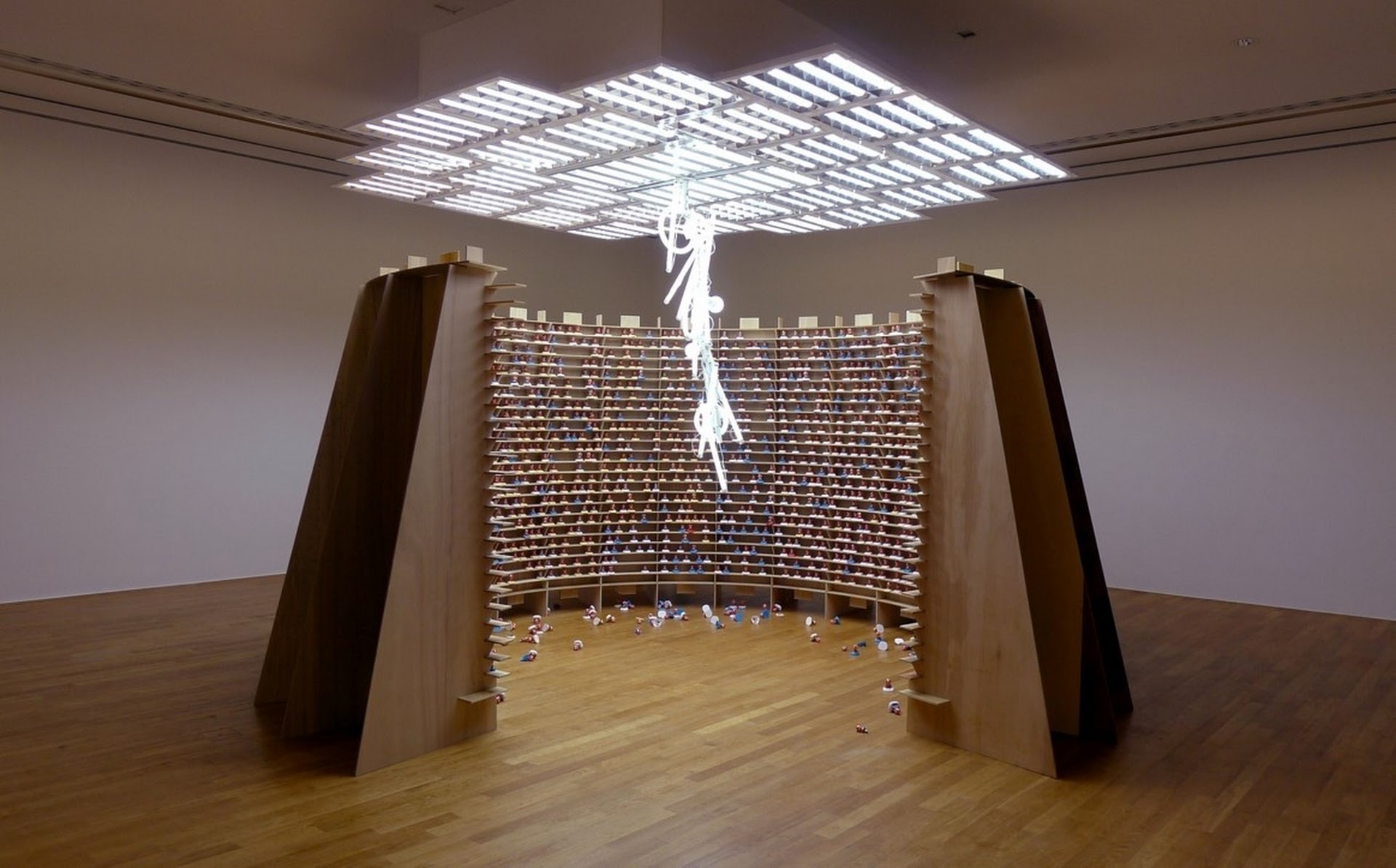
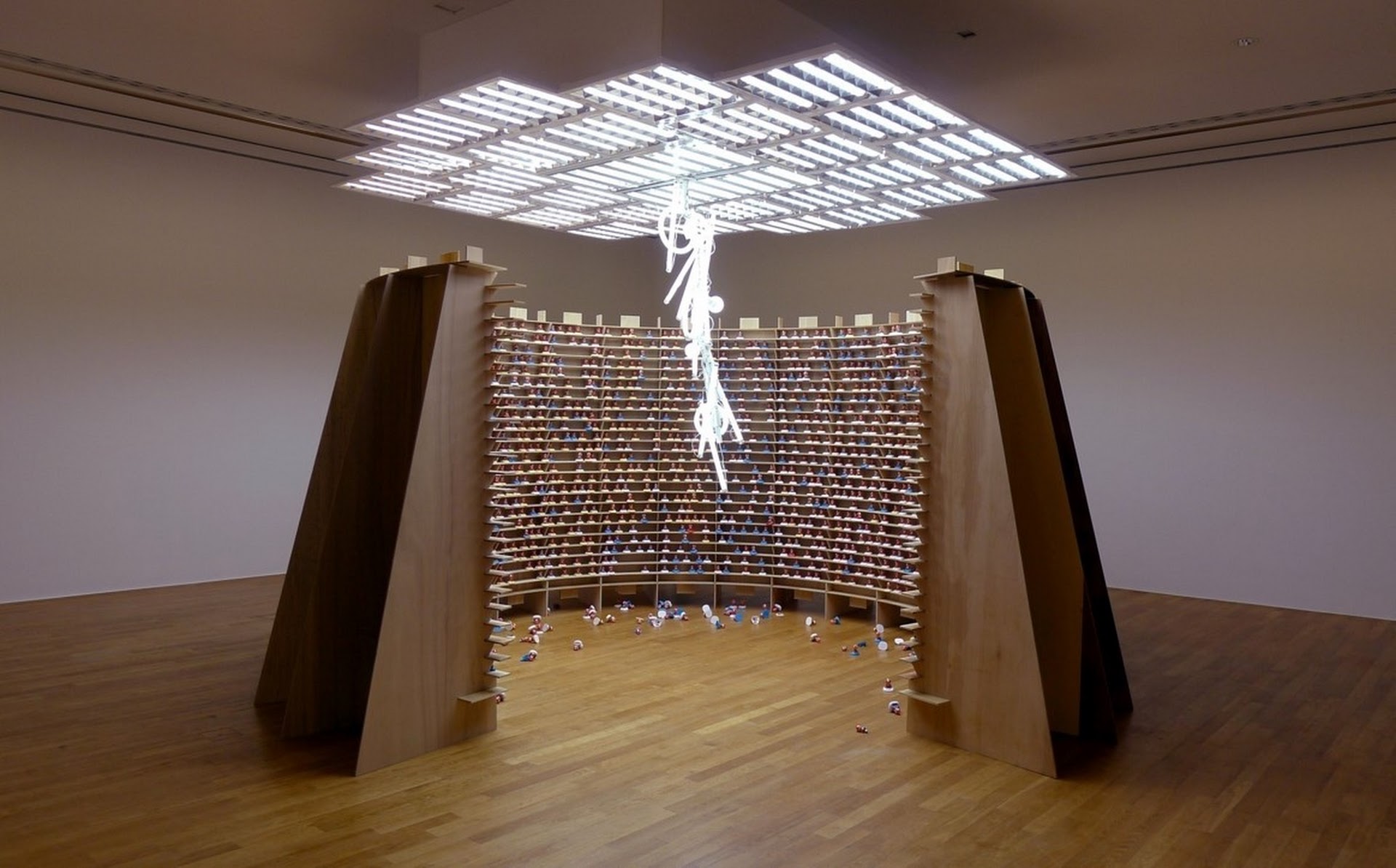
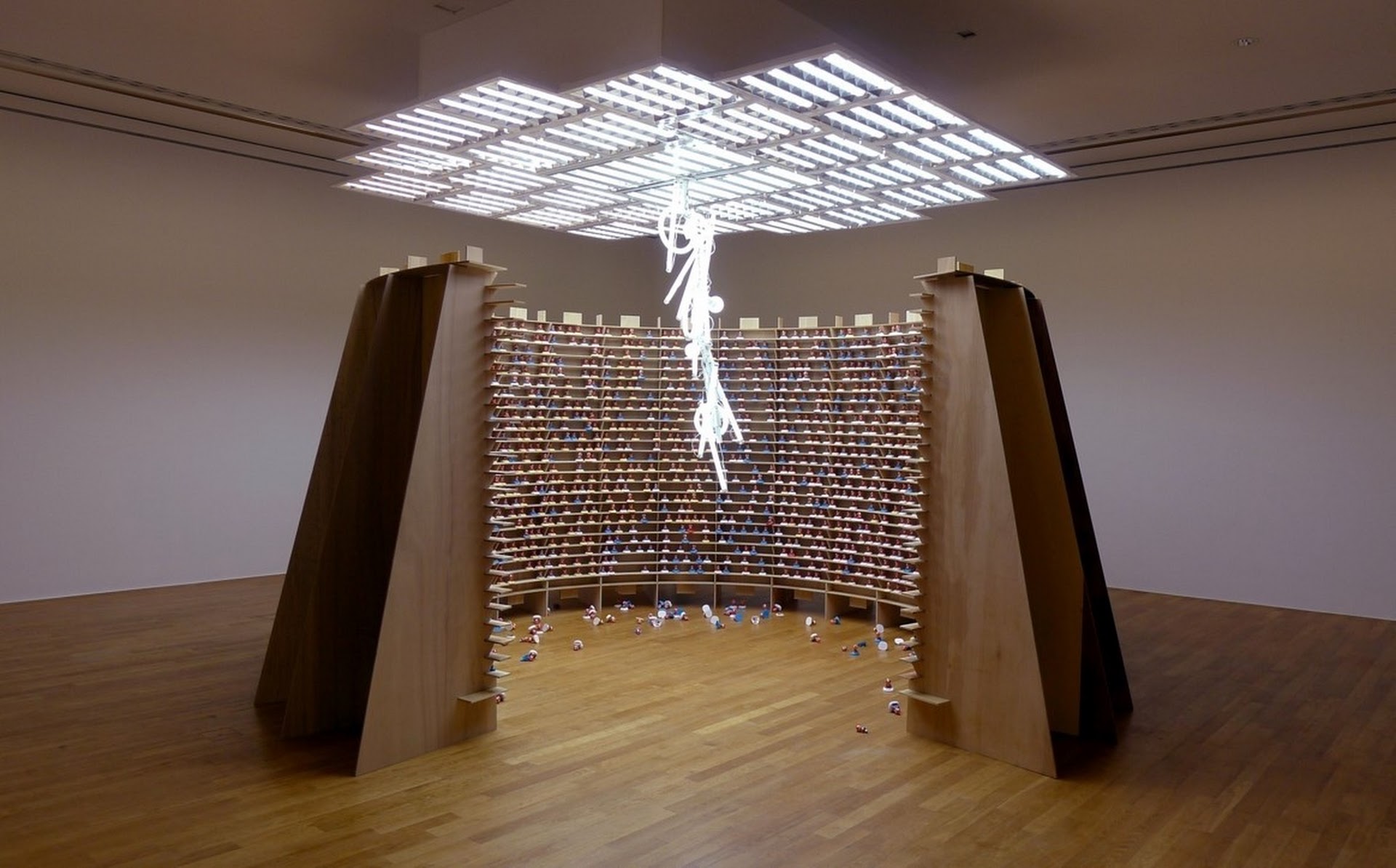
Jung Seung’s Spectacleless Complex consists of approximately 2,000 “Nohohon” dolls. Nohohon is a solar-powered toy produced by a Japanese toy company, characterized by its simple movements—gently bobbing its head or producing small sounds. Throughout his practice, Jung has frequently employed inexpensive objects purchased online or obsolete products acquired wholesale from factories.
What attracts him to these items is precisely their status as mass-produced industrial commodities: vast quantities of identical manufactured objects. In Circling Complex (2009), Jung installed more than two hundred headless cyclist automata on a circular track, where they endlessly revolved in place.
The noise generated by their motorized movements evoked the collective drone of countless insects chirping in late summer or the resonant chanting of thousands of Buddhist monks reciting sutras in unison. Likewise, in Spectacleless Complex, innumerable dolls arranged upon a semicircular, stepped platform repeatedly nod their heads and emit sounds.
The cumulative noise produced by their incessant movements resembles the ambient roar of a vast city or the synchronized ticking of countless clocks. The stepped structure itself recalls either a Roman amphitheater or the tiered altar of a Buddhist temple lined with thousands of bodhisattva figures.
Among the dolls, a few gradually lose their balance through their own mechanical motions and tumble from the platform below. They appear almost as tragic individuals cast out from the flow of an immense cyclical system.
Spectacleless Complex generates an irony through its very existence. It is a work that asks viewers to attend not to the whole—the 2,000 Nohohon dolls—but to the parts, namely those that have fallen from the structure. At the same time, however, it is designed so that the spectacle produced by the entirety of the installation leaves an immediate and powerful impression on its audience.
One of the challenges Jung Seung faces as an artist of the “multiple readymade” is that works employing large quantities of manufactured goods can easily devolve into visual monuments whose appeal relies solely on numerical repetition. Yet Jung succeeds in constructing a system in which the work operates independently on both critical and visual levels.
The artist has described Spectacleless Complex as a reflection on a reality that privileges vast currents and large-scale phenomena while overlooking specific, individual facts.
Embedded within this observation is a critique of contemporary art itself: rather than focusing on the creative spirit of individual artists, does it not increasingly treat artists and artworks as merely illustrative examples of overarching curatorial themes, as is often the case in biennials? If one cannot become a spectacle, if one cannot become one of the countless elements that contribute to the larger image, then what remains?
It is from this anxiety that the “complex” of the title begins to emerge. At the same time, in a world where growth, efficiency, and the continual refinement of systems are celebrated, content tends to be valued only insofar as it contributes to predetermined goals. Everything else risks being dismissed as insignificant.
Under such conditions, the confusion experienced by individuals living within these systems can lead to a negation of their own reason for being. The spectacle generated by an immense framework of sameness reduces individuals to mere components of a pattern.
The meaningless buzzing noise produced by the dolls resembles a new temporal “Om”—the primordial sound of Buddhist cosmology—generated not by spiritual devotion but by the cold enthusiasm of capitalist spectacle. Paradoxically, the vibrations of capitalist spectacle seem capable of producing waves even more powerful than the sacred resonance of religious ecstasy.
One of capitalism’s greatest effects is its ability to compel individuals to become willing participants in a larger vibration, driven by an obscure yet irresistible passion to merge with the whole. Rather than establishing relationships based on visibility or legibility, it creates a microcosm of endless repetition and desire. New things are continuously produced and consumed; they replace what came before, only to disappear in turn.
In this process, a “body without organs” sustains space and time at a perpetual state of virtual boiling point. For this reason, the title of the work must be understood from the perspective of those who have been excluded from the spectacle—those who have fallen away from the positions assigned to them within it.
These figures cast out from the spectacle are none other than the minority subjects represented by artists themselves. The complex they experience stems from finding themselves excluded from the dominant currents generated by capitalism, or by forms of passion that operate in a similar manner.
Powered by solar cells, the Nohohon dolls draw their energy from the invisible light dispersed throughout the surrounding space, as though the entire environment exists solely to sustain their repetitive and seemingly meaningless movements. No matter how slight the energy source may be, it is sufficient to keep their heads in motion.
As long as light remains, they will continue nodding, obeying what appears to be an irresistible command to exist. The fixed smile printed upon their peculiarly expressionless faces makes their condition appear all the more dramatic. Existence itself inflates all that exists, just as light and air fill the world.
The vast cycle of nature, which brings forth life in spring only to extinguish it in winter, instills an undeniable presence in every living thing. What makes the Nohohon dolls particularly compelling is that they too derive their energy from these same natural forces. This is perhaps why Jung chose them. As long as they exist, they must continue to move their heads. Just like us.