The Faciality of Topos
The land is not the object of
scientific perception,
but a sign that reveals what is within.
— Johann Gottfried Herder1
Henri Lefebvre said the physical
space is to nature as mental space is to “formal abstractions,” and that social
space is a place of human interaction vis-a-vis physical and mental space. If
one posits that mental space or abstract space is not a completely separate
concept from social space, but a structure in which groups and individuals
coexist in historical contexts, then spatial practice may go beyond the
physical properties of territory and land.
Not only that, it becomes “a
projection onto a (spatial) field of all aspects, elements, and moments of
social practice in a cognitive territory.”2 Prior to mankind’s
excursion into the modern logic of exclusion and inclusion via hierarchical
order, species, and typology brought about by meeting the body, soil, and
nature, the earth/place/territory existed as permanent Other within the modern rationale.
It was merely a vacuumed spatio-temporality excluded from human perception.
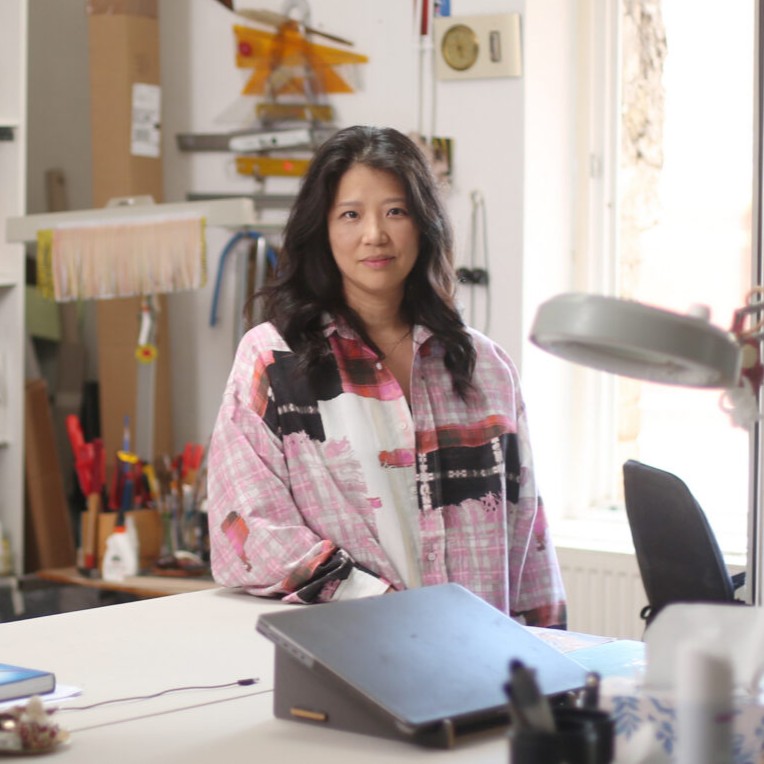
Chan Sook Choi, a visual artist,
has long deliberated over the numerous indivisible relationships pertaining to
the land and the body, such as those pushed aside, intentionally or
unintentionally, within the epistemological topography of mankind, the
cognitive ways we distinguish migrants from immigrants, and the processes
behind changes in our concept of land ownership. Drawing from her personal
experiences as a migrant to and longtime outsider in Berlin, Choi unravels the
various meanings behind spatiality and memory in the exhibition 《The Promised Land》 (2015)
that are attached to the terms “inner emigration” and “physical emigration”
through unfamiliar concepts of “Autostadt”3 that evoke
scenography,
and “opto-rhodopsin”4—a
form of future technology known for optogenetics.5
These
subjects, themes, and works are more evident in her exhibition, 《Re-move》 (2017),
which depicts the victims of sexual slavery drafted by Japan’s Imperial Army,
the Yangji-ri women of Minbuk Village at the Demilitarized Zone, Japanese women
who were encouraged to marry Koreans (as represented by the artist’s own
grandmother), the trajectory of scars in diaspora women, their loose-knit
subaltern solidarity narrative and the politics of identity, the instabilities
and hesitations derived from involuntary and arbitrary migration, and the
archive of memories that spring from waves of anxiety and unrest unfolding like
a prism.
From 《The Promised Land》 (2015) to 《Re-move》 (2017), Choi rests upon the constellation of performativity
woven by the imageries in the fragmented life of “the Other” and the affect of
life. She further tunes the frequencies—their subtle vibrations and cracks in
daily lives—of perpetual “Others” who can never settle as they signal through
roots that trail long and far before them. The organic narratives of her work
continue to expand and contract, revealing contemplative views that, at times,
evoke the following: memories of the individual and their ontological validity,
various discords created by personal narratives of individuation clashing with
collective memories, individual context that has been forgotten amidst
historiographic facts and events, and the potentialities in the memories of
traces and places of those who have been whitewashed and voided, rendered into
empty space.
An Organic Spatiality and the
Territorialized Sensitivity: 60 Ho
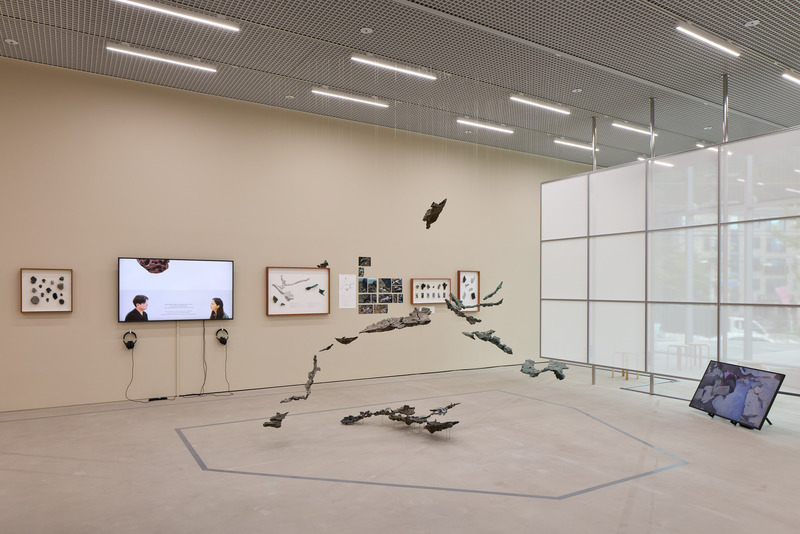
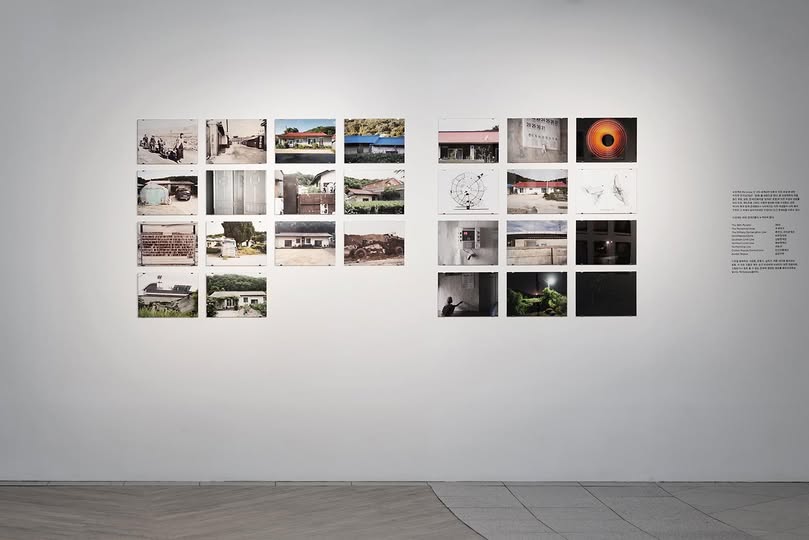
Her new work 60 Ho (2020)
details the personal narratives of women who settled in one of the 112
propaganda villages located up North at the Civilian Control Zone of the
Demilitarized Zone. After the outbreak of the Korean War in 1950, these
villages were established for purposes of land-clearing and propaganda against
North Korea. The village of Yangji-ri in Cheorwon, Gangwon-do, spreads widely
below the small peak of Sapseulbong. A large immigrant colony formed in
response to political promises of cheap land and housing made by the Park
Chung-hee administration.
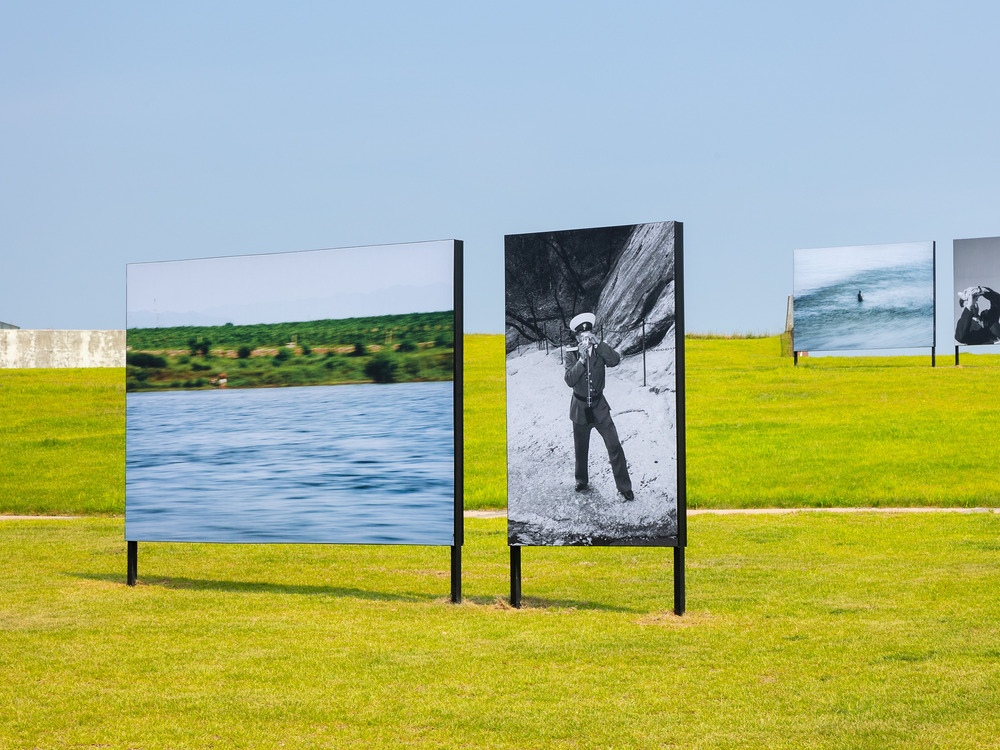
In the Google Earth panorama of Yangji-ri, filmed in
a bird’s-eye view, the colorfully roofed houses all sport windows
facing north—supposedly to facilitate observation of the enemy—but the
insides are makeshift, each with its own complex structure. The camera angle
passing through the grotesque interiors acts like an endoscope, projecting onto
a screen the intimate origin of personal psychogeography regarding ownership of
land. This view captures how an individual’s emotions and actions, like a
living creature, affects the spatiality—the architectural environment and its
intentions—in discernible or indiscernible ways.
Following Korea’s liberation,
countless migrants flocked to Minbuk village and its context of war,
usurpation, reclamation, and speculation. What lay behind the fervid craving to
settle in that village? Can we say that the land we stand on is truly ours?
Land owned initially by North Korean defectors or by Japanese became land without
ownership after the liberation and the Korean War.
Then the National Land Use and
Management Law was issued in 1972, and the government recognized land-ownership
rights in the Civilian Control Line area in the early 1980s. After that,
the “landowners” claiming registration documents appeared one after another,
causing friction with the current residents of Yangji-ri.6 Numerous
migrants, especially women who had long been indigenous to the land, were
denied ownership and eventually reduced to tenant farming.
Chan Sook Choi contemplates this
strange series of events and sharply captures the points evoked and expressed
by the network of land/body/ownership, territorial and political events, and
“organic spatiality,” where mankind and land twist and turn as if they are
homologous structures. Furthermore, she navigates a close microhistorical
viewpoint of future socio-legal directions and potentialities for change
inherent in land ownership. Under the patriarchal family-register system,
female migrants who lost their husbands to war, or to the mines scattered about
their everyday living space, cannot claim ownership of their territory.
Like ferns clandestinely sporing in a perilous ecosystem, they settle
temporarily in the “kitchen corner or tiny room,” the twisted interstices of
the village. In this state of temporal tranquility, these people, silently
enduring with a desperation to become true settlers—clearing land that bears
the names of men whose soft hands know neither labor nor dirt—become numbers.
Village soldiers begin to address them as such. 60 Ho refers
to a human reduced to a mere number in the place where she resides. In this
village, it is humid and cool even in the summer. In Artificial
Sun (2017), heat fans are placed in various corners of a house,
lending the lives of these numbered female migrants a warmth that burns
brighter than the sun.
We are faced with the artist’s disenchanted perspective
that seems almost apathetic, simultaneously delivering the video’s rush and
shock. The handheld camera glides across the maze of a Yangji-ri house, as if
in an RPG, and summarizes via Google Earth the ruins of the Demilitarized
Zone—a symbol of historical catastrophe. Ironically, the artist’s indifferent
gaze makes us more acutely aware of the relationships of coercive coexistence,
of the secularized memories of places/territories of inhumanity, and of the
“otherization” people have had to face, in all its absurdity, within a
macro-historical landscape.
There are qualities of the
unheimlich, pathological traits, and waves of emotions or ambience triggered by
the symbolic meanings behind oblique territory/land/place. Further, there are
subtle, invisible frequencies that go unreachable and undetectable by the
macro-worldview and collective memories much like the imperceptible
face/faciality7 of the abject, of those caught in involuntary
decline, referred to as 60 Ho.
All of these pierce
through the deepest trench of imagined geographies in those who have lost their
names, revealing in detail the dynamics of attraction and repulsion brought
about by the resonance between mankind and space. The screening zooms in on and
fades out from people self-mockingly singing trot songs (“I am I am drama, who
will know of my story”), while Donald John Trump creates a sense of crisis
between the two Koreas with a political speech asserting that the North will
face “fire and fury.” Just as the two scenes are mutually juxtaposed, land and
settlement, migrant and memory, sedentary and non-sedentary, and the succession
of images and connections woven by rhythm all become allegories that accumulate
and scatter.
The work gradually breaks down the narrative and symbolic
skeletons embodied by the memory of the body and the materiality of land,
altering and superseding them with fragments of minerals and drifting inorganic
substances. In compliance with the artist’s contemplative intentions, the
viewer’s gaze follows the image of inorganic substances that operate as signifiers
of visual narratives, advancing the narrative under the guidance of the mouse
cursor.
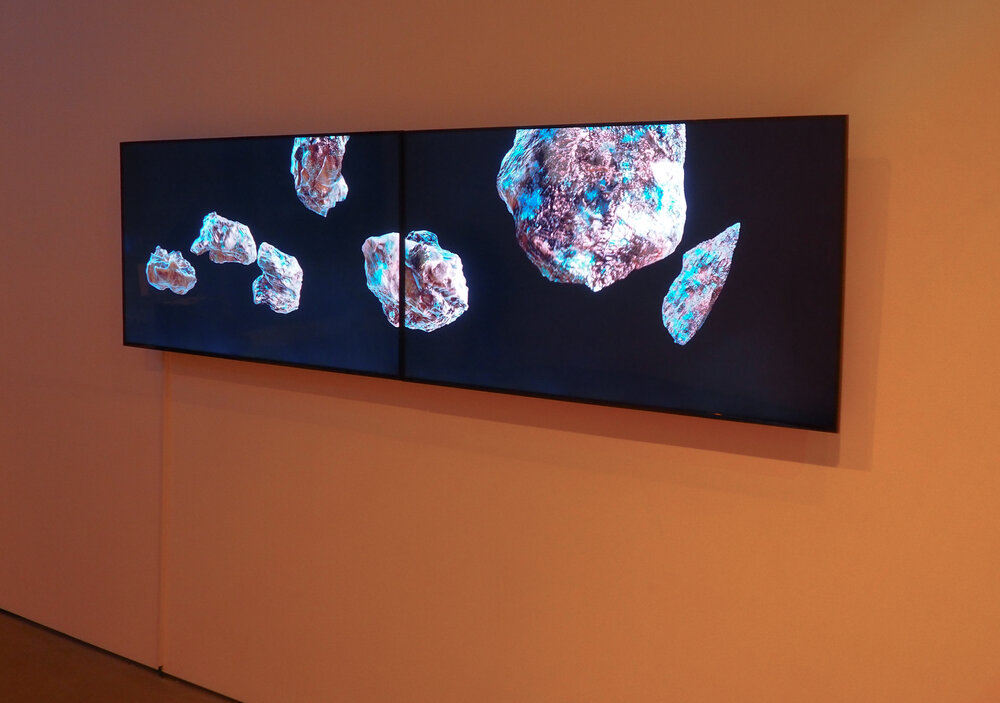
The images of minerals in 60 Ho, represented as
rocks or copper, substitute for the physicality/materiality of subjects that
have been genderized and Otherized, while embodying the memories of the land
without ever having owned it in Choi’s previous works. Eventually, these images
begin to correspond with the non-human subjects of the abject (such as
minerals) that run on empty in the pitch-black darkness, denied inclusion
permanently in the frameworks of territorialized sensitivity and geographical
conceptualizations of the norm. Just like parallelism, these images continue
and lead into qbit to adam (2021).
The Non-Sedentary and
Spatio-temporal Translocality: qbit to adam Belonging
to No One, and None to All
Physical environments and places
aren’t meaningful from the beginning; they gradually form meaning by forging
relationships with the humans they surround in due time. In other words, the
accumulation of such relationships and memories—created and altered in relation
to environment and place—can be seen as proof and a vital part of
settlement/the sedentary, and as presenting a more comprehensive sense of
place. In her new work qbit to adam, created during the
pandemic, Choi expands, both conceptually and spatiotemporally, her focus on
“individuation” and the “non-sedentary.” That has been visualized by land and
territory—an interest formerly scrutinized via themes of the Demilitarized
Zone, border areas, migration, and the women’s narrative.
The narrative of
locality is a narrative of the central/centrifugal, static/dynamic, and
opening/closing. In it, we see fragmented memories like stamped seals of those
who were pushed aside in the village of Yangji-ri; we feel a sense of loss amid
the breakdown of a rejected community that has undergone migration, settlement,
and the extinction of self. From the mines of the ancient Atacama Desert in
northern Chile to a virtual world in digital space, qbit to adam expands
the artist’s worldview of locality and bares the ontological flesh of questions
connecting locality to translocal body/land/place by exploring the spatiality
within the numerous kinds of spatiotemporal nature. With qbit to
adam, Chan Sook Choi critically reappropriates the knotted arguments
of the body/land/historicized texts and “pours out” a number of questions
pertaining to the following: ontological and metaphysical semantic
networks and their alternative directions, and human–nonhuman individuations of
land/place/space “that belongs to none and none to all.”
Just as Walter Benjamin was
transfixed by the immortality of the wax figure at Musée Gravin that resisted
organic decomposition,8 qbit to adam, which
begins with a metaphor of the Copper Man, is in itself a metaphor of
organic/inorganic, the boundary between life and death, and a dislocation of
future and past that poses numerous ontological questions about the following:
the acquisition of individuality in the extinction of land and the death of
non-humans as inorganic substances that the tomb of earth metonymizes as the
soil sprinkled atop the mineral waste of an abandoned mine; the relationality
revealed in dualities of the self and others, inclusion and exclusion, and body
and land that were incubated in the process of establishing a modern and
contemporary concept of territory in regards to ownership and crop yield; the
expansion of the virtual subject as an extended territory of new spatiality and
bodily sensation that are reappropriated by the digital environment and data;
and the spatiality as a “topos” in which objects may interact with each other
purely as objects, gaining a singular, immaculate, and complete individuality
within the relational time of the present. The recursive conclusion to the
questions derived from these themes is here on the very ground we step on, in
this mental and physical space that reflects us vaguely—like the surface of a
bronze mirror.
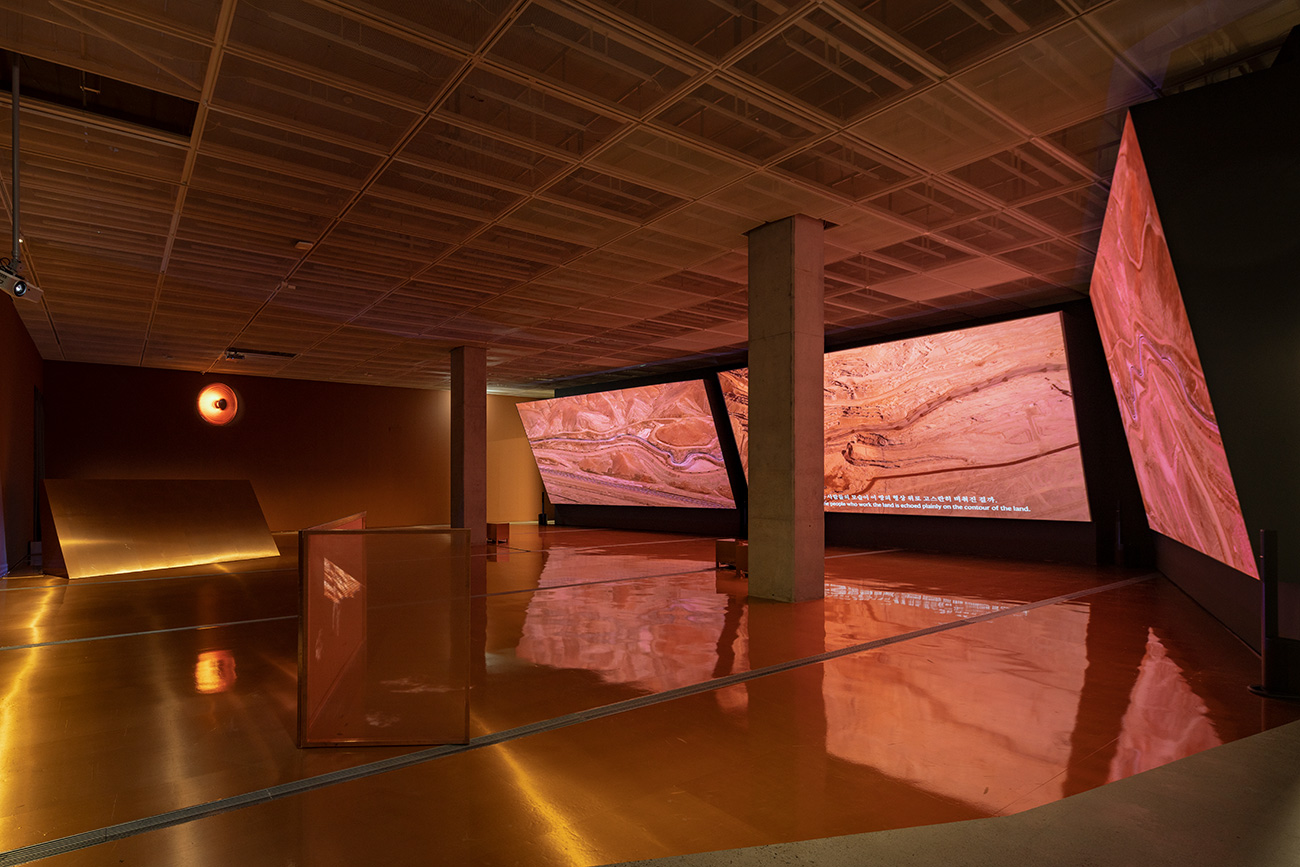
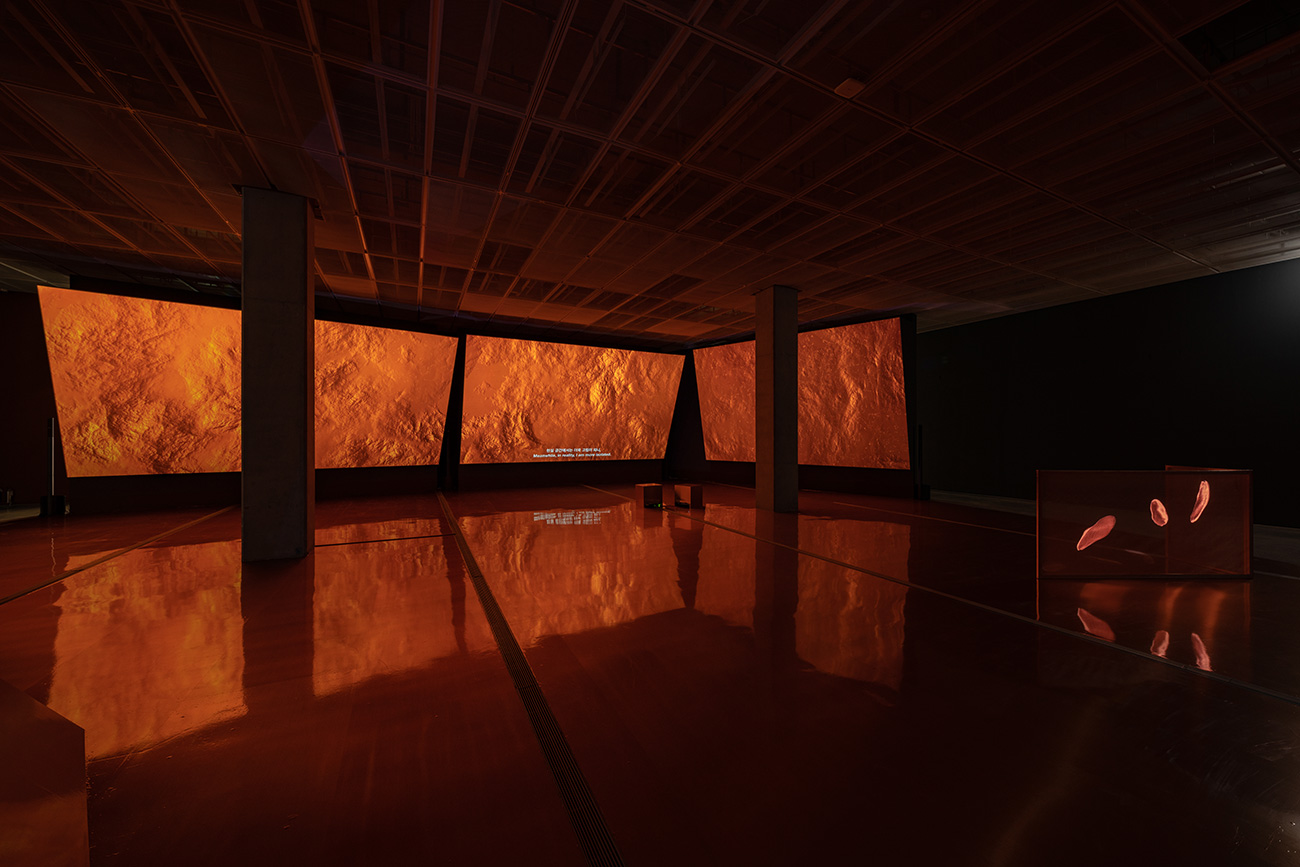
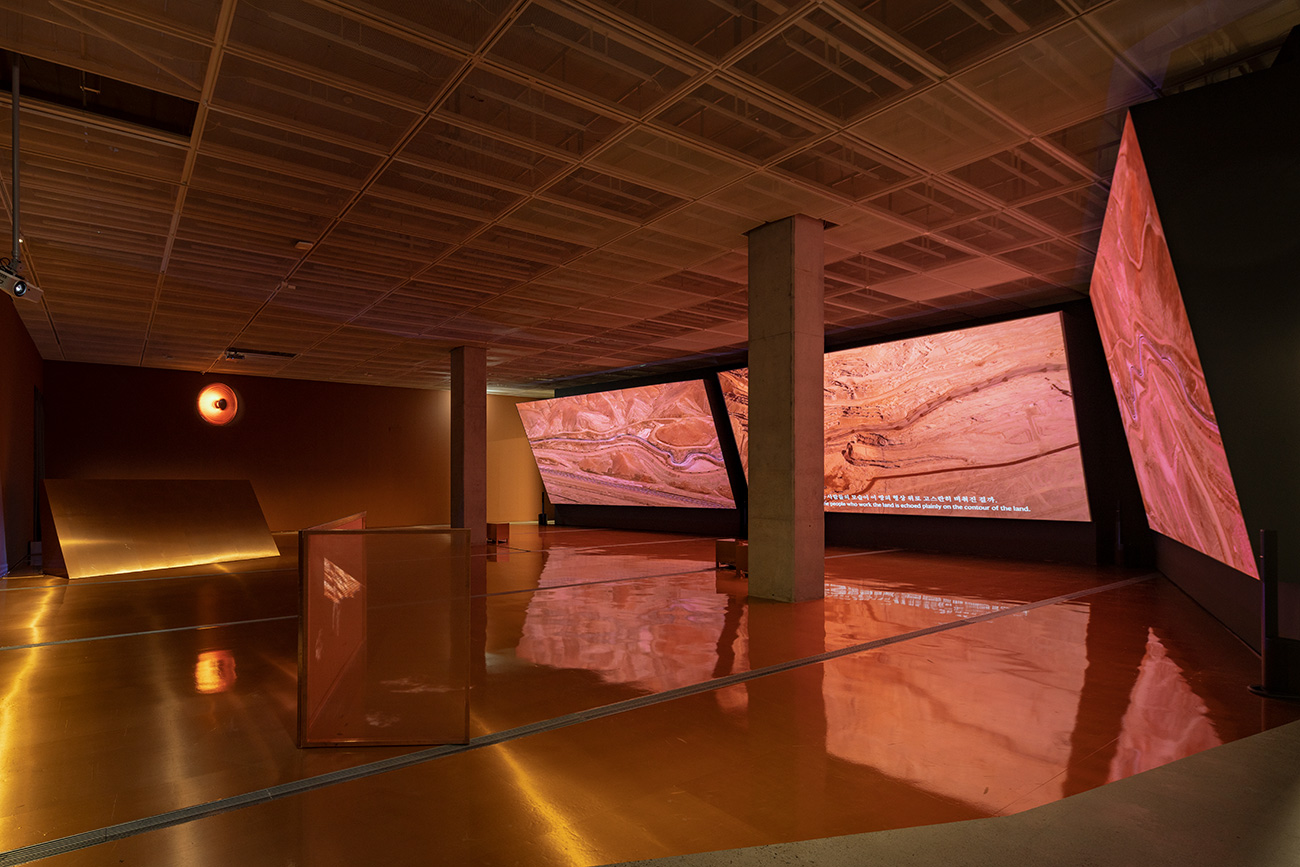
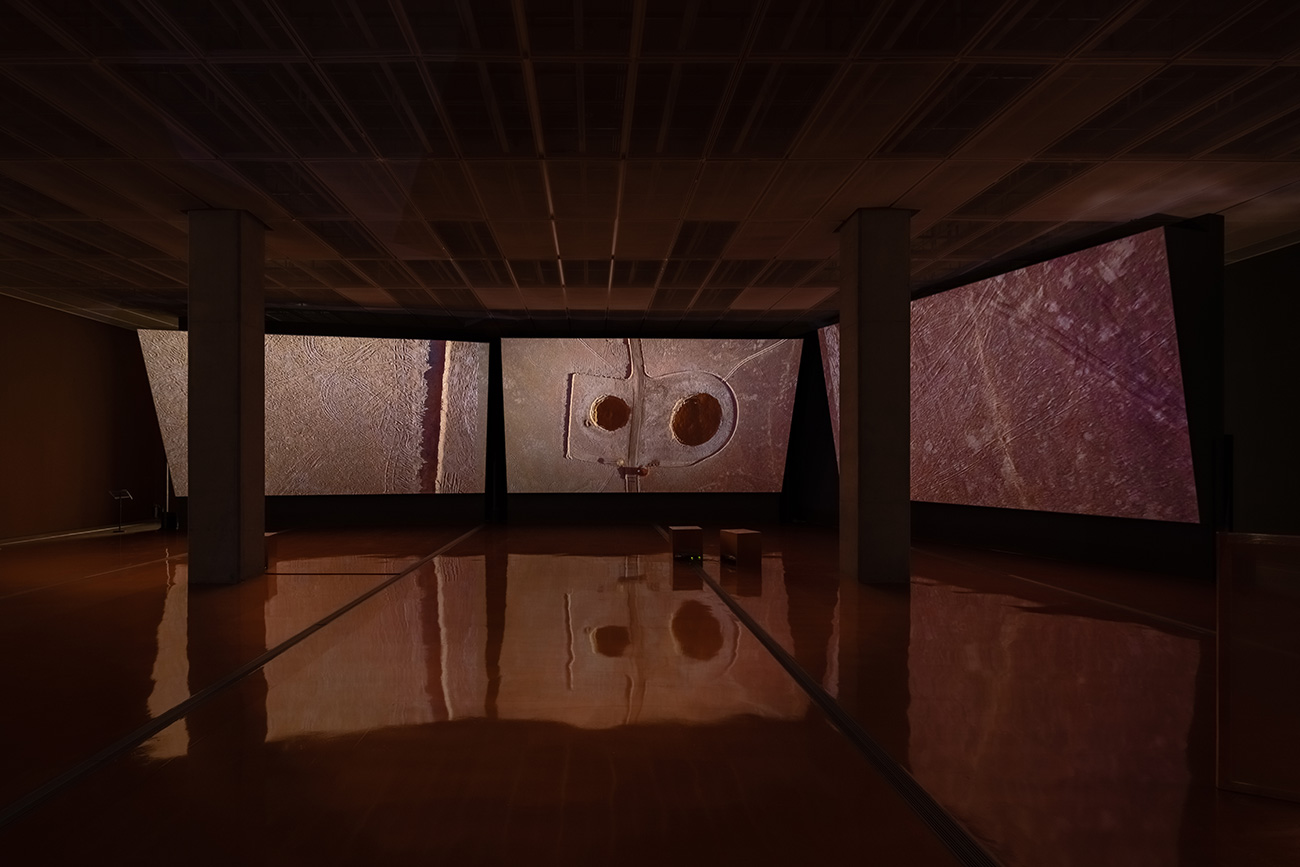
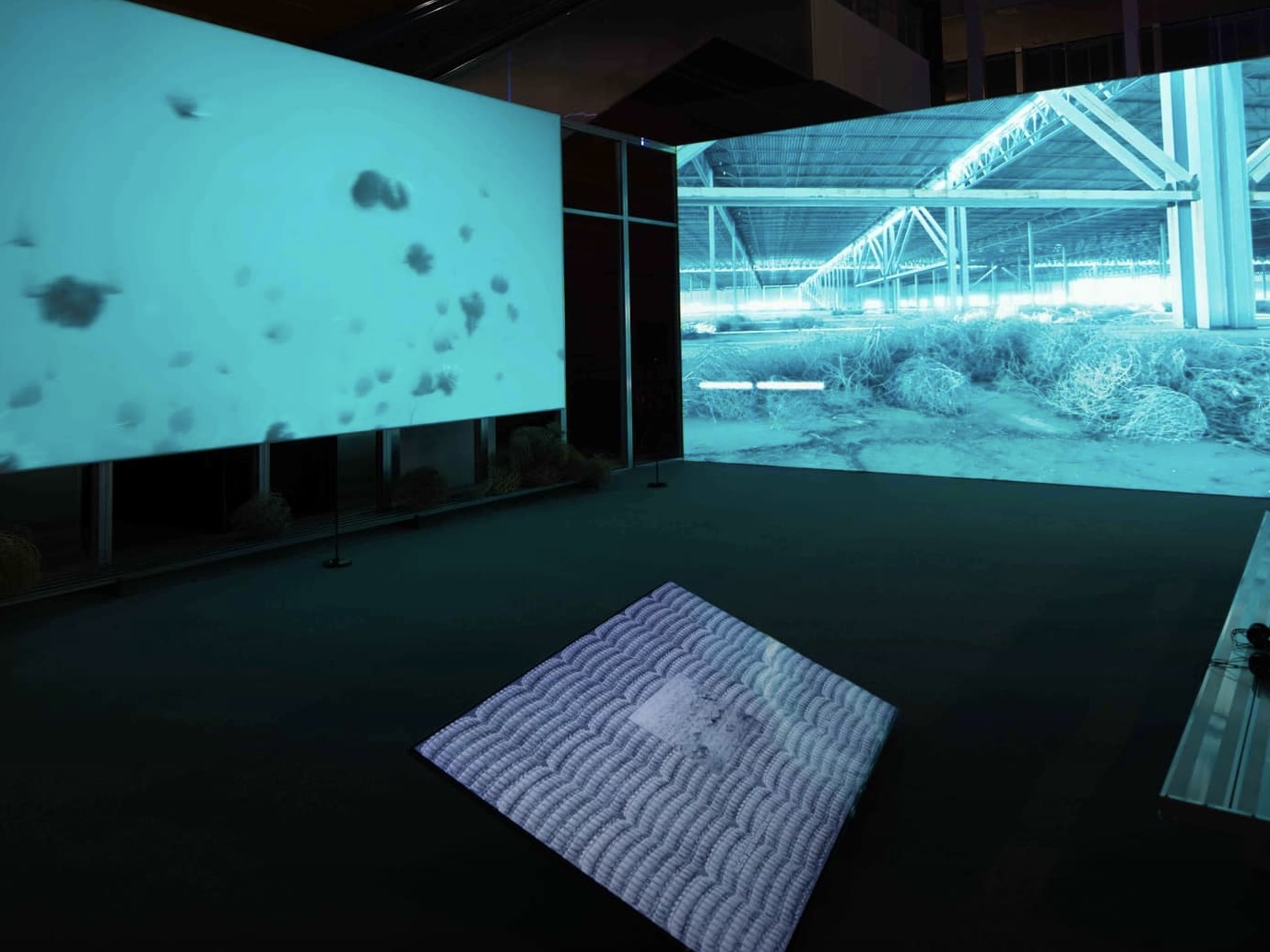
Fragments of stone, copper,
flesh, and metal circulate. These weightlessly drifting fragments of land are
then visualized into images of memories/data. (This repetitive structure of
circulation is also replicated on the video playing on the semitransparent
copper mesh screen facing the three-channel screen.) Meanwhile, the narration
holds together these intersecting videos for 33 minutes in three different
voices/transcendental subjects. This serves as the center point, conveying the
artist’s desire to hold the audience completely in her narrative within this
“space” of the exhibition.
The individual narrative of land/body/ownership,
spread across an overwhelmingly large screen, is not presented as any of the
following: an operational system, its reason of existence, or a measure of
individuality that explains the possibilities of said existence. In fact, it
operates as an “intermezzo” that permeates the space and screen like liquid,
forging a smooth connection between the different topographies of land/body/exhibition-space.
It also conveys the “undecided nature of the open space” inherent in such
topographies, and a non-hierarchical “analogy” that defies all parallels,
references, and coordinates. The amalgamation of these narratives can be seen
as a journey towards joining, separating, and reestablishing relationships
within the singular space of the exhibition.
The exhibition floor is set up
dark and blurry, much like the bronze mirror of a Mongolian shaman. The
self-reflective image bounced back by this surface is an appropriation, hardly
a faithful representation of self and screen. (The installation boasts a finish
of the same copper sheets that were used on the floor, but not on the screen.)
Namely, it operates as an ontological mirror9 designed not to
self-reflect but to attempt to escape from present space and the self of
reality. Its subtle distortions and shaking images incessantly stimulate and
encourage contemplations on thoughts or reason by continually dislocating the
images, making them amorphous and variable.
The artist approaches the design of
this “space of thought that transcends time and space” like a meticulous
scenographer, subtly tilting the screen 10, 23, and 28 degrees from the right
side of the exhibition space. Much like ending rhymes that seem to parallel one
another before subtly diverging, the screens are placed at angles, similar to antennas
that detect the wavelengths of the universe. Snow formations called
“Penitentes” “grow” towards the rising sun in the spitting image of kneeling
human figures doing penance. The screen follows the trajectory of the
artificial sun and projects the image of the earth, acting as a stage device.
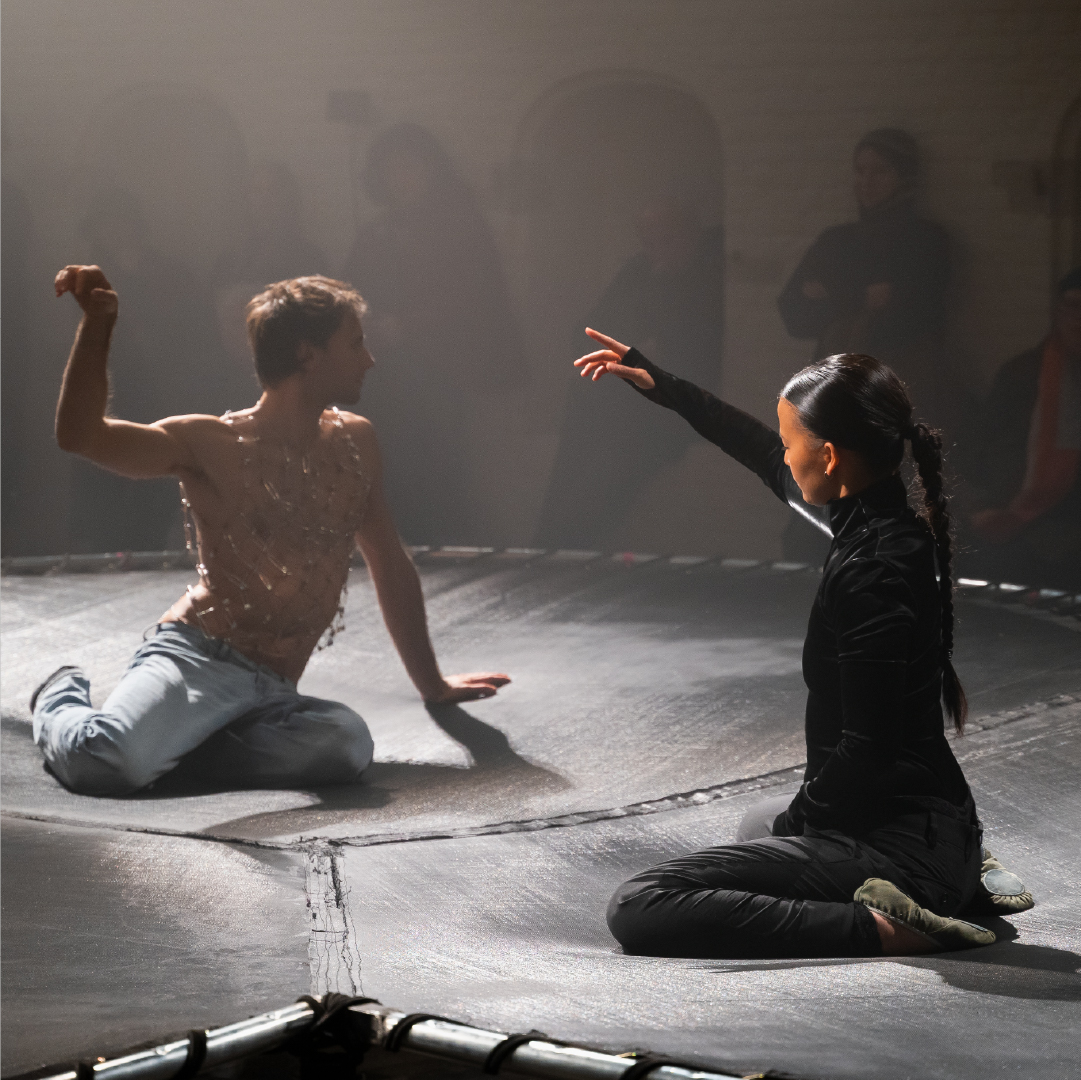
Images and the exhibition space reflect and overlap as three distinct voices
evoke a sense of presence in “synesthesia.” Through this synesthesia, which
pertains to the body and space of the audience, viewers themselves become
objects of the artwork, operating as a stage device filling out the empty
narrative space of the exhibition.
As demonstrated, qbit
to adam is an attempt by incomplete narratives to escape across
boundaries and meet a new “land.” On this journey, countless individual
narratives intersect and nomadize, untethered by any particular
nature/land/territory/spatiality—constantly on a path toward new meaning.
Concurrently, the exhibition also becomes an “exhibitionary dialectic
discursive sphere” that borrows and repeats former concepts and discourse,
creating differences by leading to a new flow of creation. And all this begins
from the fragmented visualization of the discourse on
nature/land/territory/spatiality that has been permanently otherized from the
frameworks of a narrative structure of modern history; from reflections on
nature/land/territory/spatiality that has been regarded as “irrational,
otherizing, unscientific, and of indeterminate form”; and from the artist’s
proposition of reinstating what lies behind the narrative of modernity best
represented by humanistic choices, along with the human affects triggered by
all of the above.
Through this ambitious project, Choi actively reinterprets
and re-summons intimate personal narratives of human–nonhuman subjects
occupying nature/land/territory/spatiality that previously had no choice but to
exist in a narrative vacuum of historical statements. Furthermore, she
transcribes these narratives onto a palimpsest of memories and interpretations
on which such spatiality is printed. Moreover, qbit to adam manages
to reproduce via “imaginative crossover storytelling” the artistic effects,
imaginary topographies, and mythological, literary, and scientific discourse
regarding the catastrophic contemporaneity of Planet Earth, where mankind
dominates nature, our footprints permanently marking the trajectories of geology
in the Anthropocene epoch. This is built on foundations of human–nature
hierarchy, COVID-19, the metaverse, and the advent of a post-apocalypse
triggered by the collapse of the ecosystem—all themes of interest to the art
discourse at this time. Now, the actuality of an exhibition space comes alive
in viewers’ minds with all the partiality that imagination entails. And,
without a doubt, this entices us.
Coda: On Spatiality as Pure
Memory
The resonances are dispersed on
the different planes of our life in the world,
while the reverberations invite us to give greater depth to our own existence.
In the resonance we hear the poem, in the reverberations we speak it, it is our
own.
The reverberations bring about a change of being.
It is as though the poet’s being were our being.
— Gaston Bachelard, excerpt from The Poetics of Space10
Gilles Deleuze explains how the
past is a transcendental condition that defines the present via the concept of
the paradox of “contemporaneity.” That is to say, present time may flow only
when the past and present exist within the same timeline.11 The
pure memory of Henri-Louis Bergson speaks to an epistemological state in
which a certain lesson has been learned in the past that cannot be repeated and
is not internal to the body. Pure memory is not simply limited to registering
the past through remembrance or the act of reminiscing.
It is a state in which
memory itself has the potential for ontological independence as it defies the
passage of time, contracting and relaxing for eternity in a mode of existence
that enables simultaneous coexistence.12 It is not unlike how
Anaximenes’s age-old question of memory dawns on us, evoking our own pure
memories as we observe the dislocated minerals from a mummy’s knee expand and
enlarge into fractals: “We are told God created man from soil and breathed life
into man so that he may become a living soul. Was his breath cold? Or hot?”
The artist’s interest in humans’
ambivalent ability to breathe cold and warm, the coexistence and order of those
two worlds, and the possibilities inherent in change are tied to her own life.
Choi’s interests inevitably mix with her experiences of vividly worrying about
the future of her unborn child—soon to awaken in a dystopian reality—and of
remembering the tactility of death she felt while watching her mother gradually
pass away. By juxtaposing her maternal self breathing cold air—while “imagining
the order in which one will die” in a “near-death experience”—with the vitality
of warm breathing like her future sleeping child’s, Choi questions the
spatiality of the body as a non-sedentary that empties and fills, withstanding
fluctuating temperatures.
Just as Bergson preached that pure memory precedes
images but may contain the possibility of existing in the form of an image, the
artist is attempting to visualize the “coexistability” of incommensurable
“substances” that encompass everything and behind which some kind of conception
may be/is lurking. This speaks of a representational system of memory that is
general, ambiguous, without tense, and unable to be regarded as the basis or
token of a certain phenomenon like a body or substance. These images are invisible
yet present, experienced as a perception or memory already inherent in our
minds.13
In this sense, the overlapping
metaphor of “knees” that makes repeated appearances in Choi’s works is full of
significance. Minerals derived from the knees of Copper Man connect with the
emersion of landforms in the shape of kneeling penitents called “Penitentes”
and, soon enough, join on the cross-screen of an emotional insert of a
mother kneeling before residents opposing the building of a special-needs
school in Gangseo district. The knee metaphor makes real a moment of
“surrender, penance, and awakening” (“slap one’s knees” is a Korean idiom akin
to “Eureka!”), referring to the creation of yet another object begotten from an
object. [seulha 膝下 in the
Korean phrase “the child of seulha 膝下”
literally means “under the knees.”]
To the artist, the personal reasons behind
what she considers the safest non-sedentary space for her unborn child to
occupy in the near future, are a desperate, important pure memory that brings
awareness of the land/place/spatiality. In due time, the child will learn to
meet the world by bringing to its mouth whatever is strewn about the room or
burning itself on something hot. This is why the parent keeps the child in the
safest land/place/territory: below her knees. As such, qbit to
adam is a “topos” of organic totality in which the heterogeneous
subjects of artist and audience—through their individual bodies observing the
exhibition—extract perception and memories and seek the possibility of
coexistence via contemplation and reflection.
The metonymization of spatiality
revealed in qbit to adam, along with the expansion of
the conceptual/sensory meanings behind nature/land/territory/spatiality brought
about by advancements in technology, emphasizes the indivisibility of the land
and body, or possibilities of coexistence in the land and body—not unlike the
Copper Man, in whom the two “states” of organic and inorganic coexist (the
Copper Man later appears in the face of an avatar in cyberspace). From ancient
mines to the mining of cryptocurrency, the artist overviews the “history” of
past labor and the concept of virtual ownership in the near future. In doing
so, she overturns the foundations of modern epistemology—namely, the narrative
systems and discourse frameworks based on rational thinking—and intentionally
bypasses, affects, revolves, and recreates the directions of meanings radiated
by these prisms.
As such, Choi creates a
nondiachronic narrative of pure memories pertaining to a primal
nature/land/territory/spatiality that knows not the concept of ownership and
promise—in other words, the “potential as a priori condition”—and dictates that
negotiations between human “intervention” and nature cannot by any means
dismantle the original meaning of land/space/territory. Furthermore, she asks
the audience the legitimate meanings behind “actuality”—the sense of the earth
we stand on.
Here, viewers may interrogate the intended reinstatement of the
memory of the other, the individuation of nonhuman spatiality, and the
dismantling of the meanings behind the other/land/space/territory that exists
in a narrative-imaginative vacuum built upon a foundation of communal silence.
What did Choi intend to say with these matters? As Bachelard articulates
in The Poetics of Space, in the “resonance”
we hear the poem, and in the “reverberations” we speak it. The “resonances” and
“reverberations,” created for the possibility of coexistence in “substances,”
draw out a “change in existence.”
The metanarrative and
post-genealogical symbolic representation exhibited in Choi’s qbit
to adam and 60 Ho visualize the
political/social/cultural hierarchical topography pertaining to the invisible
nature/land/territory/spatiality that has always existed yet had little choice
but to be hidden and oppressed. At the same time, the work reads as a resilient
pledge, or token, assuring us of the eventual recovery of the original textures
that were once warm and smooth.
It does this by dismantling and rupturing
potential realities that could never be clearly defined with the inherent pure
memory of individual senses. The artist’s intimate personal narrative ends with
an epilogue of stone, copper, flesh, and metal. “What land would I return to
upon death?” This question reverberates like a round song in the exhibition
hall, resonating with the audience. And there lies the “promised land” that
belongs to none and none to all.
1 Johann Gottfried
Herder, Ideen zur Philosophic der Geschichte der Menschheit (1784).
2 Henri Lefebvre, The
Production of Space, trans. Donald Nicholson-Smith (Oxford: Basil
Blackwell, 1991), 8: “spatial practice consists in a projection onto a
(spatial) field of all aspects, elements and moments of social practice.”
3 A compound word of
“automobile” and “city,” and the actual name of a Volkswagen factory-tour
program. By appropriating the curatorial presented by this gigantic theme park,
the artist shows the change in the possibility of bodily movement
through the development of mobile technology, such as the dissemination of
personal vehicles through energetic guides of cutting-edge technology and
contradictory texts and images. The artist also reveals an overlapping,
ambivalent interest in physical and mental migration by erasing moments of
everyday scenery and memories with a different light.
4 A compound word of “light”
(opto) and “light-sensing pigment proteins” (rhodopsins) in the retina of the
eye. An opto-rhodopsin is a virtual device that can implant memories by
electrically stimulating light particles received by the eye.
5 A compound word of “light”
(opto) and genetics. The term refers to a technology that controls brain
activity through light control and genetic-engineering technology.
6 From 1968 to 1973, the
Park Chung-hee administration began to build national villages, such as
Reconstruction Villages and Unification Villages, in the DMZ for the purposes
of civilian defense and anti–North Korea propaganda. Yangji-ri is one of the
Reconstruction Villages. Many people suspect that the quality of life there
deteriorated because the poor moved in; the village is officially a temporary
residence because the state did not recognize the private right to land or
housing. In 1972, the Yushin Constitution stipulated the necessity of national
land planning. In the same year, the National Land Use and Management Law
called for systematic management of urban and non-urban areas. Land-related
problems began to arise when the government recognized land-ownership rights in
the Civilian Control Zone in the early 1980s to revitalize the economy after
the second oil crisis in 1970. The government also promoted the policy of
allowing owners to register non-recovered land for the purposes of preservation
and restoration. As a result, people appeared with documents proving past
ownership to claim their private-property right. Soon, friction began with the
residents who had already risked their lives settling into the village, for
instance by removing landmines from the land. For more information, refer to
Hee-nam Jung (2010) and Sang-in Jun and Jong-kyum Lee (2017).
7 Félix Guattari coined the
term “faciality-landscapity” (visagéité-paysagéité) to describe the spatial
form of the redundancy of the unconscious. Guattari explained that a face is a
product of specific social formations. When certain facial expressions are
acquired by symbols and expressions that transpire through calculation, the
face finally achieves its independent “faciality-landscapity,” detached from
the body/head. In other words, a face embedded with facial expressions as
signifiers becomes a tool and sign to convey one’s intention. Félix
Guattari, The Machinic Unconscious: Essays in Schizoanalysis (Los
Angeles, CA: Semiotext(e)/Foreign Agents Series, 2011).
8 Benjamin describes the wax
figure in the Musée Gravin as a “Wish Image as Ruin: Eternal Fleetingness,”
stating, “No form of eternalizing is so startling as that of the ephemeral and
the fashionable forms which the wax figure cabinets preserve for us.” Quoted in
Susan Buck-Morss, The Dialectics of Seeing: Walter Benjamin and the
Arcades Project, trans. Kim Jeong-a (Seoul: Munhakdongne, 2004).
9 Caroline Humphrey argued
that the shaman’s bronze mirror was designed to stimulate human thought. The
principle of the diffuse-reflection effect distorts the mirror slightly,
keeping humans from seeing themselves as they are. Caroline Humphrey, “Inside
and Outside the Mirror: Mongolian Shamans’ Mirrors as Instruments of
Perspectivism,” Inner Asia, vol. 9, no. 2 (2007), 173–195.
10 Bachelard, 2014:7.
11 All the pasts and
presents are diachronic if the present and the past are diachronic at every
moment. Therefore the present and the past as a whole always coexist.
Deleuze says that “what we call the empirical character of the presents which
make us up is constituted by the relations of succession and simultaneity
between them, their relations of contiguity, causality, resemblance and even
opposition [...] what we live empirically as a succession of different presents
from the point of view of active synthesis is also the ever-increasing
coexistence of levels of the past within passive synthesis.” Gilles Deleuze and
Paul Patton, Difference and Repetition (2001), 83.
12 Joo Jae-hyung, “On the
mode of existence of Bergson’s pure memory,” Cheolhak, vol. 129 (2016),
153.
13 Herni
Bergson, Matter and Memory, trans. Park Jong-won (Seoul: Acanet, 2005),
151.
References
Bachelard, Gaston. The
Poetics of Space (Boston: Beacon, 1969). Print. Beacon Paperbacks.
Deleuze, Gilles and Paul
Patton. Difference and Repetition (2001).
Gaier, Ulrich. “Johann Gottfried
Herder (1744–1803), Auch Eine Philosophie der Geschichte zur Bildung der
Menschheit (1774).” KulturPoetik 4, no. 1 (Göttingen, 2004), 104–115.
Humphrey, Caroline. “Inside and
Outside the Mirror: Mongolian Shamans’ Mirrors as. Instruments of
Perspectivism.” Inner Asia 9, no. 2 (White Horse Press,
2007): 173–195.
Lefebvre, Henri. The
Production of Space. Oxford; Cambridge, Mass.: B. Blackwell, 1991. Print.
Noor Mohammadi, Susan. “The Role
of Poetic Image in Gaston Bachelard’s Contribution
to Architecture.” Environmental Philosophy 12, no .1 (2015):
67–86.
Simondon, Gilbert and Drew S.
Burk. Two Lessons on Animal and Man. 1st ed. Minneapolis, Minn.:
Univocal, 2011. Print.
Guattari, Félix. The
Machinic Unconscious: Essays in Schizoanalysis. Los Angeles,
CA: Semiotext(e), 2011. Print. Semiotext(e) Foreign Agents Ser.
Bachelard, Gaston. The
Poetics of Space. trans. Kwang-soo Kwak. Seoul: Minumsa, 1990.
Joo, Jae-hyung. “On the mode of
existence of Bergson’s pure memory.” Cheolhak
129 (2016): 151–176.
Bergson, Herni. Matter and
Memory. trans. Park Jong-won. Seoul: Acanet, 2005.
Jun, Sang-in and Lee Jong-kyum.
“State Village Campaign in DMZ: A Case Study of ‘Tongil-chon’,
Cheorwon.” Journal of Korea Planning Association 52, no. 4
(2017): 27–41.
Jung, Hee-nam. “The Evolution of
Korean Land Policies since Independence, 1948–2008.” Korea Real Estate
Review 20, no.1 (2010): 281–306.