Refugee Crisis1
In March of 2015, a three-year
old boy was found dead on a beach in Bodrum, Turkey. The small body of Aylan
Kurdi, a Syrian refugee, was washed ashore. The horrendous image of the
lifeless body lying on the beach sent angry shockwaves worldwide. The death of
the boy, who fell victim to his parents’ choice between life and death and
settlement and migration, prompted a frantic call to people around the world to
act with moral responsibility. This was followed by violent protests, with
voices exclaiming, “A boy died due to the wrongdoings of the world!” and “We
are all at fault!” Next came the urge to revise immigration laws in every
nation. Civil war in Syria had caused the mass migration of approximately two
million displaced people who then attempted to emigrate to Europe.
On a winter day in December 2017,
a black woman in France made an urgent call to an emergency response service,
requesting an ambulance. However, the operator, who noticed the African migrant
woman’s accent, did not send the one, and in the end, the woman died. When the
news went viral in France, authorities initiated an investigation. The
recording of the phone call, which was released to the public during the
investigation, clearly indicates that the migrant woman was in tremendous
distress when she pleaded, “I am going to die.” What’s more shocking is the
operator’s response, “So, call your doctor,” and “Yes, you are going to die.
Certainly. One day. Like everyone.”2 Human beings choose to
migrate in order to survive or to search for better living conditions. Yet,
they often face new threats in the region where they settle and, therefore, may
choose to move again.
For instance, according to Sonia
Shah, author of The Next Great Migration: The Beauty and Terror of
Life on the Move, “People had fled Haiti en masse after a devastating
earthquake hit the island in 2010. The U.S. government allowed about sixty
thousand Haitians to stay in the country under a program known as
‘temporary protective status’ (TPS), which granted eighteen months of legal
status to people from countries that suffered natural disasters or protracted
unrest. Haitian earthquake survivors arrived in the United States on airlifts
still covered in the dust from the rubble from which they’d been extracted. But
the welcome did not last. A few months after the quake, U.S. officials sent Air
Force cargo planes to Haiti to broadcast the message that anyone who dared try
to come to the United States would be arrested and turned back.”3
With the recent surge in
cross-border migration, politicians in favor of anti-migration policies are
gaining popularity amid growing concerns that crimes by migrants and hatred
toward migrants are escalating social crisis. As weakening racial boundaries appear
to pose a bigger threat to racial purity, negative attitudes toward migrants
have become more widespread. Recently, the philosophical views of Jacques
Derrida, Giorgio Agamben, and Jean-Luc Nancy, which assert that a community
needs to be built on a foundation of acceptance and hospitality toward the
“other,” have become a topic of public discourse. Nevertheless, migrants are
still living under unstable conditions. As they migrate — half-willingly,
half-unwillingly — due to war or natural disasters, the issue of migration is
no longer an issue pertaining to an individual’s life but, rather, it is a
social problem.
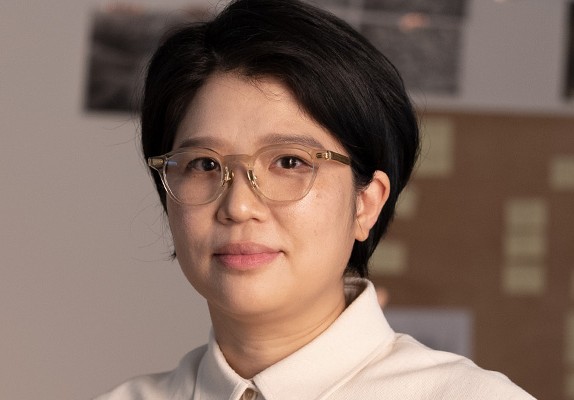
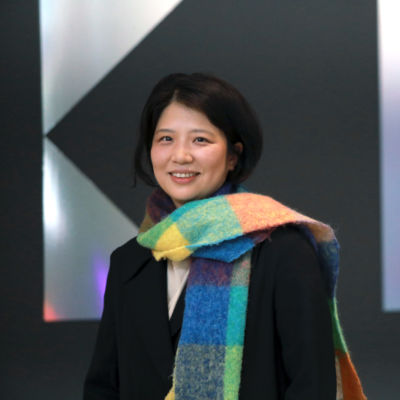
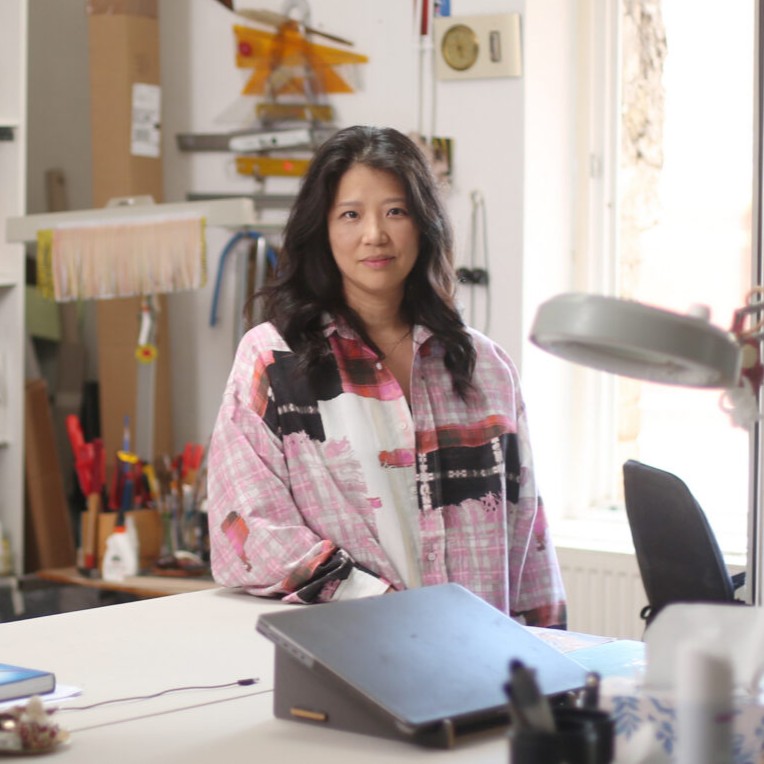
The overarching theme of Chan
Sook Choi’s artistic journey is migration. Choi’s work is presented in the form
of an autobiography featuring her family history and other people’s life
stories using video, performance, installation, and objects. Choi, a
Korean-Asian woman artist who moved to Germany in her early 20s, was unable to
assimilate completely into European society. Coincidentally, she found her
existence being gradually forgotten in Korea, which prompted her to confront
her status as an “existential” outsider. Human beings elect to move in search
of a more stable life but, because of that choice, find themselves in a
situation where they become isolated. The artist, who is not a stranger to this
experience, began asking many questions of herself and others such as, “Why and
how do human beings migrate?” and “Is physical migration the only possible form
of migration?”
The types of migrating plant
species, which move from one habitat to another due to climate change, are on
the rise. This is common now both on land and sea: all living species,
including animals and plants, move. Mankind is no exception, and people cross
borders, often risking their lives, even as we speak. These days,
satellites are used to track and take photos of migratory birds. The data
collected in this way are used to identify migratory birds’ flyways. Global
human migration data are also available, although the actual figure is arguably
much higher than the statistics suggest. Migrants are often forced to repeat
the cycle of migration, settling in yet another new place and feeling like
strangers due to otherization. Stuck in the blurred boundary between
theorization and dataization, Choi began to explore the concept of migration.
At the center of migration were the lives of otherized women who lead
independent lives despite their otherization.
One day, carrying a few photos
with her, the artist embarked on a journey to Japan to trace her Japanese
grandmother’s footsteps. By crossing the lives of her grandmother, who had
moved to Korea during Japanese colonial period, and the artist, who is enjoying
a plentiful life, wove stitch by stitch the temporality of the fragmented past
onto a square fabric of the present. While tracing her beloved grandmother’s
life in a distant, foreign country, Choi observed the firm fortress that was
the nation’s borders and the people isolated within the fortress. Even though
they had otherized and isolated themselves by choosing to migrate, they would
be freed from the chains of racial discrimination, anti-miscegenation,
classism, and neocolonialism had it not been for the nation’s borders.
While negative perceptions toward
migrants are gaining stronger ground due to mass migration taking place of
late, many theorists agree with Sonia Shah’s assertion, which strongly counters
this perception. Shah opposes policies adopted by a number of governments that
label refugees and migrants as intruders instead of accepting them as new
neighbors. She asserts that mankind has the genetic urge to move — more so than
to settle in one place — and acknowledges that Africa is where all of mankind
originated4 and that human culture was originally a hybrid
culture. Choi’s work embraces Shah’s view on tolerance and love for humankind
in the context of migration.
Allegory of Settlement and
Migration
Once she has selected a specific
theme for her work, Choi embarks on a long journey of thorough research. Her
new work always recalls parts of her previous works which had remained
unresolved. In this way, her projects with different themes are interconnected
with one another like a Moebius strip. To be more precise, personal and
historical issues, memory and oblivion, and mental and physical issues are
framed in a powerful, continuous allegory. When tracing the allegory of the
world reconstructed by the artist, the interpretation of each work points to a
consistent direction. In the process of identifying and interpreting each
theme, seemingly disparate elements converge in one story.
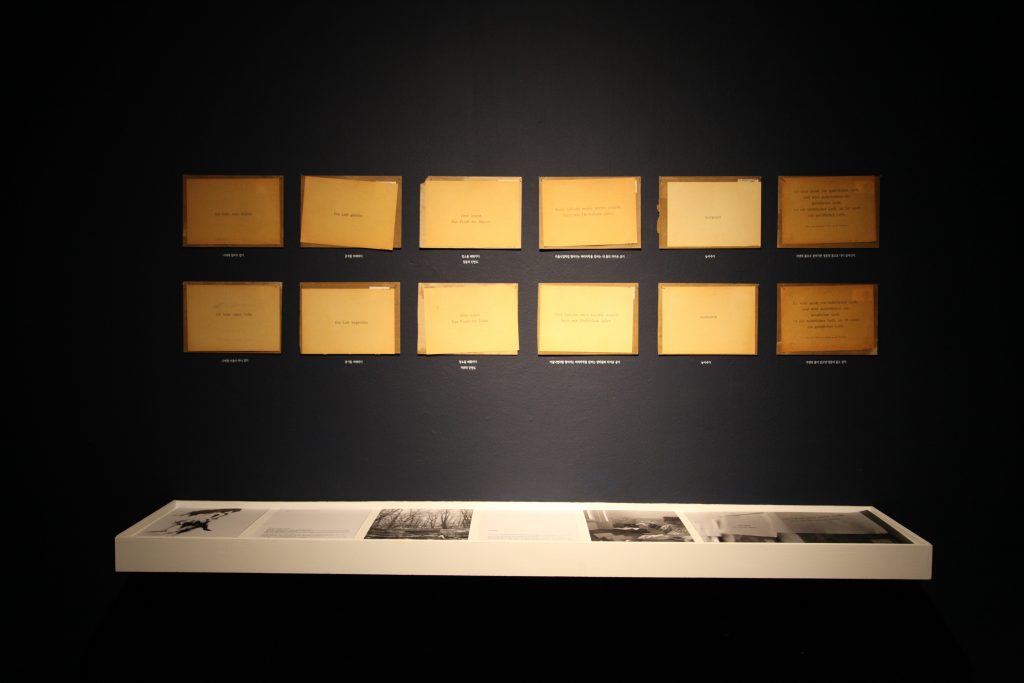
For instance, the
central theme of FOR GOTT EN (2012) deals with
religion-based, inner emigration but it also features — with no less
significance — themes such as the lives of migrant women, forgotten memories,
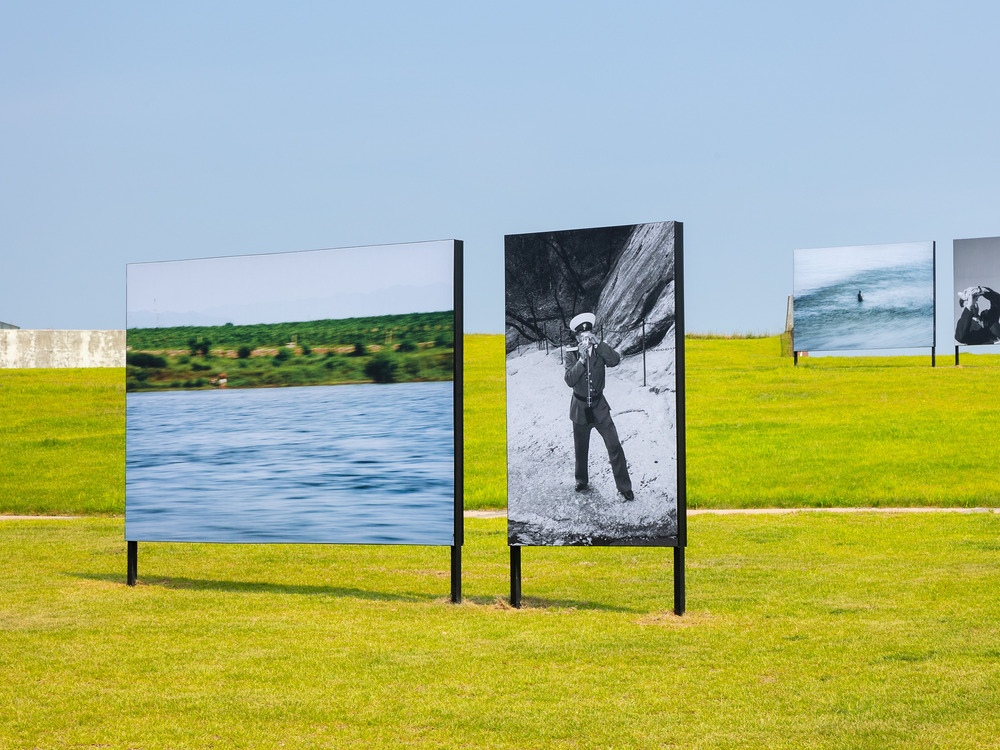
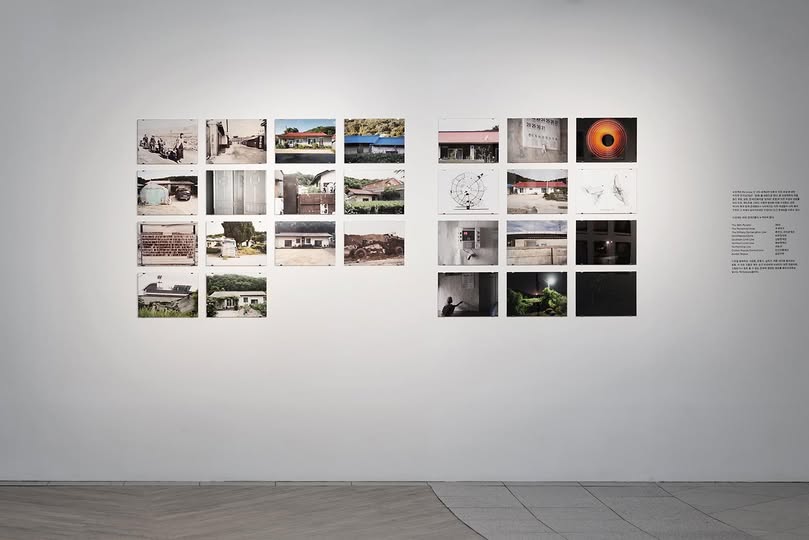
and the history of the human face. Another work, Yangji-ri (2018),
highlights the placeness of the Civilian Control Zone and sheds light on the
lives of resident elderly women in the form of an autobiographical fiction.
Rather than being an observer on the periphery, the artist gets involved in the
tiresome lives of her subjects living in Yangji-ri and becomes one with them.
She also views the issues of the elderly women who have been living in the
village through its inception from the perspective of land ownership regulated
by the law and the system.
In this sense, she tells the story of the body of the
people who have built houses on land, which could be subject to legal dispute,
and she amplifies the voices of the people who were stripped of basic rights,
living outside of the boundaries of the system regulated by the nation. Elderly
women of the Yangji-ri, who believe that the ownership issue will be resolved
someday, live in an uncertain situation, in between settlement and migration.
Perhaps Choi connected her own life, which has repeated the cycle of settlement
and migration, with their seemingly peaceful lives with nevertheless unstable
roots.
In all probability, this is why
Choi replaces the women’s lives with her own to tell the history of migration
and settlement from a broader perspective. As her work on the series
progressed, it appears to have rekindled her desire to restore her past identity,
which has been otherized in foreign countries. Whereas in the past she had felt
as if she was standing in the middle of a vast sea all alone, as a stranger,
isolated by an unfamiliar barrier of temporality, she is now standing side by
side with many migrant women. Within the theme of migration, women, and land,
the artist has produced The Promised Land (2010),5 FOR
GOTT EN, Yangji-ri, and Myitkyina (2019),
all of which have preceded her completion of the newly-released work, qbit
to adam (2021). Indeed, in the end, all fragments of the
finished works reconnect with the very first work.
As someone who has lived in
Germany as a foreigner (‘intruder’)6 for a long while, Choi has
understandably been drawn to the issue of migration and the lives of women and
has continued to expand her research. Apart from the issue of who the subject
or the other is, foreigners can be referred to as “people not from here.” As
this statement connotes, the other can be shunned from the society and be
locked up under the mandate that safe distance must be maintained between them
and the rest of the society. The statement refuses to acknowledge the very
existence of the other.7 Migrants are people who settle in a
specific place with the hope of settling there permanently.
Virtually every
migrant hopes to avoid being labeled as a foreigner and dreams of stable
settlement. However, for the humankind born with the strong innate desire to
migrate, stable settlement is not always in the picture. This is true for many
migrants: those displaced by war, those forced to live under colonial rule, or
those who exist on the brink of life and death and thus are forever strangers,
forever others. In consideration of such circumstances, Choi focuses on the
hardships and the loneliness experienced by those who live with psychological
deprivation as foreigners and forever strangers despite the ownership of
physical space and stable settlement.
For Choi, the concept of
migration is not merely about movement between physical spaces — that is to
say, cross-border migration. Michael Arzt and Frank Motz analyzed Choi’s work
saying, “Chan Sook Choi, 2012 Kunstraum HALLE 14 grant recipient, undertook
fieldwork to investigate and research the contemporary status of God, belief,
religion and spirituality by meeting with six women from a Leipzig parish. All
were aged between 60 and 90, all were from Leipzig, and all held unwaveringly
onto their faith during the GDR regime (1949 – 1989) which oppressed religious
freedom.
This was the beginning of Chan Sook Choi’s artistic as well as
personally intensive long term research and meeting project FOR
GOTT EN.”8 In this exhibition, a video
installation presents the interviews with the six women, who reflect on their
lives as they discuss faith and God, and memory and oblivion. The prevailing
theme of this work is the interaction between personal history and religious
perception. As she did for The Promised Land, Choi once
again installed an apparatus for moving from one location to another: the
palanquin is the means of transportation made specifically for the women in the
interview.
It functions as a reminder of the lives of the women and restores
past memories that have been forgotten. The sentence, “Your eye is a window to
your body/soul,” is written on the palanquin. According to Arzt and Motz, this
is “an invitation to a journey through time and back, a trip that takes place
in the personal memories of their lives as they are carried from the past into
the present. Choi’s camera documented the process of memory; the women’s faces
and their reactions to the film they were shown.”9 In this way,
Choi provided these women with an opportunity to communicate with their own
pasts, which, in turn, has expanded their present lives. Arzt and Motz
continued their analysis:
“Chan Sook Choi created a mobile
system, a small world allowing the old to unfold inside its frame, where they
could look inward without the artist’s assistance. The artist’s personal
address and her repeated visits to the women, her assistance and pastoral care,
her dedication and appreciation allowed distance and inhibitions to melt, and
all this radiating from an initially foreign and foreign seeming Korean, whose
appearance is from another land, who speaks German with an accent and whose
background is far removed from the East German region of Saxony.”10
Motz, who was the director of the
project, provides a very detailed account of the process and of Choi’s
perspective on making FOR GOTT EN while residing in
Leipzig for months. As a foreigner in an unfamiliar land, Choi collaborated
closely with her subjects for this project. In this process, the barrier
between the objectified other — the six women — and the artist herself was torn
down. The artist used this approach again when she created Yangji-ri.
She lived in Yangji-ri for five months in order to grow closer to the elderly
women — like a family member — and subsequently created this work. The
endearing interest she paid to the women who had been otherized very likely
provided solace to the women, who had experienced much struggle in their lives.
“While living in Yangji-ri, I was
able to walk on land for the first time as part of my everyday life. Stepping
out from home meant standing on earth, the land. There was this old lady, the
eldest in the village, who was over 90 years old. She just casually mentioned
while passing through, ‘I noticed you up late last night… I just came by and
sat down here briefly because I missed my friend who used to live here.’ That
was all she said… Since land is ultimately the basis for human life, it must be
vital to those who want to settle down. The experience I had in Yangji-ri and
the older women who lived there allowed me to contemplate land, body, and other
forms of ownership.”11
The artist lived in the Minbuk
Village, a propaganda village, in Cheorwon, Gangwon-do for five months and
spent a lot of time with elderly women who have lived there for a long while.
Since 1968, people began living in Yangji-ri, located in the Civilian Control
Zone between North and South Koreas. The government had offered land for them
to settle there; however, they could not have full ownership of the land. Choi
heard various stories about the land comprising this village when she
interviewed the women. For instance, “I came to live on bare land filled with
mines. I later found out that, as the land was not in our name, should the
owner happen to return, we would have been chased out and would not have been
able to do anything about it.”
Choi elaborated, these were “stories of hardship
these women shared repetitively as they crouched to brush dust from crops they
plucked from the land, stories filled with regret and frustration about the
land not being theirs, told repetitively like the dust that blew around when
they tried to brush it from crops.” While experiencing the history and lives of
the people of Yangji-ri, she became interested in the way people owned land and
about the fundamental human desire to settle on land. As a result, she posed
the following question:
“Why is the land yours?”
Land, the border between settling
and migration, and the significance of land ownership
“Blessed are the gentle, for they
shall inherit the earth.” (Matthew 5:5)
“But the Lord God called to the man, ‘Where are you?’” (Genesis 3:9)
Choi’s artwork can be further
analyzed with the words of Alain Marchadour and David Neuhaus, “The second
account of creation uses the word ‘earth’ (adamah) instead
of Land (aretz). Adamah designates the very
substance from which Adam is formed and from which apparently he derives his
name. Adamah has the vocation to become a garden, a
cultivated place, through the nurturing care of Adam. He is placed in the
garden ‘to till it and keep it’ (Genesis 2:15).”12 Man was made
from the earth of the Holy Land.
In the land blessed in the name of the Lord
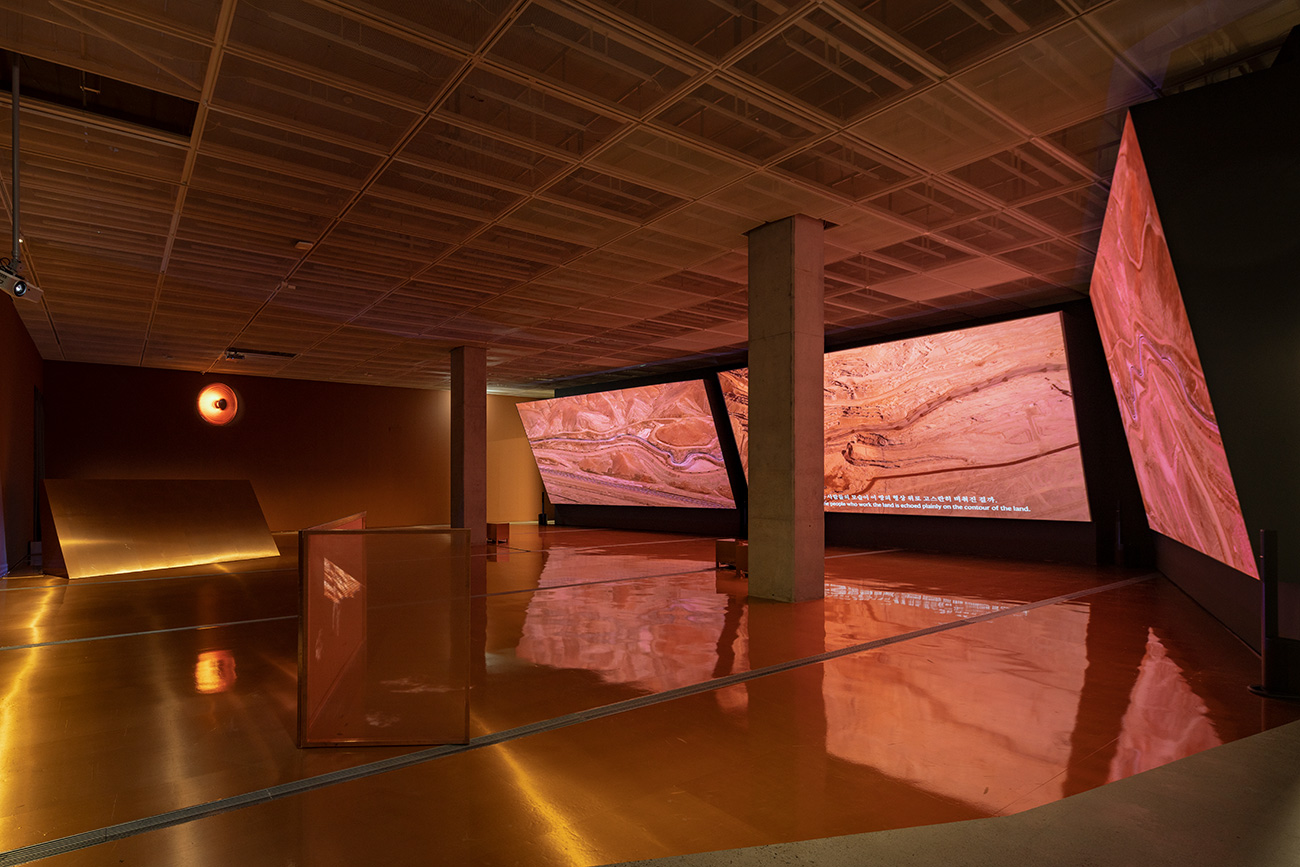
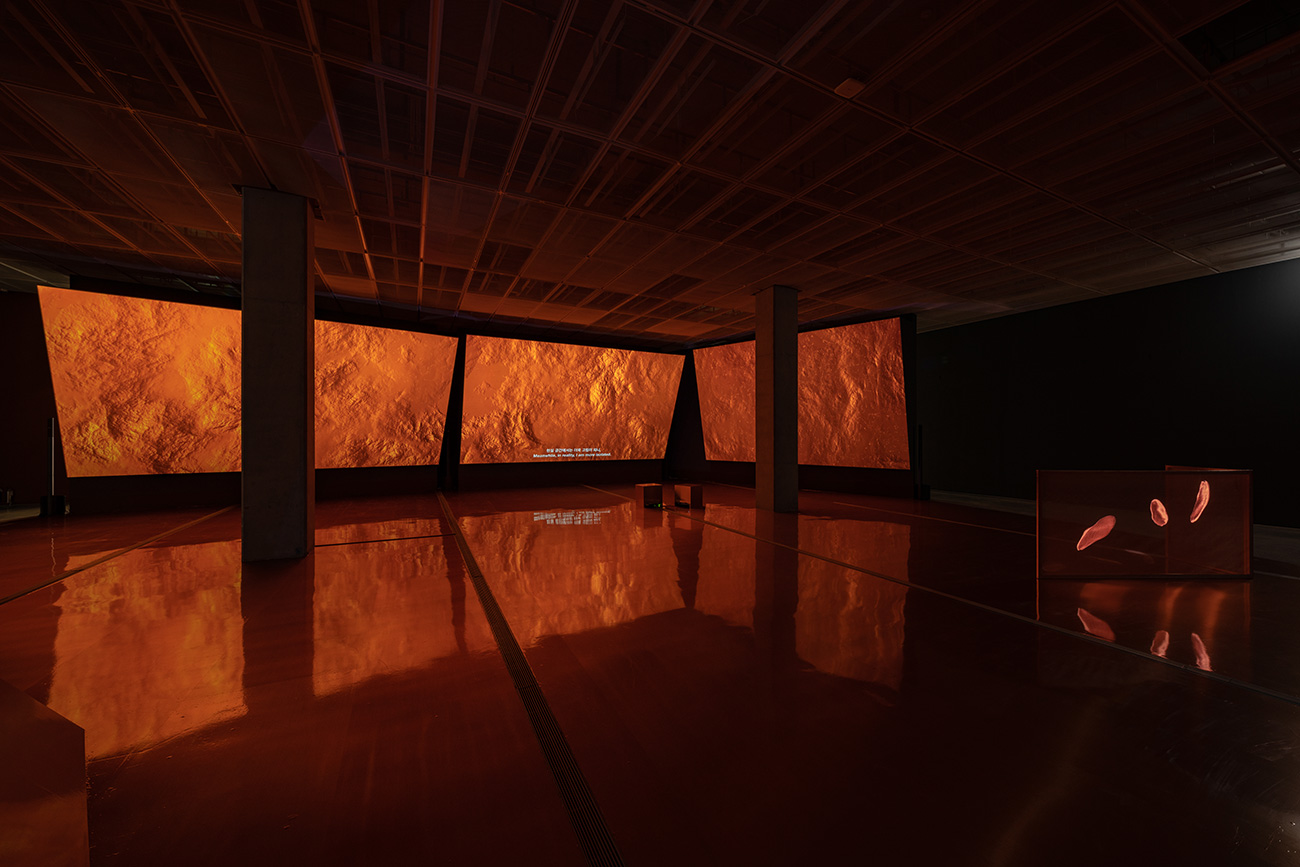
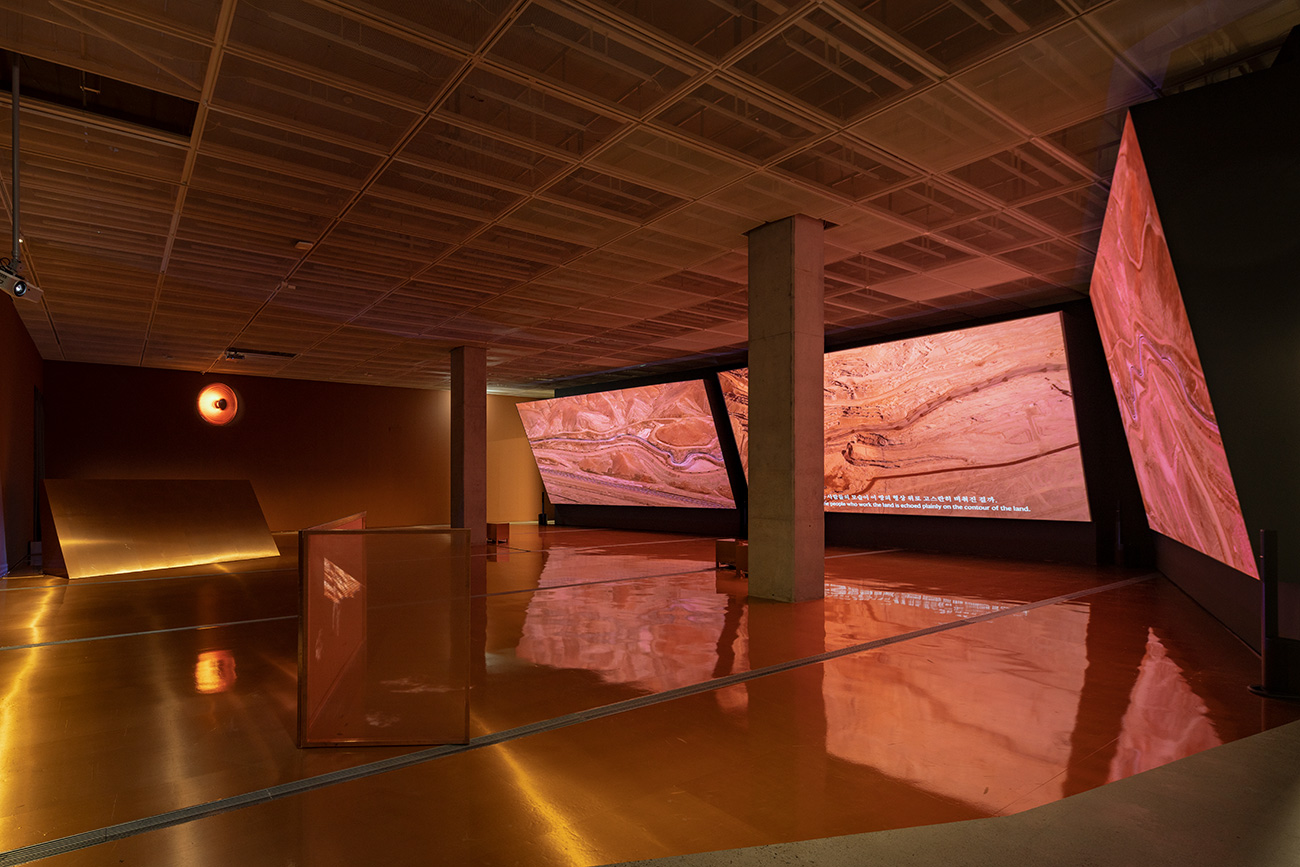
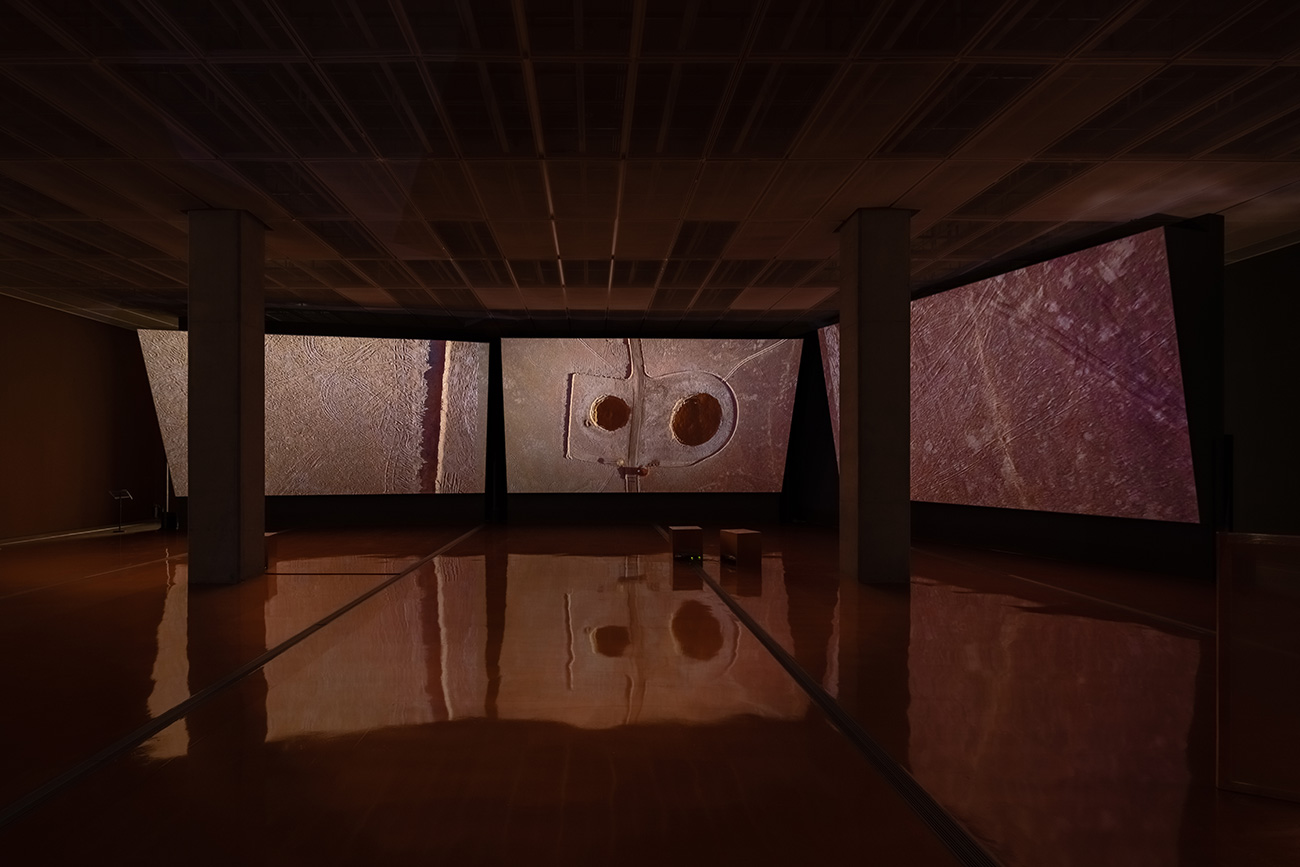
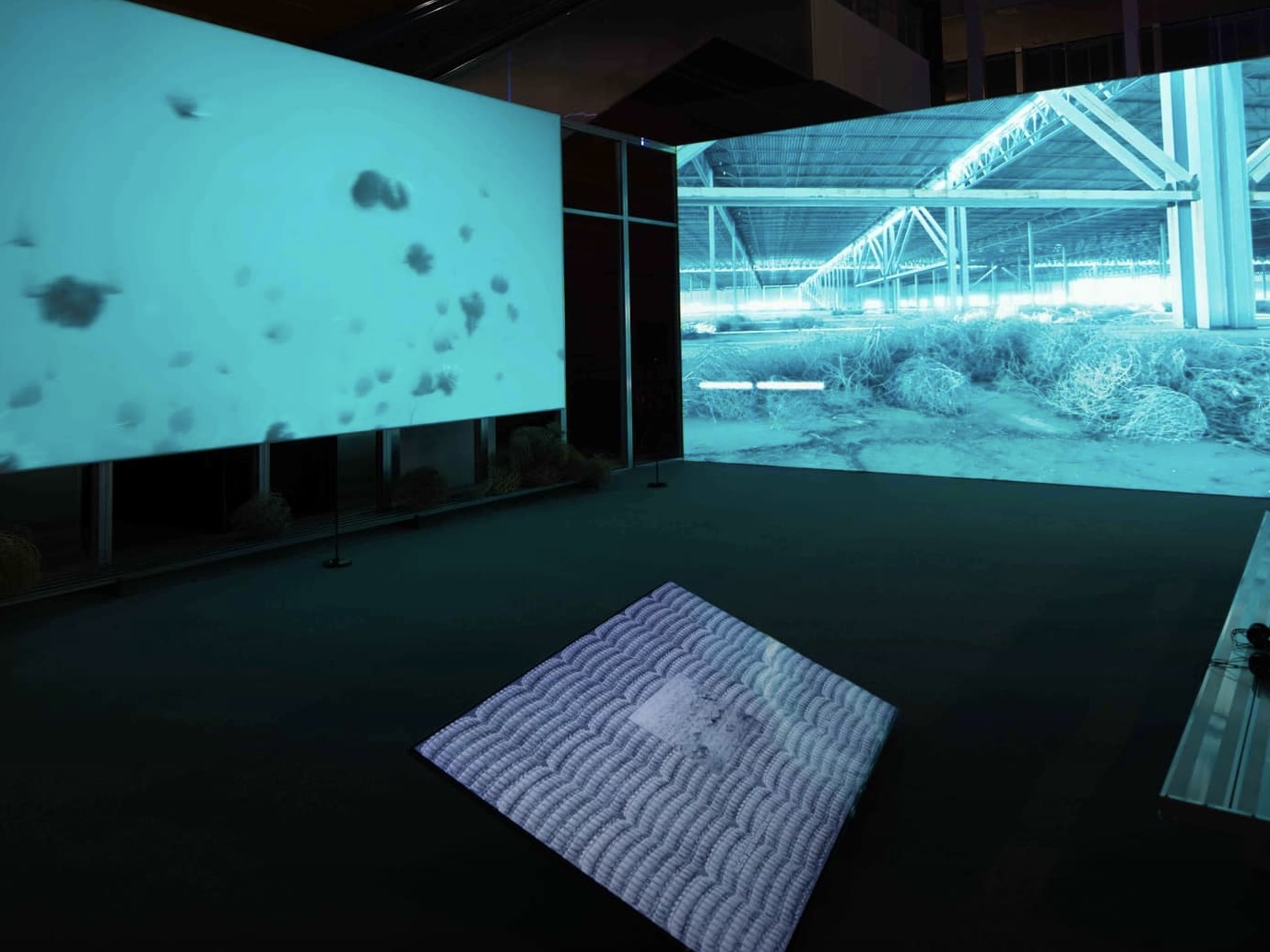
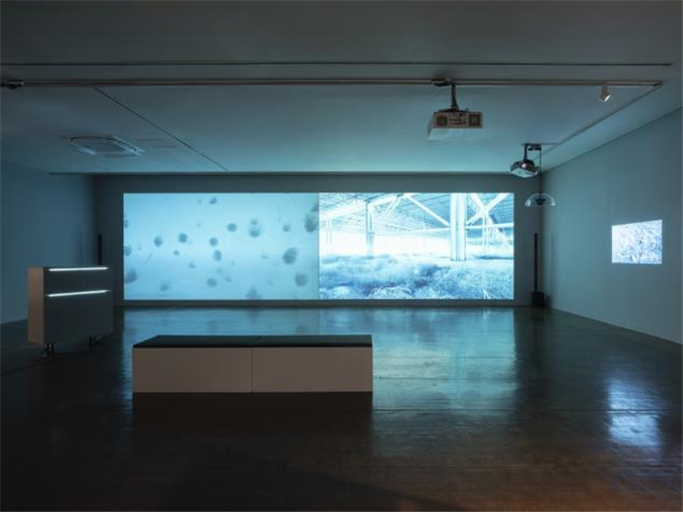
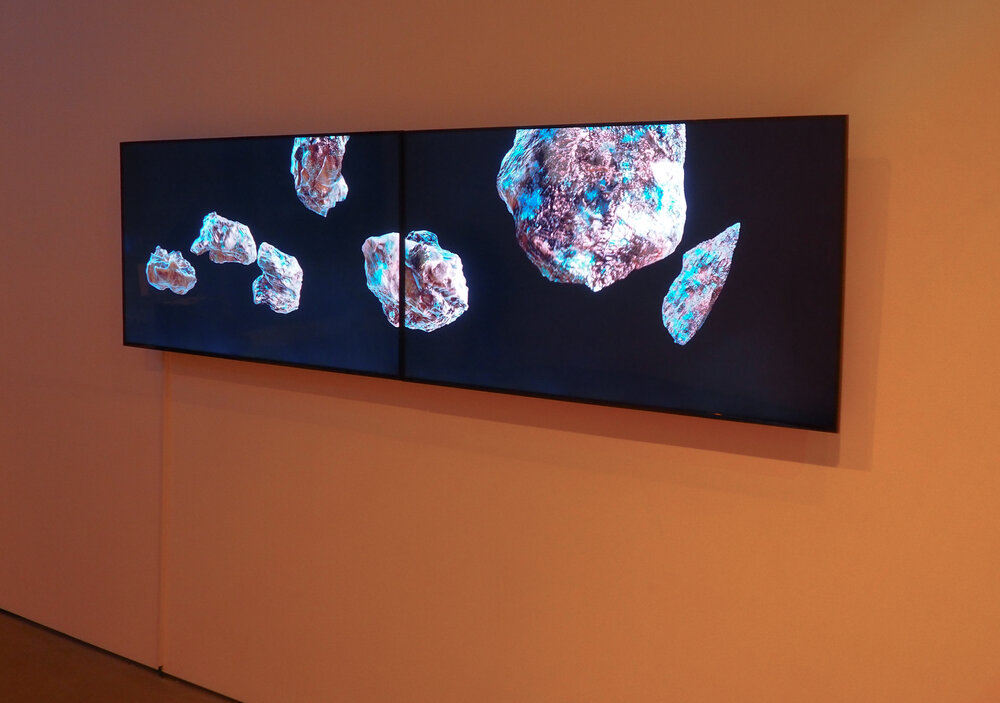
God, man’s body may have been one with the land. Choi’s work, qbit to
adam, is exhibited in a space filled with three large screens
and a copper-textured floor. Within the texture of the land, the audience reads
the narrative created by the artist about the body and the land. Choi studied
the concept of land for many years — for instance, who established the borders
of a given land, when the concept of ownership began to be applied to land, and
how useful land would become as property in the future. With time as her
resource, she attempted to answer questions about the land in social,
historical, and religious contexts. The result of such deep contemplation is
the one, mass allegory in which the land, the grave, the body, and the mummy
converge or scatter in both video and text.
Choi explored the concept of land
— made of earth and also the source of man’s body — and realized that this
source is replaced by transcendence. Death, as man’s irreversible fate, returns
him to the earth. From the word “land” in the Bible, where “land” is mentioned
for the first time, to the word “land” as it is used in modern times, the
history and the range of meaning of the “land” is vast. In search of the places
where the border between land and body disappears, after a 23-hour flight, she
visited the city of Calama in Chile as well as the nearby Atacama Desert.
“In
1899, a mummy was found in an ancient mine located in northern Chile,” the
artist recalled. “Green copper had seeped into his body over many years,
turning it into mineral. Copper Man. If you look at his body carefully, you
will see there is no border between the body and the land anymore.”13 Ultimately,
this work originated from this scenario, from Choi linking the land to the
body. The gallery floor is filled with copper-textured material, which
functions as a medium connecting the land and body. It also symbolizes Copper
Man, who arose from the earth covered in copper-colored minerals.
Land
Chan Sook Choi has continued
pondering the concepts of migration, land, and land ownership through such
works as The Promised Land, Yangji-ri, and Black
Air (2019). The flow of her reasoning proceeded like dominos,
one following the next. qbit to adam, which she
completed for the Korea Artist Prize 2021 exhibition, is a convergence of all
of her aforementioned keywords: “Adam,” who had been banished from the first
land to the vast wilderness; “People,” who had been swept to the margins of the
social, political contexts; “Workers,” who toil on the land their entire lives
but still cannot secure their rights; “Land,” sold and bought based strictly on
the logic of economics in capitalistic society; “Moments,” when vast nature
turns into a personal possession; and “Migrants,” who still cannot find land on
which to settle.
To Choi, land is the resting place for the roaming body and
soul, a space for embracing and welcoming others. Here, on the land, there is
no social system that mass produces refugees, workers, or migrants. This land
cannot be bought or sold; it does not belong to anybody, like a grave that
rises on the land. When you reach the end of such reasoning, you realize that
the body and the land are one and cannot be separated — the way it used to be
before Genesis. In the land, where the desire of mankind has been castrated,
the senses of texture and touch embrace our bodies, and the artist asks,
How are the borders of
the body and the borders of land different?
What do you see when you look down into the grave of the dead?
Body
Three large screens have been
installed in the exhibition space to visualize the texture of the land, which
appears to be alive and breathing. With this land as background,
apricot-colored pieces of skin symbolizing the body rotate. Pieces of copper
appear frequently on the screen, juxtaposed with the animated sense of the land
as a backdrop. These flesh and copper fragments in the video signify that the
body and the land are separate yet one. The gallery floor, which is covered in
a copper-like material, seems to interact with the copper pieces in the video,
surrounding the bodies of the audience. In this way, audience members connect,
become one with the floor, the land; their bodies take part in the journey
across this simulated land and the difficult lives of those who had been driven
from it.
Then, Choi asks:
When was the land separated from the body?
Data
With advancements in technology,
mankind is now moving toward the virtual, augmented, and hybrid realities made
possible by computer data. They exert influence not only on our ordinary daily
lives, but also on our societies, cultures, politics, and economies. This also
pertains to the concept of land and land ownership. When virtual reality was
first introduced, it was a public asset owned jointly by people — much like the
way in which the land was regarded in relation to mankind through much of
history.
However, as the concept of common ownership began to disappear, a
series of events we had experienced with actual, physical land are being
repeated in the virtual world. We buy land on virtual platforms and focus on
decorating avatars. I in the real world become an avatar in the virtual space I
create and meet with other people — also avatars. Just like that, time and
space in the real world move to the virtual. Besides eating and drinking, I buy
a house there, which I decorate to my tastes, and I meet my friends virtually
as well.
As the concept of the land changes, the way in which humans intervene
and manage the land has also changed. Additionally, the ego that exists in such
a space sees the body disappear, becoming disconnected with the land, becoming
an ego that has been transformed to data — to the avatar.
Moving land, the battle for the
virtual land
In Ted Chiang’s short story, “The
Lifecycle of Software Objects,” “I” from real life live together with an avatar
in the same time and space. Ana Alvarado, who had failed to find a job for a
long while, opens a window to Next Dimension and starts her favorite game: “Age
of Iridium.” “The beachhead is crowded, but her avatar is wearing the coveted
mother-of-pearl combat armor, and it’s not long before some players ask her if
she wants to join their fireteam.
They cross the combat zone, hazy with the
smoke of burning vehicles, and for an hour they work to clear out a stronghold
of mantids; it’s the perfect mission for Ana’s mood, easy enough that she can
be confident of victory but challenging enough that she can derive satisfaction
from it.”14 Ana is rejected by someone in real life but, in the
“Age of Iridium,” her avatar is data that has an attractive item sought by all.
Subsequently, Ana quickly accesses another Internet platform, “Data Earth,” to
meet with a friend.
“She logs on to Data Earth, and
the window zooms in to her last location, a dance club cut into a giant cliff
face. Data Earth has its own gaming continents – Elderthorn, Orbis Tertius -
but they aren’t to Ana’s taste,
so she spends her time here on the social continents. Her avatar is still
wearing a party outfit from her last visit; she changes to more conventional
clothes and then opens a portal to Robyn’s home address. A step through and
she’s in Robyn’s virtual living room, on a residential aerostat floating above
a semicircular waterfall a mile across. Their avatars hug,”15 and
they start to talk to each other.
With the emergence of the virtual
world, there are now avatars through which one can project their emotions as
they do in the real world. Moreover, with the recent emergence of NFT and
metaverse, land, houses, trees, gardens, cars, clothes, bags, and other items
can be purchased in the virtual world just as the reality. As seen in Ted
Chiang’s novel, people meet on an online platform where they can freely and
comfortably do anything and everything they do in the real world.
Not only
should physical bodies be taken care of, but also the avatars existing in the
virtual space. Separated from our physical, perhaps our minds and souls might
more closely resemble non-material data. The concept of land ownership has
switched to ownership in the virtual world while the body has been substituted
by an avatar. I put together the images of myself, one of me standing on the
vast and forlorn earth, and another of me floating in an ever-proliferating
world, like the vast plains of the universe. I begin to move my body. Standing
on the copper-textured floor and watching a video about the land, I sense a
strong connection between my body and the land.
1 The English word ‘refugee’
originates from the French word ‘refuge,’ meaning a hiding place. This
originates from the Latin word fugere, meaning a shelter
from danger.
2 “Ce que l’on sait de
l’histoire de Naomi Musenga, morte après avoir été raillée par une
opératrice du Samu,” franceinfo, September 5, 2018,
https://www.francetvinfo.fr/sante/ce-que-l-on-sait-de-l-histoire-de-naomi-musenga-morte-apres-av
oir-tente-d-appeler-a-l-aide-le-samu_2743789.html.
3 Sonia Shah, The
Next Great Migration: The Beauty and Terror of Life on the Move,
trans. Seong Won (Seoul: Medici, 2020), 80.
4 “People who had faith in
the myth of biological race and a racial order found sufficient scientific
evidence to back up their beliefs. One popularly cited statistic from the Human
Genome Project noted that people are 99.9 percent the same ‘regardless of
race.’ That didn’t mean that a consistent 0.1 percent genetic difference
defined racial groups.” Sonia Shah, The Next Great Migration: The
Beauty and Terror of Life on the Move, trans. Seong Won (Seoul:
Medici, 2020).
5 Chan Sook Choi juxtaposed
two concepts when dealing with physical and mental migration. The concept of
migration within the context of human history and personal history of migration
is presented as the main narrative. On the other hand, the concept of
‘movement’’ is presented using tools and devices made available through
technological advancement. She used means of movement as a direct metaphor for
migration while using means of transportation to express imaginary migration. The
Promised Land used the collage technique by putting together the
video of a huge German theme park with an automated voice over of a Volkswagen
showroom explaining the most advanced German technology. The more advanced
technology gets, the more technologically dependent humankind becomes. As the
voice of the guide explaining the fully-automated, safe production process of
the Volkswagen factory that does not need any human intervention is played in
this work, Choi raises the question, “What is the ultimate paradise that humankind
is pursuing?” In this regard, Choi believes that “following the outcome of
technological advancement and the goal of religion will eventually lead to
utopian perspectives.” This work is played in a mobile structure whose motif
is, according to the artist, “the mobile, portable temple that Jews have built
for God’s promised land.”
6 Guillaume Le Blanc
discusses the stigmatization of “foreigners” or “strangers.” “Strangers” are
labeled so because they are considered a threat to a nation’s native language
and legal system. In this sense, foreigners are “otherized” as those who constantly
intrude. More importantly, otherization is originated from the hierarchical
classification created by establishing foreigners as others in an effort to
solidify control over these strangers. Guillaume Le Blanc, Dedans,
dehors: La condition d’étranger, trans. Park Young-ok (Paju:
Geulhangari, 2014), 34.
7 Ibid., 26.
8 Michael Arzt and Frank
Motz, “You Are the Sole Carrier of Your Own Memory,” FOR GOTT EN by
Chan Sook Choi (LOOP Press, 2015), 141.
9 Ibid., 142.
10 Ibid., 143.
11 Chan Sook Choi, MMCA
Artist Interview (2021).
12 Adam distances himself
from God by trying to hide. Adam experiences fear for the first time, thereby
indicating that he had lost trust in God. As he had broken the covenant of God,
the source of all blessing, the blessed land turned into the cursed land. He is
banished from the land of blessing to vast, arid wilderness. Likewise, the land
itself becomes destined to follow the misfortune of man. Alain Marchadour and
David Neuhaus, “The Land, the Bible, and History: Toward the Land That I Will
Show You,” trans. Kwon Yu-hyeon (Seoul: Withbible, 2006), 28-29.
13 Excerpt from Chan Sook
Choi’s video work qbit to adam script.
14 Ted Chiang, Exhalation,
trans. Sanghoon Kim (Seoul: Ellie, 2019), 99-100.
15 Ibid., 101.