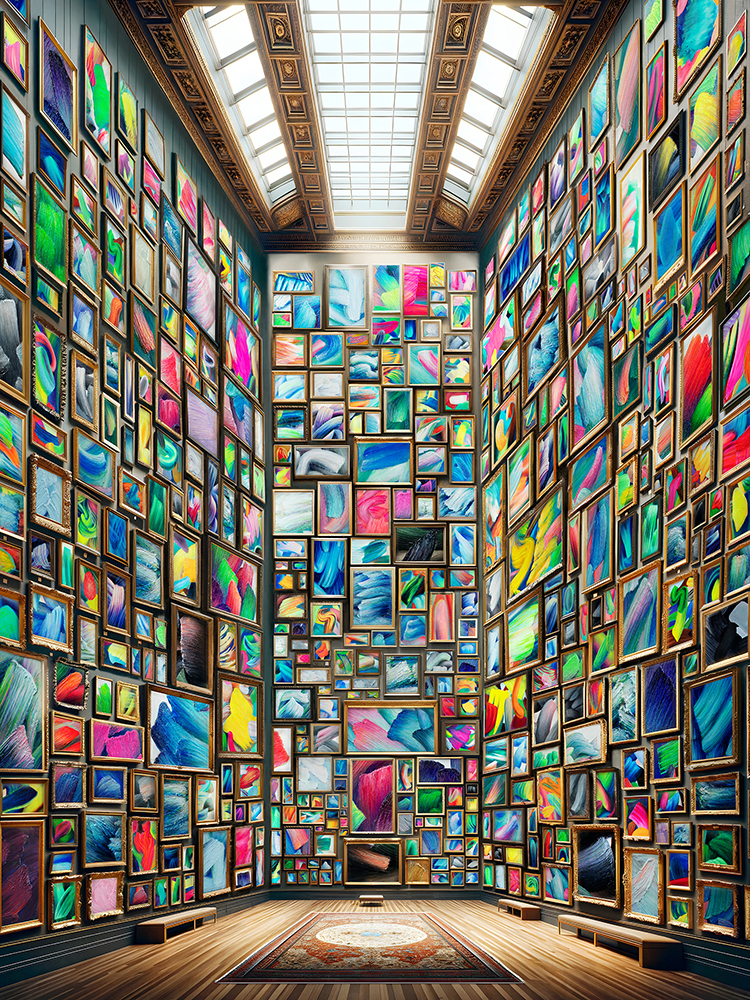
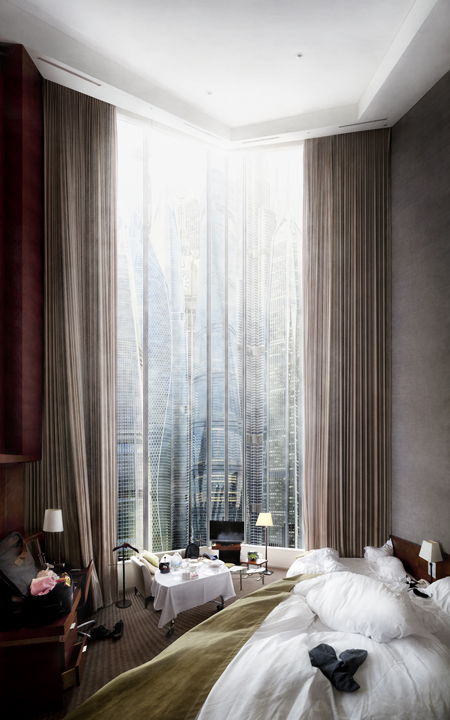
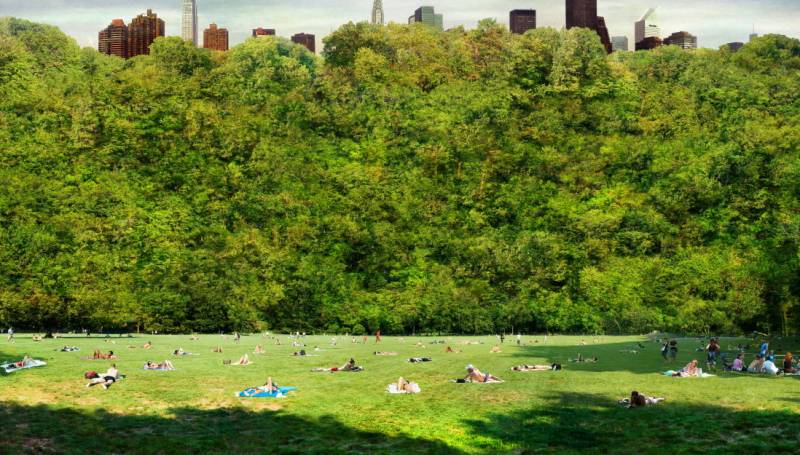
Sangbin IM’s major works often take the form of photography. Yet his works look markedly different from conventional photographs. Oversized eyeglasses that seem out of place against their surroundings appear in the image; buildings are stretched excessively upward and downward; and enormous walls are sometimes covered with countless artworks.
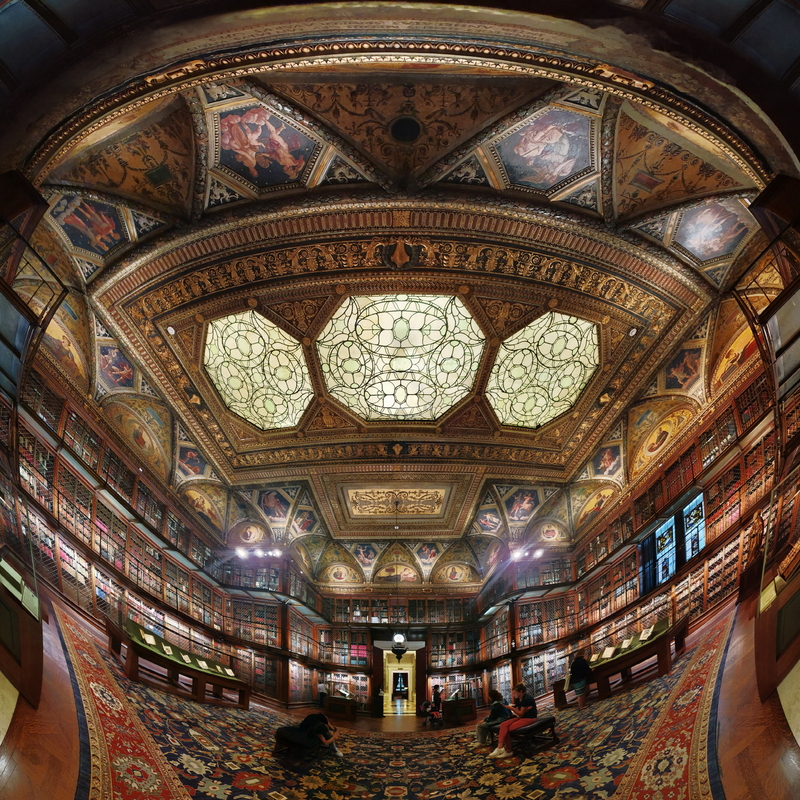
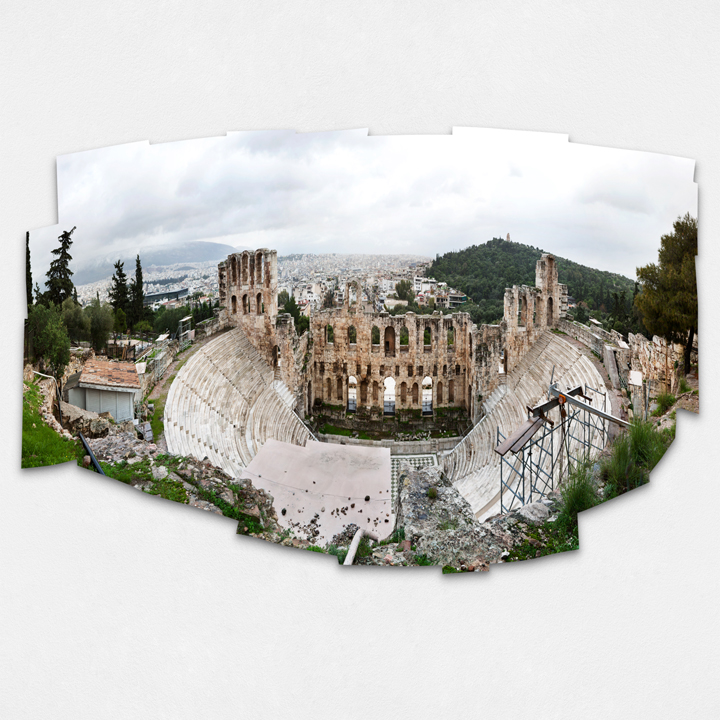
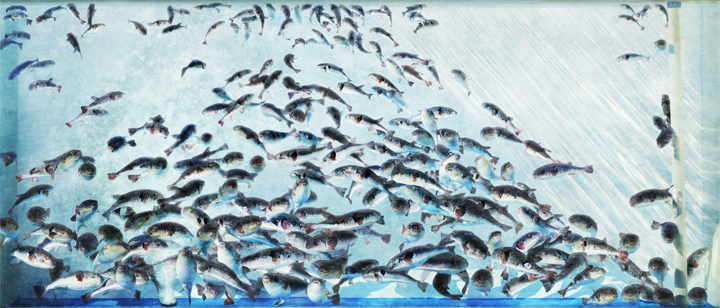
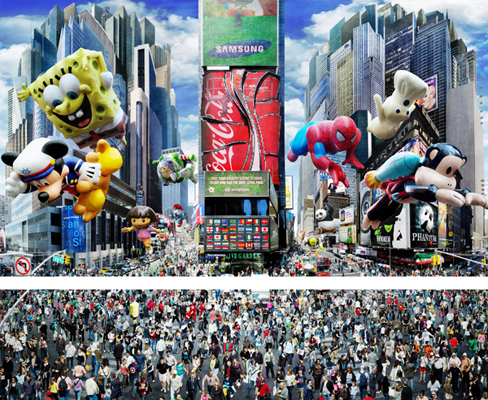
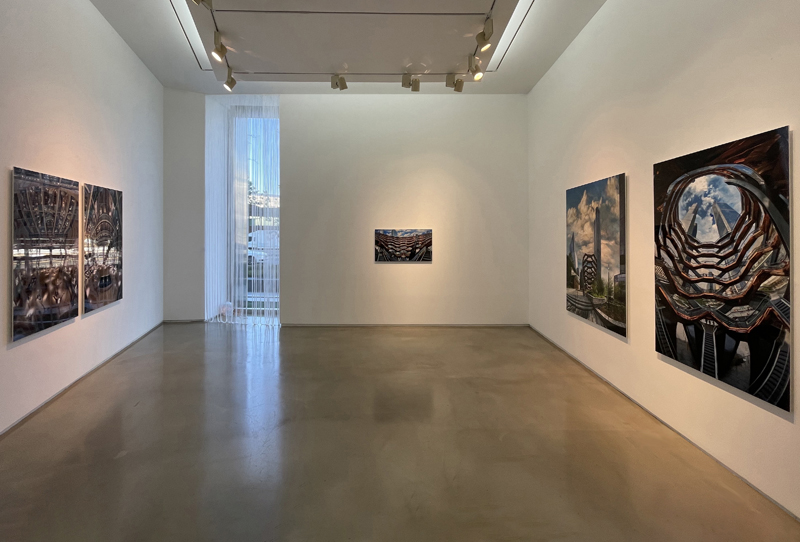
Awkward compositions that depart from conventional perspective, curved edges reminiscent of a wide-angle lens, and panoramic views extending left and right as though mocking the limits of human vision also appear, while at times the image is artificially divided vertically or horizontally. Some objects and landscapes in his works also possess soft textures and contours, as if they had been painted. Although he clearly selects familiar landscapes as his subject matter, his works appear somehow awkward, unexpected, and at times even surreal.
One of the most important elements in his work is the act of ‘seeing.’ In order to see something, there must of course be something to see, as well as someone who sees it. Sangbin IM pays attention not only to the object and the viewer, but also to the viewer’s ‘position.’ In fact, that position is the artist’s own. Long interested in gaze and viewpoint, he has often included specific objects that imply where the viewer is located.
A rearview mirror and windshield wiper suggest that he is inside a car, while a railing indicates that he is standing somewhere elevated. Distorted roads, sidewalks, and retaining walls likewise allow us to estimate the artist’s position. These distortions make use of the phenomenon in which nearby objects appear curved when the focus is placed on a distant subject.
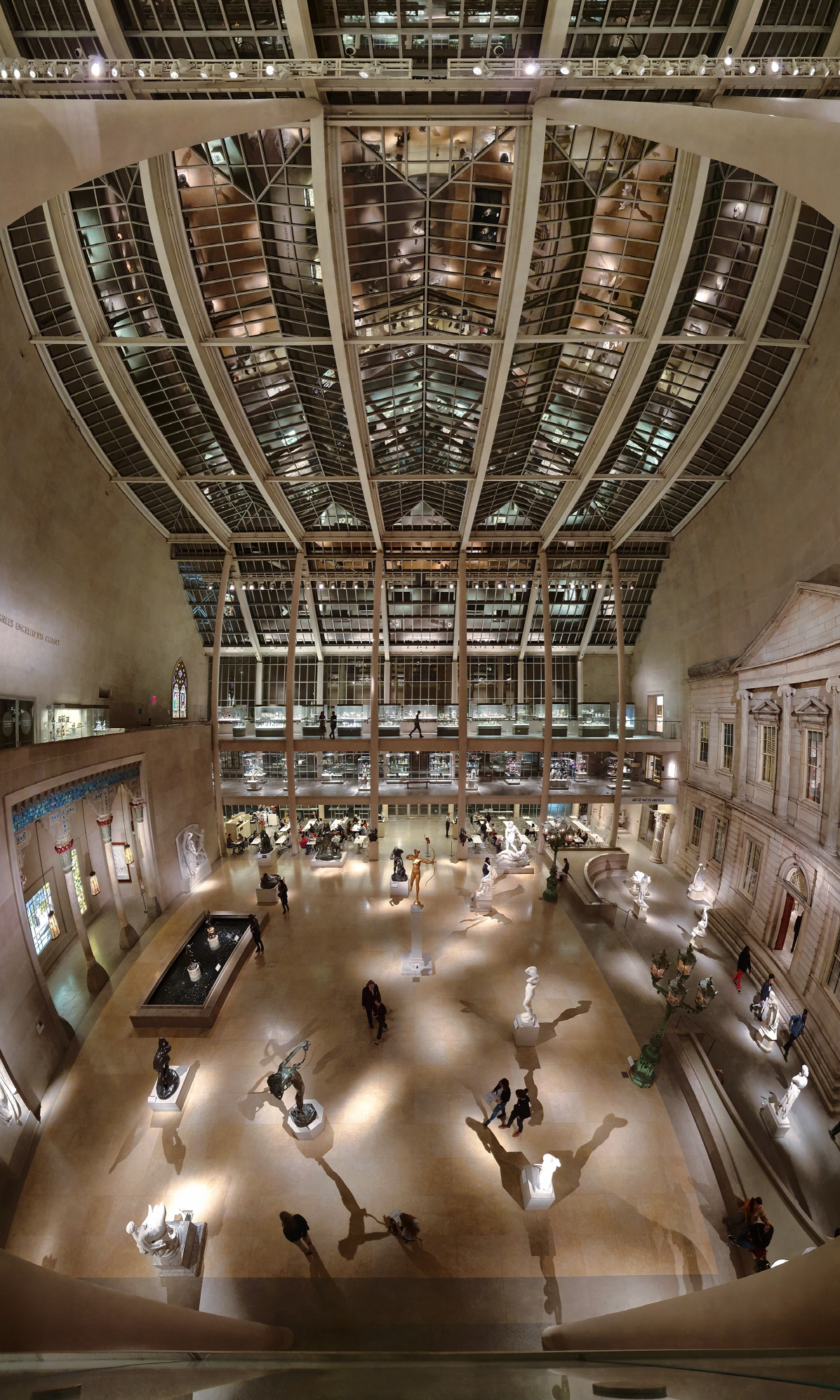
Sangbin IM has also incorporated multiple views seen from a single position into one image. If, for example, the artist is on the second floor, the lower part of the image may depict a downward view toward the first floor, resembling a bird’s-eye perspective; the middle may present a frontal view from the second floor, like level-distance perspective; and the upper part may show an upward view toward the ceiling, like high-distance perspective.
The result is a spectacular scene composed of multiple angles and viewpoints. Although the spectacle itself may seem to be the protagonist, what is in fact more essential is the artist’s gaze and position from which that spectacle is observed. Through such distinctive structures, he creates expansive and dynamic scenes that foreground the relationship between observer and object. This reveals both the act of perceiving an object or landscape and the awareness of oneself in the act of perceiving it.
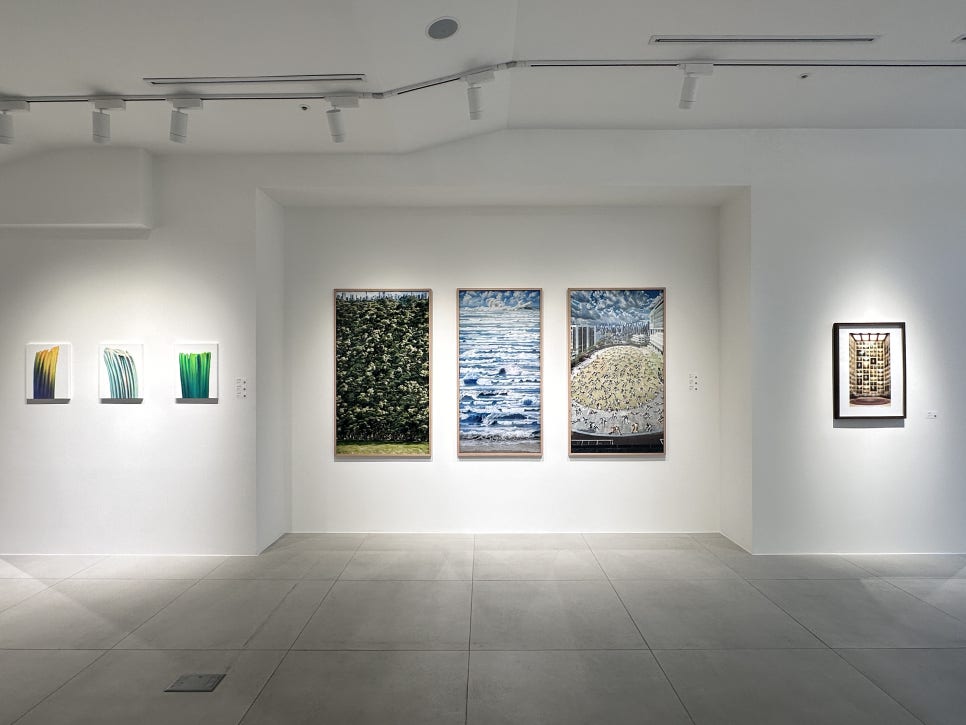
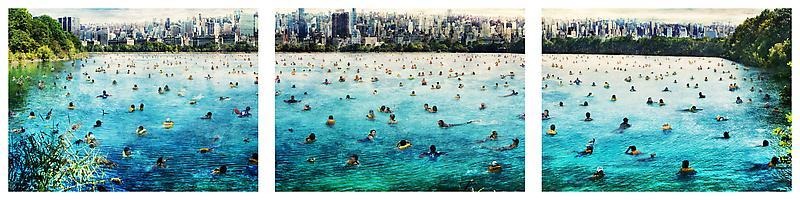
Sangbin IM has continued to invest the gaze and position from which objects are viewed with human desire and psychology. One body of work that reflects this intention is the series centered on Manhattan. Yet Manhattan is not viewed from within the city itself, but from across the river. As a result, Manhattan appears like a fantastical island floating on the water.
The gaze directed toward Manhattan from across the river contains a sense of admiration and longing for the city. It is the gaze of an outsider who does not belong to Manhattan. Even among Americans, there are those who truly belong to Manhattan and those who do not. At the same time, this gaze is also that of the artist himself, an Asian longing for entry into mainstream American society.
In this series, Sangbin IM did not photograph Manhattan from a single fixed location. After selecting a particular point in Manhattan as his target, he moved around outside the city and took numerous photographs, as if to suggest the multiplicity of an outsider’s gaze. He then composited these images to construct a spectacular image of Manhattan.
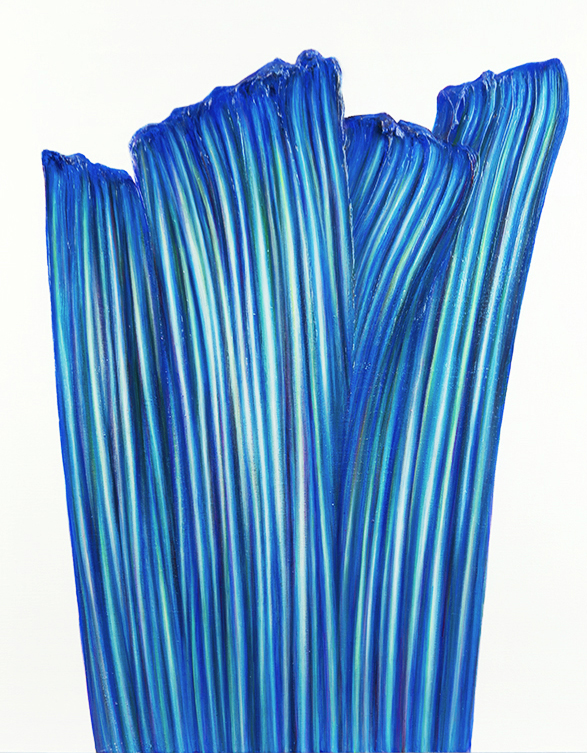
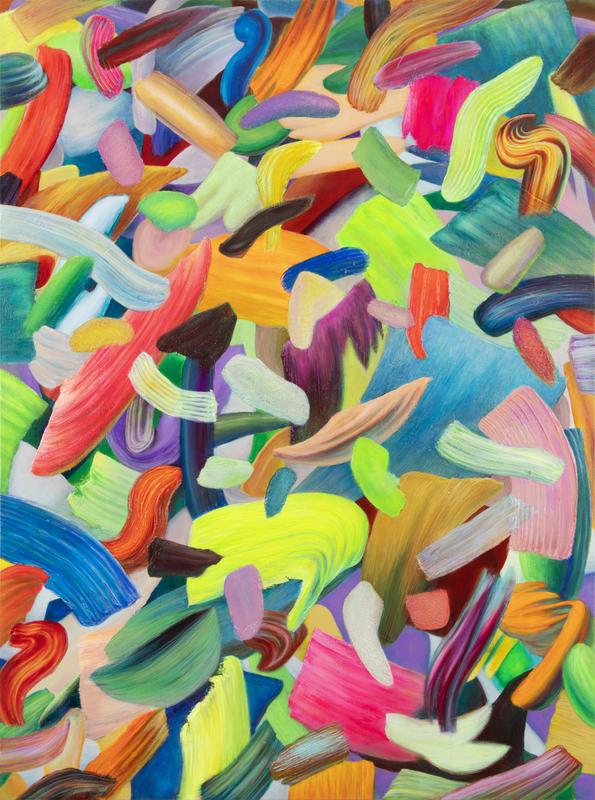
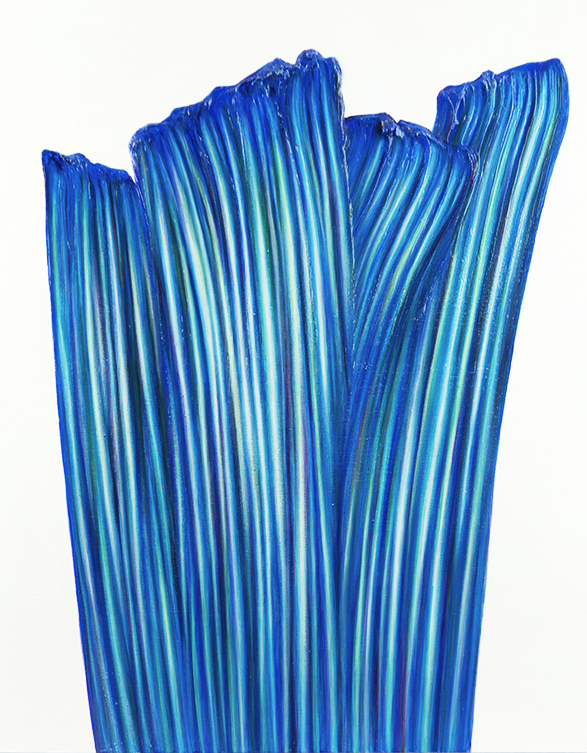
The buildings maintained relatively consistent forms, while the fluid river and sky changed slightly from image to image. In other words, while the architecture was rigid and geometric, nature was fluid and organic. To visualize these qualities of nature, Sangbin IM introduced ‘painterly texture.’ To depict the sky, for instance, he first photographs it with a camera, then paints an image that conveys the sensation of the sky and photographs that painting as well.
He subsequently combines these two types of images digitally to devise an original image of the sky. In rendering the contours of objects, the ‘soft edge’ derived from painterly texture makes them appear gentle, while the ‘hard edge’ derived from photography makes them appear cold and rigid. By employing these two elements in multiple ways, he produces delicate and subtle nuances. In this respect, his work differs considerably from conventional photography. It is photography deeply infused with painting.
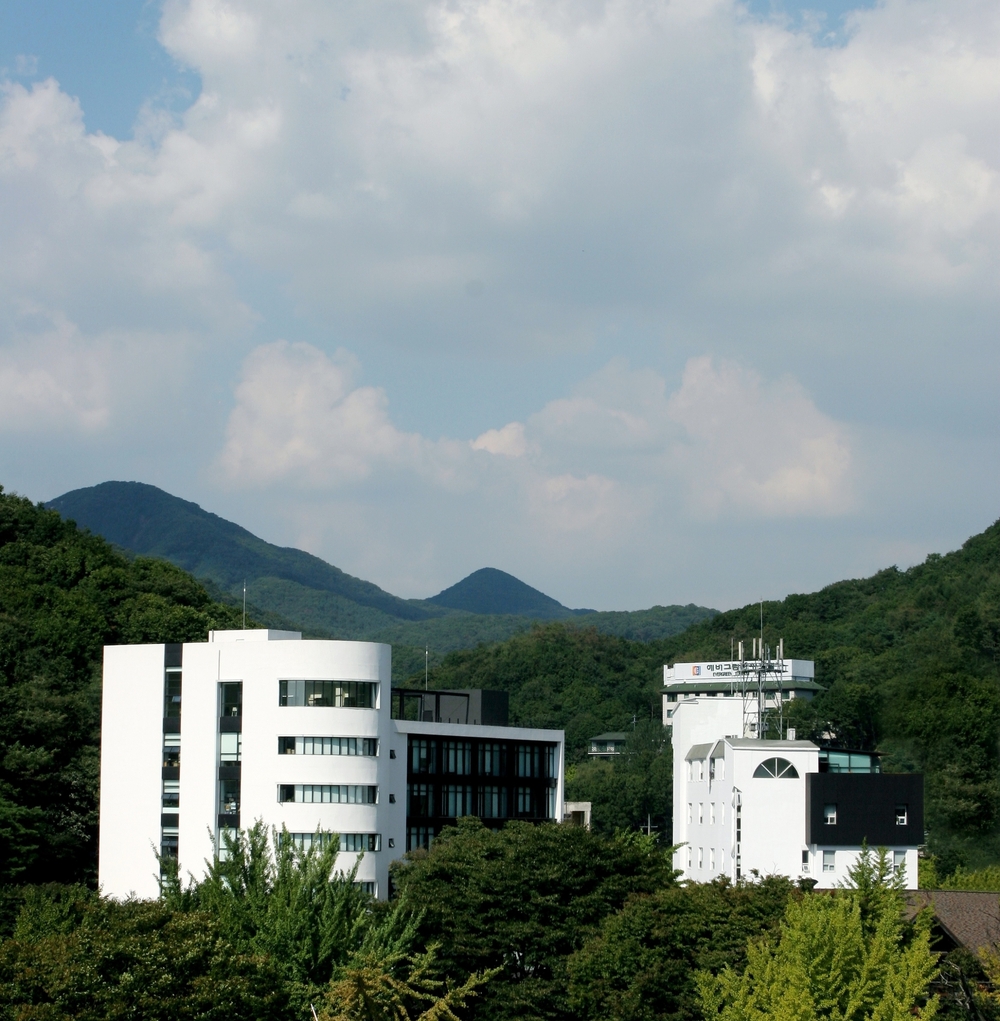
His exploration of Seoul as a city began only after his time living in the United States. Although Seoul is his hometown, living abroad allowed him to notice things he had overlooked while living there. In particular, Seoul contains far more cultural heritage sites than Manhattan, and he came to feel that Korea’s traditional palaces appeared strikingly diminutive when surrounded by high-rise buildings.
When they were first constructed, these buildings must have appeared monumental. Yet through a contemporary or Western gaze, they can seem small and modest. Spectacle, in other words, is relative. To compensate for this diminished sense of spectacle, he stretches buildings vertically. This became the basis of another series.
Interestingly, this idea came from the internet. In the past, when users scrolled down a webpage, images would sometimes stretch vertically due to temporary errors in digital signals caused by limited data transmission. Most of Sangbin IM’s works are completed on the computer. Yet until the mid-1990s, he was someone who had relatively little to do with computers.
Trained in Western painting, he learned to use computers during his military service and began working seriously with digital images after being discharged. On a computer, transforming, arranging, and constructing images was far easier than in painting. At the time, he focused intensely on the conjunctions, transformations, and relationships between analog and digital processes, but he was by no means an unquestioning believer in digital technology. Rather, he remained wary of its limitations while exploring its possibilities from multiple angles.
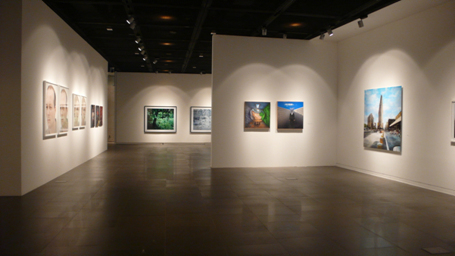
The distortion and transformation of images are particularly evident in another series. Sangbin IM photographed every artwork on display in a museum and arranged them within a single image. For example, he photographed all the works in the Metropolitan Museum of Art’s modern art section and placed them along walls and floors extended far beyond their actual dimensions.
Such an arrangement would be impossible in reality, but it allows the entire collection to be surveyed at a glance. One might say that the museum became famous because it acquired these works; conversely, the works may also have gained value because they were acquired by the museum.
In any case, through these artworks the museum would have attracted both people and capital, thereby forming cultural power. Once such circumstances are understood, it becomes difficult to view the works purely in terms of aesthetic appreciation. They are exceedingly beautiful, yet there is something bitter beneath the surface.
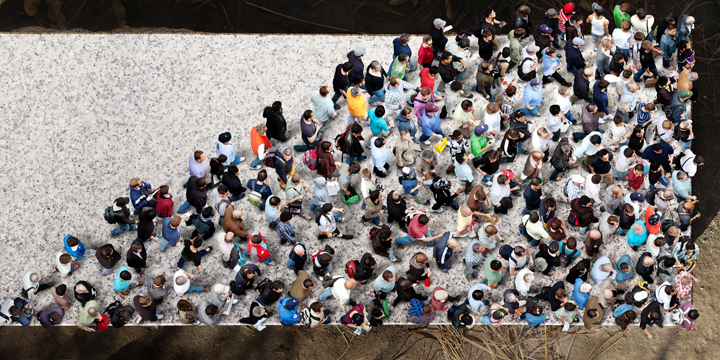
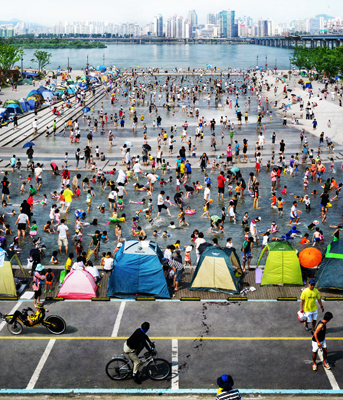
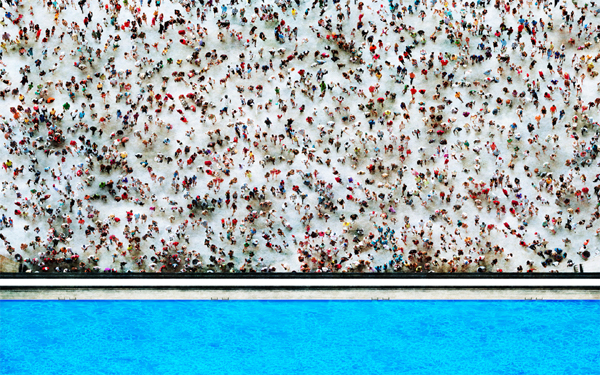
In a similar context, Sangbin IM incorporates into his work urban cultural and recreational facilities frequently visited by the public, including parks, stadiums, libraries, and museums. It may seem entirely natural that people gather in such places, but conversely, if one analyzes people’s routes and behavior and constructs such facilities accordingly, people are bound to gather there. When they do, the scene itself becomes spectacular.
Likewise, while a city is a place where different kinds of people live together, it is also because it is a city that different people gather there. A city is thus formed as diverse individuals meet, form relationships, and collide with one another, and the artist likewise produces his works through encounters, relationships, and collisions with others. His works, therefore, are not simply urban landscapes, but urban landscapes animated by countless microscopic forces.
Representing Reality through the Distortion and Transformation of Images
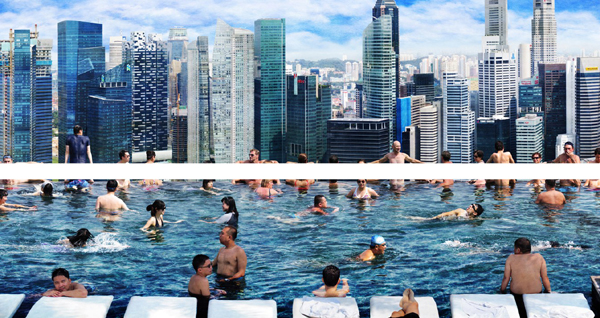
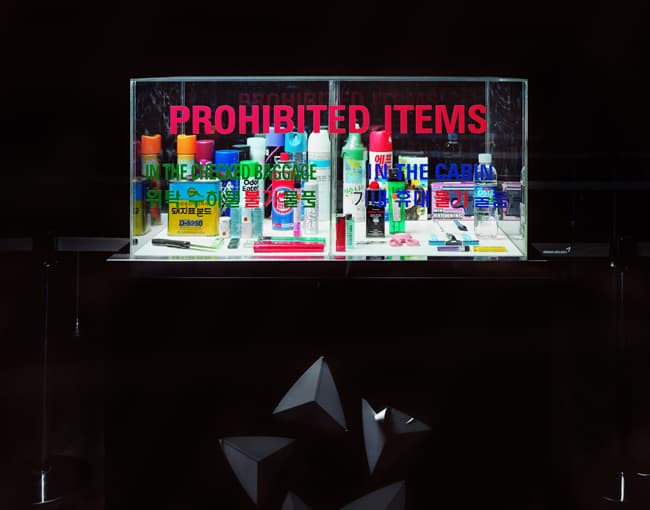
Recently, Sangbin IM has been photographing internationally renowned tourist destinations such as Iguazu Falls, Waikiki, Cancún, and Bali. He visits these places, experiences their energy, and seeks to speak about them in his own way. In his accounts, sweetness and bitterness always seem to coexist.
In his work on Iguazu Falls, for example, he photographed the site from multiple locations and reconstructed the images to create a spectacular scene. In fact, it is fundamentally impossible to capture the vastness and energy of a natural site like Iguazu Falls from a single viewpoint. He also introduces objects such as kayaks, hang gliders, and swimming goggles into the image, constructing a first-person narrative—as though he had plunged down the falls in a kayak, flown above them on a hang glider, or swum underwater while snorkeling.
Of course, he did not actually perform these acts. Personally going somewhere and doing something there can instill a sense of pride and superiority. Whether the experience involves a historical event, a personal achievement, or a famous tourist destination, people tend to present their own experience as if it were the ultimate one, adding their own interpretations and constructing a personal version of events.
Such absurd exaggeration can at times be strangely relatable, because what matters is not so much what he actually saw there, but the way his story allows us to glimpse his inner world and psychology.
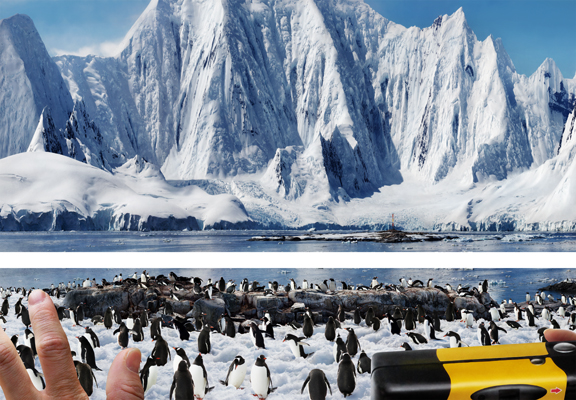
The Antarctic project, which began in late 2013, follows a similar logic. Only a few decades ago, Antarctica was an unknown land accessible only to explorers. Today, however, anyone with enough money can visit Antarctica in relative safety and experience the sublime beauty of nature. Capitalism has now penetrated even Antarctica.
The artist depicts himself as though he had ventured through the region in a small wooden boat, even though he did not actually do so. Even without explicitly considering the competing interests surrounding Antarctica or the melting of glaciers caused by global warming, the Antarctic landscape can no longer appear to us as simply beautiful.
Meanwhile, Sangbin IM has also been working with single-channel video and sound installation. These include Sigh Project, in which sighs express the frustrations of life; Courtship Project, in which someone repeatedly calls the artist’s name; Mural Project, which involves reading graffiti on the wall of an entertainment agency; Creation Project, which depicts fundamental elements such as water, fire, forests, and wind; and Hypnosis Project, which places the viewer under hypnosis.
All of these remain unreleased works that question the meaning and role of art while prompting the artist to reflect on himself as an artist. Although they differ somewhat in form from his earlier works, they candidly reveal the expectations, desires, vanity, frustration, self-satisfaction, and self-hypnosis he has experienced through his artistic practice. The artist he describes is not the idealized and flawless figure found in textbooks, but one who meets, relates to, and clashes with others. Like his works, such an artist can at times be sweet and at other times bitter.