1.
In the decade or so since 2007, Ayoung Kim has engaged in persistent archiving and research efforts to explore significant historical factors and issues of reality from a “here and now” standpoint — matters of Korea’s modern and
contemporary history, petropolitics, territorial imperialism, and migrations of
capital and information. These weighty, sometimes tragicomic historical
narratives have been reconfigured into multidimensional, playful narratives
that cut across a multidisciplinary range of media (video, sound, performance,
dance, musical theater, diagramming, fiction, text, etc.) and follow a
dialectical and nonlinear (sometimes fragmentary) storytelling approach
deliberately chosen by the artist, with the use of montage, allegory, and
algorithms. This open-ended working approach by Kim has ultimately enabled a
critique that opens up a new history and perception of the reality.
Ayoung Kim’s strengths as artist
lie in her unique approach to her art, which is as dogged as detective work in
her exhaustive gathering, reinterpreting, reproducing, and recontextualizing of
information. To complete a single work, she willingly takes on an arduous
research process lasting several years. Yet her archival research is not
intended to reaffirm or reinforce some existing collective memory shared among
us. It violates and deconstructs, functioning as material for a trenchant
perspective that critically reexamines historical perspectives.
As examples of this, we may
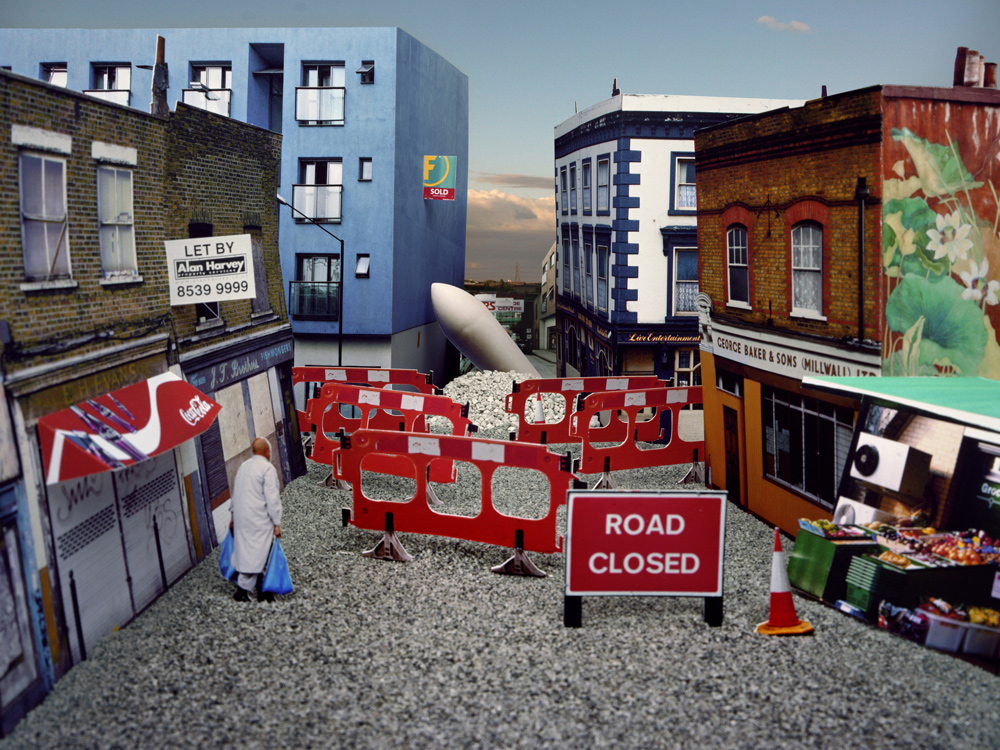
consider her Ephemeral Ephemera (2007–2009), a
photomontage series that “privately” stages the public context of newspaper and
news articles concerning war, murder, accidents, and the like; Every
North Star Part I & II (2010) from the series Tales
of a City, which uses the life of a female jockey who committed
suicide to allude to aspects distorted and lost through the cultural
translation process of Europe horse racing being introduced in Korea; PH
Express (2011–2012), which recalls fragments of imperial history
through its juxtaposition of the invention of the railroad with the 19th
century occupation of Geomun Island by the British Navy; Please
Return to Busan Port (2012), which presents the spatiality and
historical memories of Busan in the late 1980s in the form of a montage with
the story of a boy involved in smuggling at the time; Zepheth,
Whale Oil from the Hanging Gardens to You, Shell (2014–2015),
which recontextualizes the implications of Korea’s petroleum resource-centered
modernization into a work of narrative-based musical theater mixing text,
sound, and performance; and her most recent work Porosity Valley,
Portable Holes (2017), which overlays the geological of
Australia with the crucial implications of the internet era and its migrations
of information.
All of these works are based on
lengthy, performative research and archiving by the artists in settings such as
France, Australia, and Britain — yet through her intertextual methods of fact
montaged with fiction, history clashing with myth, and multiple layers of text,
she has sparked flashes of the things that have been omitted without
inscription into our memory. With her unique archiving methodology and its
tenacious gathering, montaging, and interpreting of history, incidents, and
information, she has ultimately sought to present us not with the mere “facts,”
but with the “truth.”
2.
The characteristic aspects of
Ayoung Kim’s artwork over the decade or so since 2010 have been located
somewhere in between a physical interest and global historical implications in
the apparatus of modernity, and diachronic and synchronic
examination of Korea’s modernization, and the artist’s own multilayered command
of language as she translates social and historical texts into artistic
vocabulary.
The mechanisms of modernization that she has seized upon include
such things as steamships, trains, railroads, petroleum, and information — yet
if we stop to consider them, there is some commonality existing among them:
they are all characterized by “fluidity” or “liquidity,” with collisions,
translations, transplantations, and reproductions that arise as they migrate
through different times and spaces toward capital and power.
If we follow the artist’s
research process as she explores the mechanisms of modernity that enabled the
“liquid modern,” we find certain points where global history intersects with
Korea’s modernization. In Trans-KMS Railway (2012)
and The Railway Traveler’s Handbook (2013), trains
and railroads are the inventions of modernity that she focuses upon. In terms
of the temporal, these are media that enabled the systems of modernity and its
ephemeral or instantaneous aspects. In a spatial sense, however, they are
powerful physical means of movement that reduced distances and facilitated
imperial expansion.
Through her research into the
Trans-Siberian Railway (Russia’s invasion of East Asia), African railways
(Britain’s colonization of Africa), and Korea’s railway stations (Japan’s
policies of Korean colonization), she pinpoints the colonial incursions the logic
of power, and the politics of modernization that surround the train. She also
fully explores the global historical implications of railroads as mechanisms of
imperialism — deeply imbued in the process of colonization — and the colonial
modernization that occurred through this in Korea.
In a similar context, the
artist’s Zepheth, Whale Oil from the Hanging Gardens to You,
Shell series presents a multilayered analogy concerning global
warfare over oil capital, economic crises precipitated by oil fluctuations, and
a modernization project by means of Korean construction efforts in the Middle
East and oil money, which ties in with the story of the artist’s own father.
Kim’s interest in the mechanisms
of modernity leads into an intellectual exploration of the areas where Korea’s
modernization connects with the larger global historical context of
imperialism, decolonization, power, and capital.
For the artist, modernization
coexists less with moments of perfect wholes oriented toward progress and
utopia than with moments of fracturing — imperialism and colonization, war and
crisis, loss and death. These contradictions and fracturing moments cannot be
recorded, signified, or controlled through the language of symbolic systems.
Korea’s unique modernization
process and the narratives behind it have been common themes in Korean
contemporary art since the 2000s, but Ayoung Kim differs from other artists in
the way she has translated things into sound within the strata of art. From
her Trans-KMS Railway to the Zepheth,
Whale Oil from the Hanging Gardens to You, Shell series, In
This Vessel We Shall Be Kept (2016), and Fraud
Tectonics (2016), she has had a chorus deliver a sound
performance (called the “Chanting Ritual”) in which historical information has
been filtered through a “deus ex machina” or “algorithm” to become a
language/sound beyond linear narrative or logic.
With their focus on sound, Ayoung
Kim’s choruses evoke incantatory feelings with their mixtures of simple noises,
shouts, cries, singing, and murmuring, while also calling to mind the multiple
voices and stories that existed in various times and spaces between the early
1900s and the late 1990s.
Her polyphonic approach to
artwork — which involves gathering texts and information and processing it into
a single narrative, while collaborating with composers, choreographers,
vocalists, and others to present this as a new context of artistic language —
has ultimately served to summon forth the countless voices and stories that
have been hidden, suppressed, or otherwise left unspoken in the modernization
process.
The significance of the artist’s
performative efforts lies in the way they render the modernization narrative
strange and fragmentary, while at the same time poking holes in the thick
carapace of the vast “enlightenment” project that is modernization to reveal
the different layers sealed away underneath.
3.
Since Porosity Valley, Portable Holes in 2017, Ayoung Kim’s interest has
shifted to the more concrete issue of physical/non-material migrations of data.
With the artist having so consistently drawn connections between
liquidity/fluidity and the implications of modernization, it would not be
overstating matters to say that issues of migration and movement, as well as
their psychological and political effects, have been longstanding interests. PH
Express concerns imbalances of power and the “political migration” of the
British military to Geomun Island with imperialist ambitions; Every North Star
Part I & II focuses on the cultural migration and psychological divisions
associated with the adoption of European horse racing culture and Zepheth,
Whale Oil from the Hanging Gardens to You, Shell concerns nothing less than
global economic migrations of materials and goods through petroleum-based
capital.
By the time of Kim’s most recent work Porosity Valley, Portable Holes,
the focus had converged upon the issue of the extensive scattering of
information in the post-internet era and the physical migrations that can be
inferred from it. Omnidirectional movements of information — and of data and
digital information in particular — are obviously political not only in terms
of their connections with flows of capital and funding in the global market,
but also through their relationship with an unseen dynamics of power that
censors and decides those flows. In the artwork of Ayoung Kim, these “fluid
conditions” that dominated every aspect of our lives — power, capital,
knowledge, information, and so forth — are presented as a complex story based
on the artist’s uniquely hybrid, nonlinear narrative structures and
“speculative fiction” approach.
To return to the work Porosity
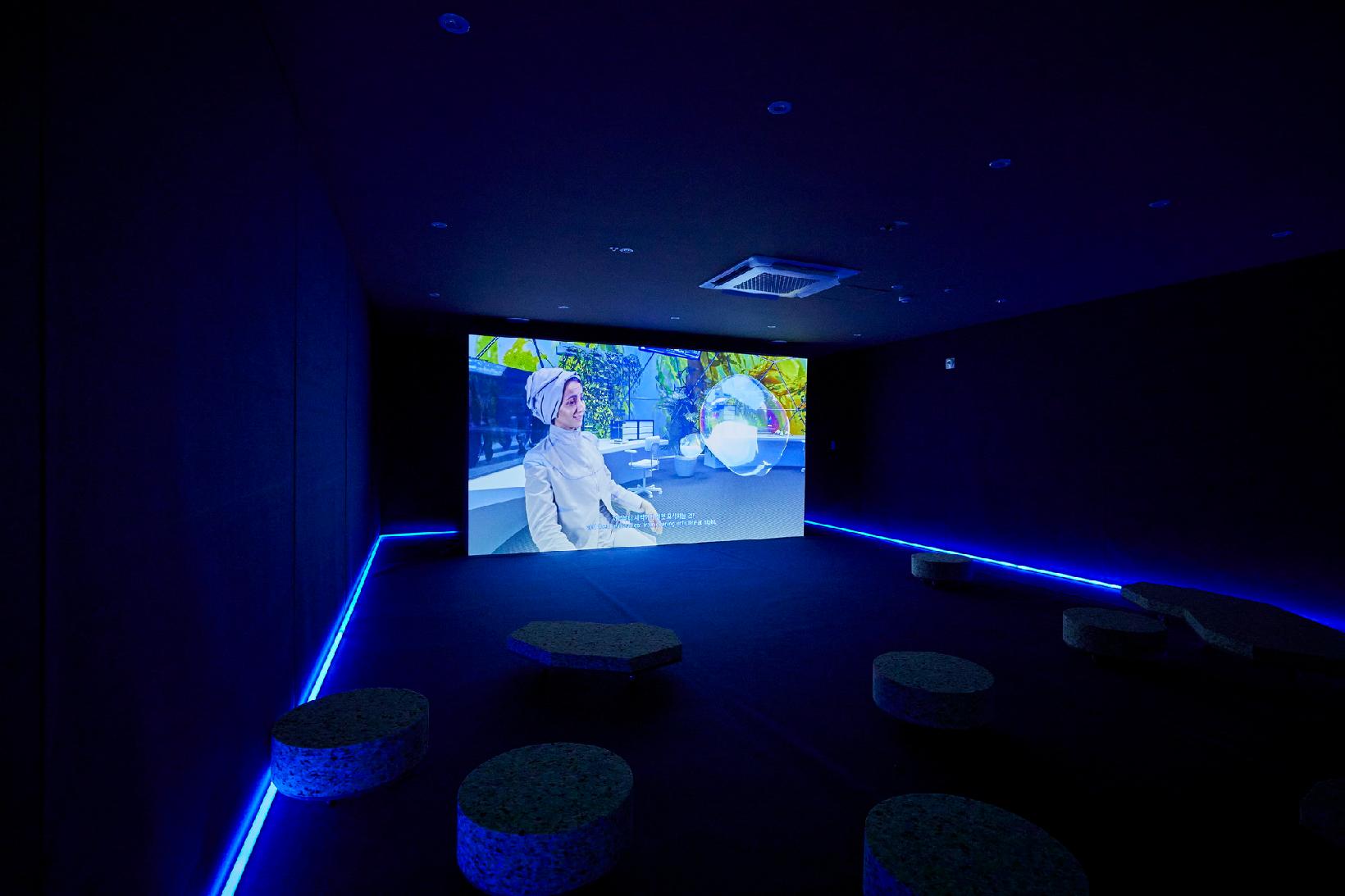
Valley, Portable Holes, we find that this video includes a mythical life form
known as “Petra” which lives in Porosity Valley. Forced to migrate elsewhere
after an unidentified explosion, s/he visits a migration counseling center and
awaits a decision on his/her migration — actions by a mythical entity that also
recall the situation faced by refugees today, who are forced to migrate due to
political conflicts.
4.
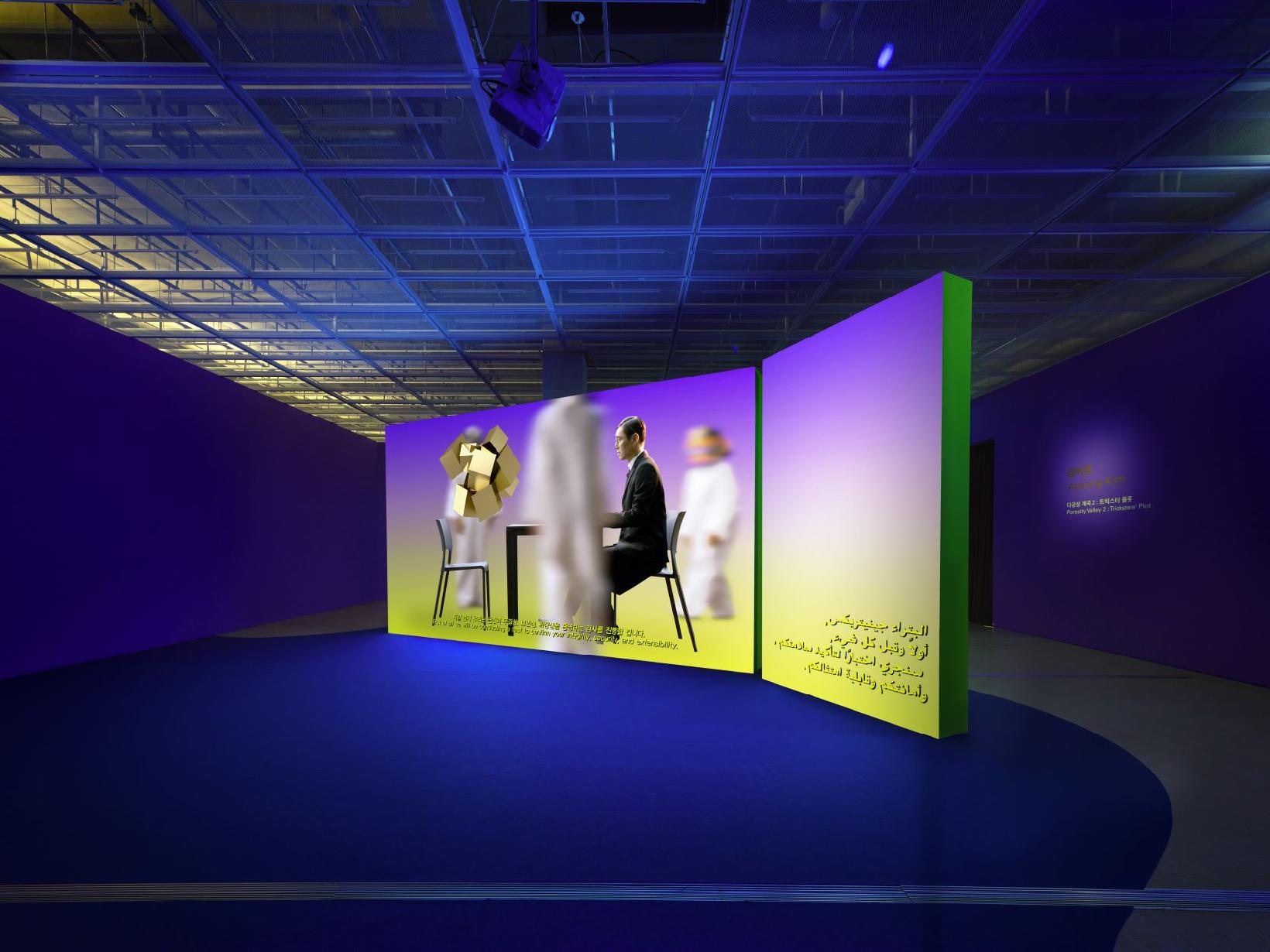
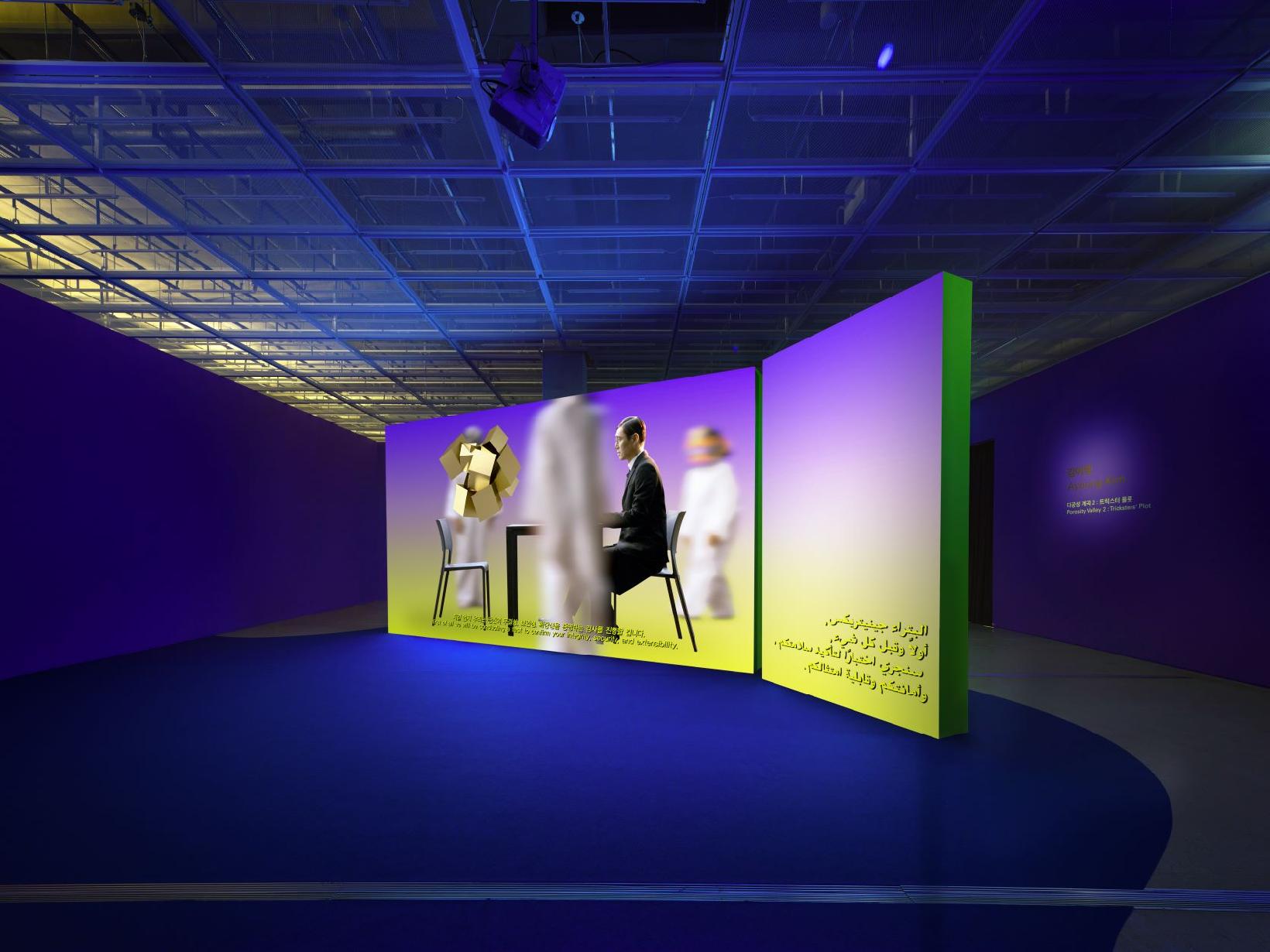
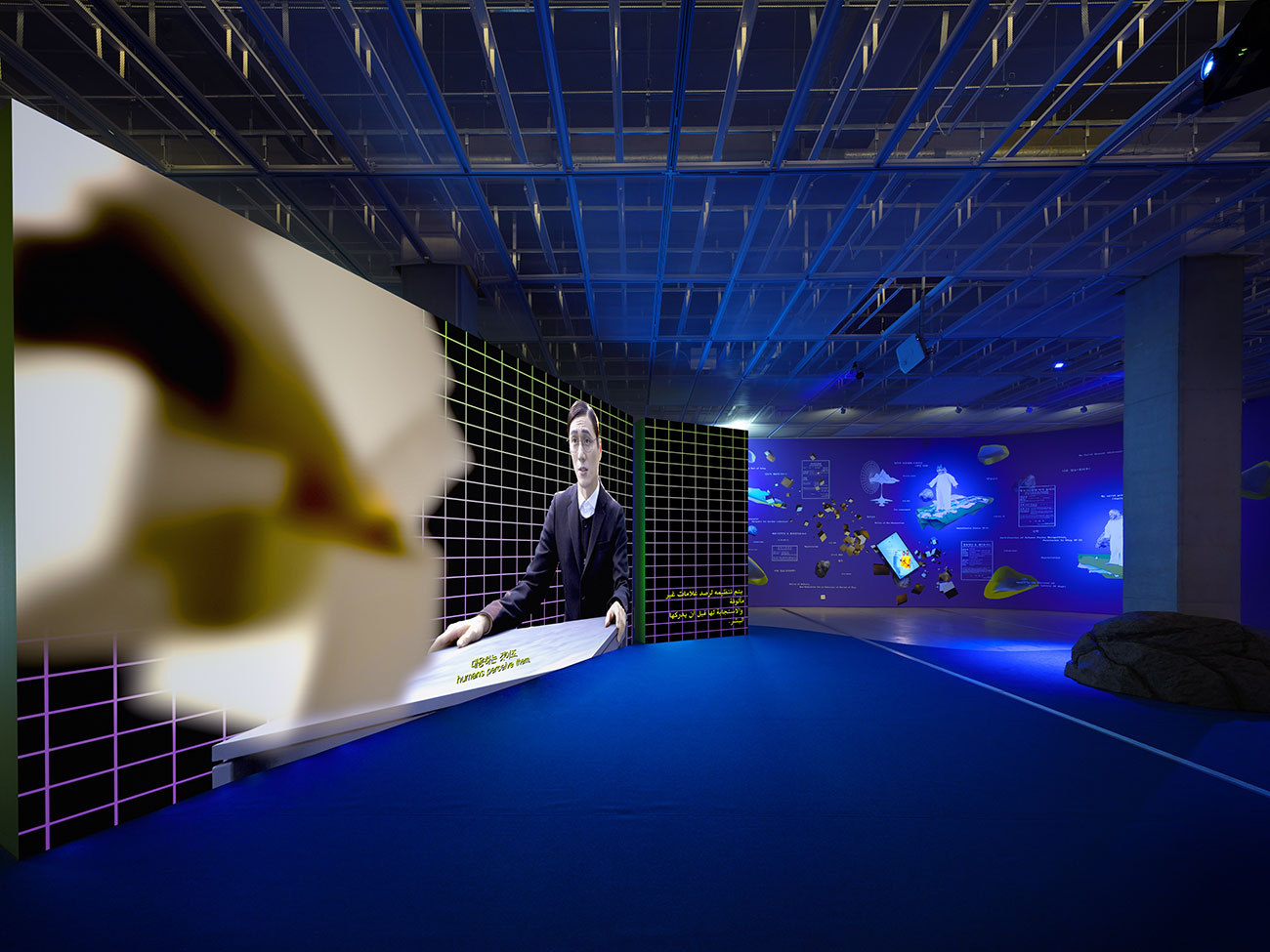
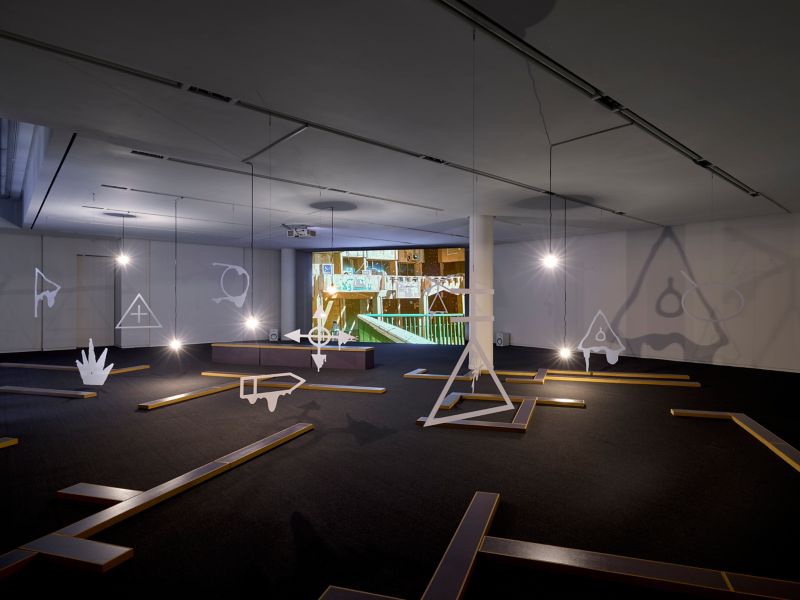
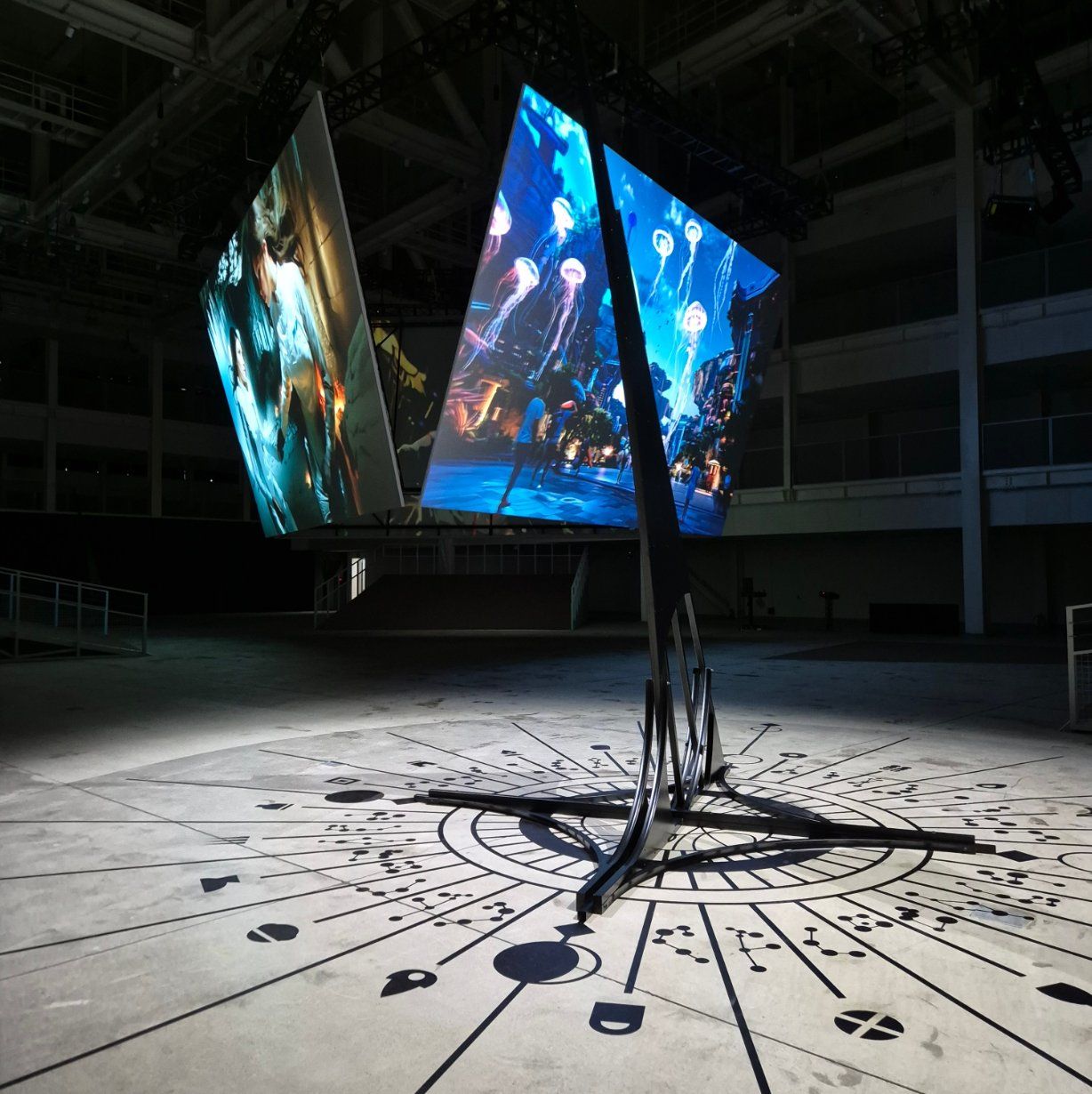
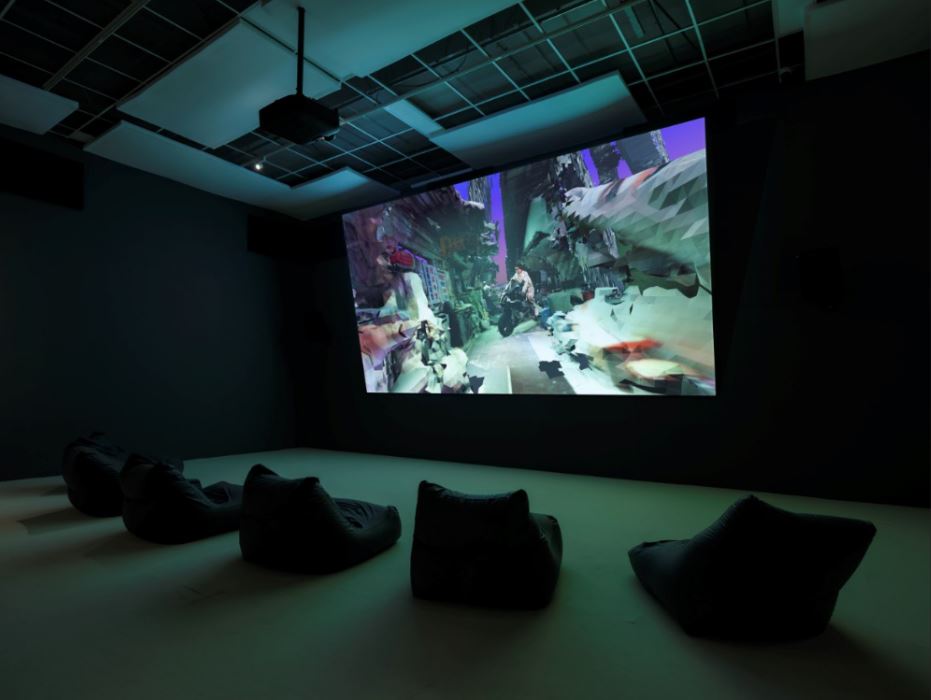
Porosity Valley 2: Tricksters’
Plot, which Kim presented for the Korea Artist Prize 2019, is an expanded
version of the Porosity Valley, Portable Holes that offers a more dramatic
extension of the previous work’s imaginary narrative surrounding “migration”
and its implications. Like the earlier work, “Petra Genetrix” from Porosity
Valley appears as the main character, and the narrative — a blend of classical
fable and futuristic Sci-fi centering on this imaginary “trickster” figure —
uses “data migration” as a way of invoking the contentious political issue of
refugee migration.
In addition to being more driven by imagined narrative than
its predecessors, Porosity Valley 2: Tricksters’ Plot also has a far more
complex story. The fiction overwhelms the documentary aspect, with archeology,
futurism, and Sci-fi imagination predominant over realism. On one hand, this is
a continuation of the same montage techniques, algorithms, and nonlinear
narrative used by the artist from her Ephemeral Ephemera series through Tales
of the City and PH Express and on to Zepheth.
On the other, she also
incorporates the tendencies of her documentary/fiction-leaning video works
since the 2000s — for which she has used fiction as a basis for reconfiguring
social and historical facts into a form of resistance history — as well as
speculative fiction and its use of science fiction to imagine alternative
realities.
Tricksters’ Plot, Imagined
Narrative
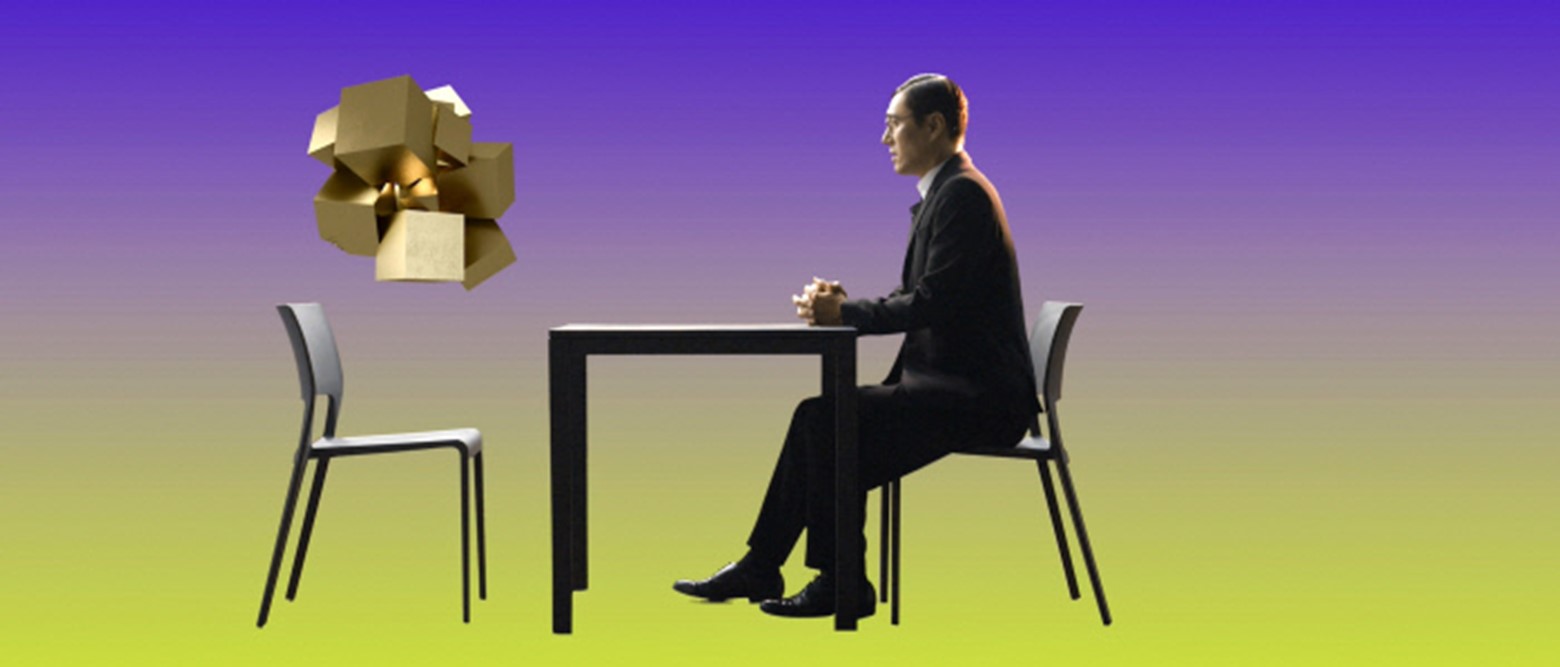
Petra Genetrix, the central
figure who figures in the beginning and end of the video work, is a kind of
data clusters deposited in Crypto Valley after an explosion in Porosity Valley.
Cubic in form, Petra is a manifold being that repeatedly divides, (self-)replicates,
and combines as s/he follows a dramatic video narrative of swimming through
different virtual spaces, traveling from Porosity Valley through a portable
hole and on through Crypto Valley, a Smart Grid, and a data center. Upon
arriving in Crypto Valley, s/he is classified as an unregistered alien life
form and submitted to a rigorous migration review at the Crypto Migration
Center; in the process, s/he receives the designation “non-recognized alien
migration applicant G-1-6-2564.”
The review process ends with Petra being
deemed an “abnormal pattern of life” — akin to a virus posing an ongoing threat
to the autonomous immunity system and security — and imprisoned in the Smart
Grid, a special region of Crypto Valley that serves as an alien life protective
custody center with round-the-clock monitoring. Trapped behind the Smart Grid’s
bars, Petra escapes by separating into cubes of different sizes and ends up
encountering the “Mother Rock,” a collective intelligence and transcendent
presence that connects the whole island together. The story ends with Petra
becoming a sublime, independent entity and a fully-fledged xenogenesis matrix
in her/his own right through biological hybridization with the Mother Rock.
The literal “trickster plot” that
Ayoung Kim traverses and redevelops into fiction with Porosity Valley 2:
Tricksters’ Plot is set against a backdrop that is both immemorial past and
distant future. The video’s narrative leads us both to infer the ancient past
350 million years ago (Petra’s date of birth) and to envision a futuristic city
where a Cloud Passage Integrity Program (CPIP) operates and daily life is
governed by the surveillance and controls of a Smart Grid. A peculiar world
where ancient past collides with unfamiliar future, it intersects with the
Afrofuturist world view merging ancient Africa with outer space imagery.
Whereas Afrofuturism has delved into artistic genres such as literature, music,
and cinema since the mid-20th century, recontextualizing Africa’s ancient
mythology into a futuristic vision while ironically critiquing the ethnicity
and gender issues faced by black people, Ayoung Kim’s video work Porosity
Valley 2: Tricksters’ Plot holds up a speculative mirror to our reality today
with a Sci-fi imagination that juxtaposes mythology with technology.
Kim’s
fictional narrative within Crypto Valley is not intended to prophesy or
represent the information age of the 21st century, as exemplified by its data
flows; rather, it operates on an imaginative level to twist the social
divisions and contradictions that surround the migration and refugee issues as
a way of critiquing the reality and examining an alternative reality. In that
sense, the Sci-fi vision that is presented in Porosity Valley 2: Tricksters’
Plot should be discussed within a context of “speculative fiction,” rather than
in science fiction terms.
Mirroring the Reality
Porosity Valley 2:
Tricksters’ Plot features numerous intricate hidden devices that
mirror reality. To begin with, the migration pathway that Petra Genetrix
experiences — a perilous process of migration, review, surveillance,
incarceration, and escape — mirrors the social issue of refugee migration at a
real-world level. In particular, Porosity Valley 2 has
its starting point in a heated debate that unfolded over 561 Yemeni refugees
who migrated to Jeju Island in 2018 to escape a civil war in their home
country.
Three Yemeni refugees that the
artist met — named Yasmin, Ahmed Aska, and Yusef al-Rami — actually perform in
the video, acting as a chorus and embodying entities such as “strata,” “waves,”
and “stones” that carry within them the earth’s own memories; alongside Petra,
they represent another set of protagonists driving the migration narrative. The
designation of “alien migration applicant G-1-5-3407” assigned to Petra by the
gatekeeper when s/he arrives in Crypto Valley corresponds straightforwardly
with the “refugee applicants G-1-5” classification actually applied to refugee
applicants in South Korea.
Crypto Valley,
the place where Petra undergoes her/his migration review, alludes to Jeju
Island as a maritime base region situated in an imaginary archipelago;
the Smart Grid where data that fail to receive
stay permits are kept in custody until their deportation from Crypto Valley is
modeled on the grid layout of the Hwaseong Immigration Processing Center, where
foreign migrants without permission to stay are placed in custody.
The cold lines of dialogue spoken
by the Crypto Valley gatekeeper to Petra — “If your review is not completed in
the next six months, the Crypto Migration Center will temporarily extend your
sojourn status. Once your eligibility has been confirmed, you will be implanted
with an Alien Registration Chip as part of CPIP — our ‘Cloud Passage Integrity
Program’” — call to the mind the rigorous refugee application system in South
Korea, where applicants must renew their humanitarian sojourn permit every six
months and only a small few end up receiving a visa.
Just as Petra has her/his right
to freely move about Crypto Valley taken away as an “alien migration applicant”
in Porosity Valley 2, so refugee “applicants” who do
not receive officially humanitarian sojourn permissions are left as unseen
presences, unable to belong to any system or take on any employment.
From Nameless Symbol to Mythical
Presence
The human dignity that is lost
when a being is substituted with a symbol for control and management is akin to
an “unfinished task” for Ayoung Kim to restore in the realm of art. When
refugees are referred to as numbers, they become like phantom presences in
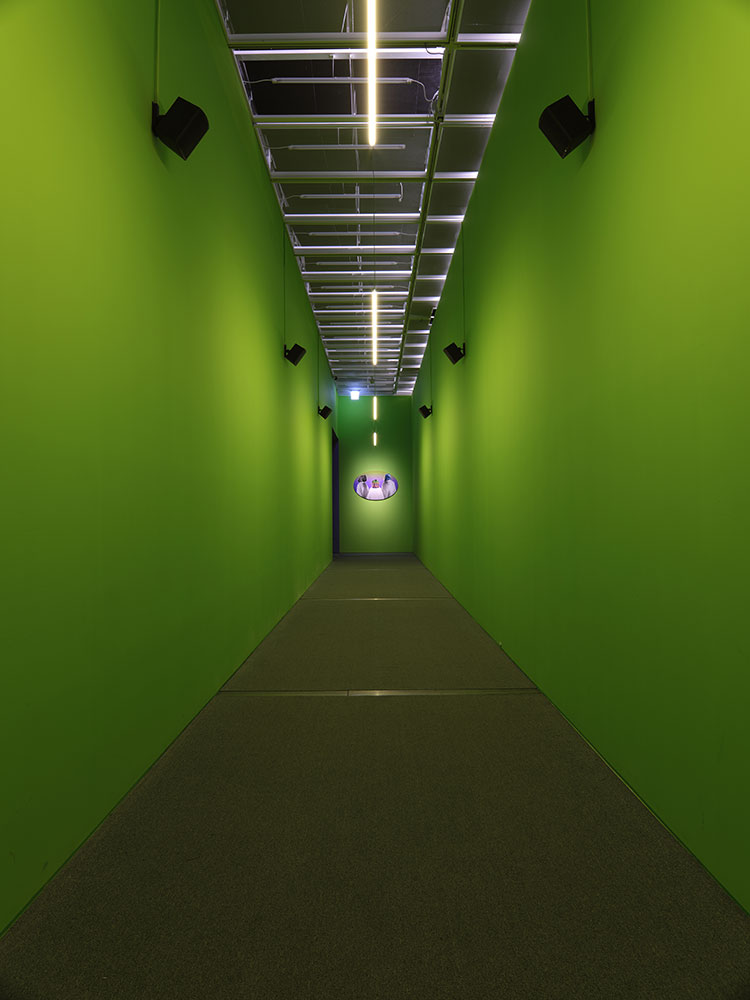
South Korean society whose voices have been stripped away. The long, narrow
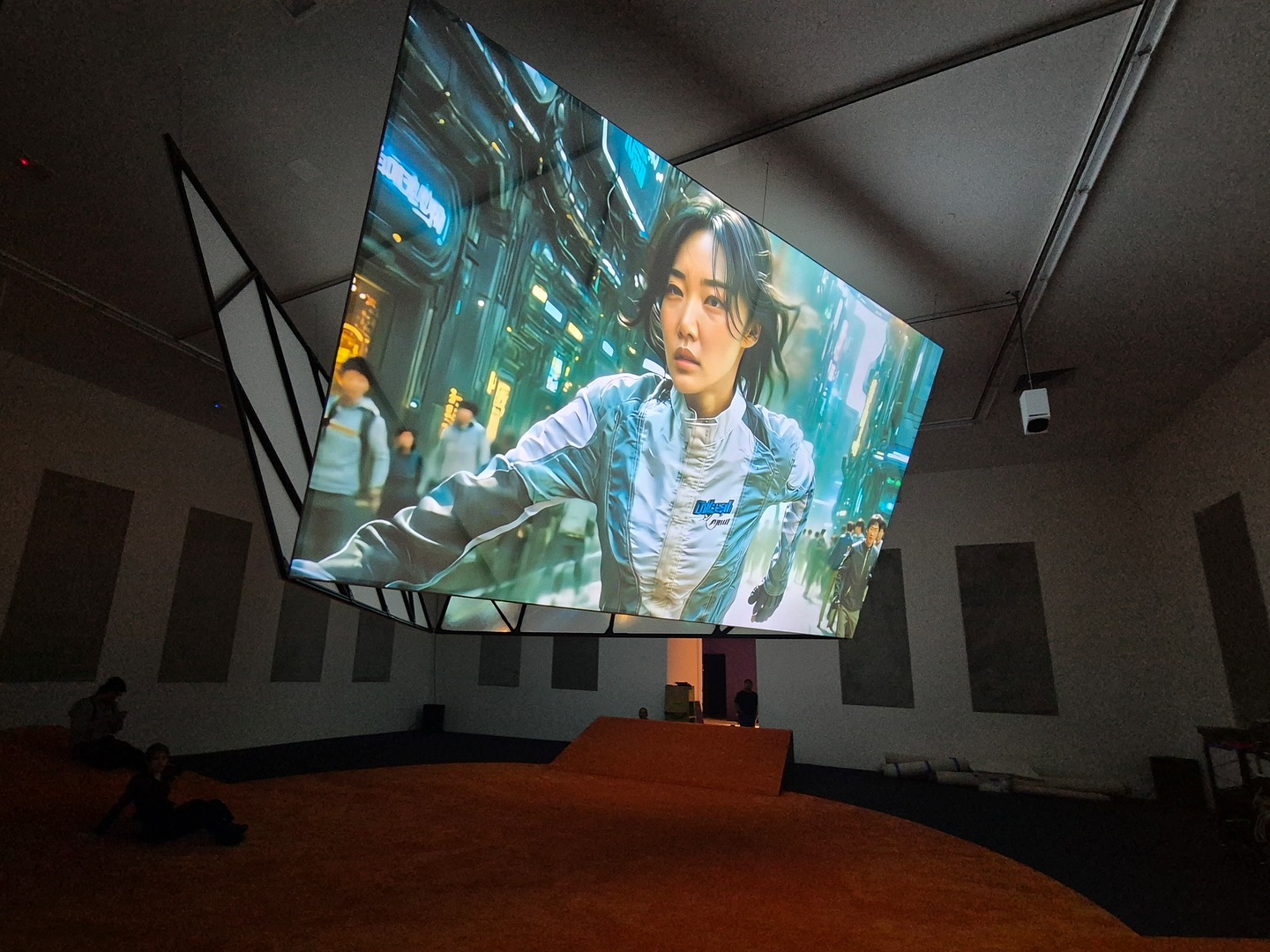
green path leading into Porosity Valley 2: Tricksters’ Plot is
reconfigured by the artist into a six-channel sound installation space blending
the voices of three Yemeni refugees. It is, in effect, a virtual space where
the uncounted — people who are denied a part of life — can make their voices
heard as political agents.
The artist has also conferred a
divine dignity to Petra Genetrix, a figure that drifts in the same way as the
refugees; indeed, the “Petra Genetrix” concept originates in icons of the god
Mithras, who was born (genetrix) out of rock (petra), referring to birth as
well as a “matrix” while literally signifying the “Mother Rock” that gave rise
to Mithras. “Petra Genetrix” thus carries the sense of a rock that gives birth
to a god — a mineral that carries life.
As both an ancient deity that has
successfully migrated and a divine, gender-defying presence that possesses
life, wisdom, and transcendence, Petra Genetrix serves in Porosity
Valley 2 as a dramatic medium representing the exceeding real
and political issues of “refugees” and “migration” in mythical and metonymic
terms. This is also the powerful mythical implication proposed by the artist
for restoring the identity of refugees who are denied dignity and left to drift
as migrants.
Crumbling Boundaries
The narrative of Porosity
Valley 2 ends with Petra Genetrix achieving hybridization with
the Mother Rock — a superintelligence, storehouse of memory, and general data
center that remembers and foresees all of Crypto Valley’s past, present, and
future information. Its immune system effectively weakened by inbreeding, the
Mother Rock has consistently asked for different forms of information for the
sake of its system’s stability. Petra Genetrix is like a vaccine that erases
this boundary of “inbreeding/hybridism” and strengthens immunity.
The mythic ending of Porosity
Valley 2 is a critique of South Korean society’s rigid hierarchy
and “pure blood” ideology, which shuns heterogeneity and “otherizes”
difference, and a reference to the possibility that abstract space dominated by
uniformity and heterogeneity might accommodate a “differential space” that
acknowledges discontinuities and fissures.
It is an open-ended conclusion,
one drawn from the experiences internalized by the artist over the years as an
“unstable outsider.” As they leave abstract space and enter differential space,
the genealogies of solitary figures — such as migrants, deportees, and refugees
— can become our own stories.
As we come to recognize more
complex modes of living than the imaginary community of “state/nation” and
reject the exclusivity of “pure blood” ideology, these lone figures — like
Petra Genetrix in the conclusion — can attain both political legitimacy and
divine dignity.