The Birth
of Lyric Combined Paintings
"All
painting is the art of space, and the history of modern painting has been
regarded as a struggle for and against space." — Barnett Newman
(1905-1970)
The
formative works of Kim Sooja show different expressive formats, such as
abstract expressionist style paintings, collages in relief, and sculptural
expression using objects. In her works, we see her tenacity for a handicraft
character, and for pure form in her sewing of cloth. They are lyrical
"combined paintings", which involve the true features of life.
Working
for more than ten years in collage, combining the techniques of sewing and
drawing with cloth, Kim Sooja has focused on reflecting life in her art. In the
early stages of her art, she pursued "pure abstract form" through
sewing cloth and drawing. From the beginning of the 1990s, she changed her
format into "object works in unity with life tools", pursuing open
form in three-dimensions. And through her works at the P.S.1 Museum in New York
City, she moved to three-dimensional works by which she achieved a
"harmony with given space", together with picturesque expressions of
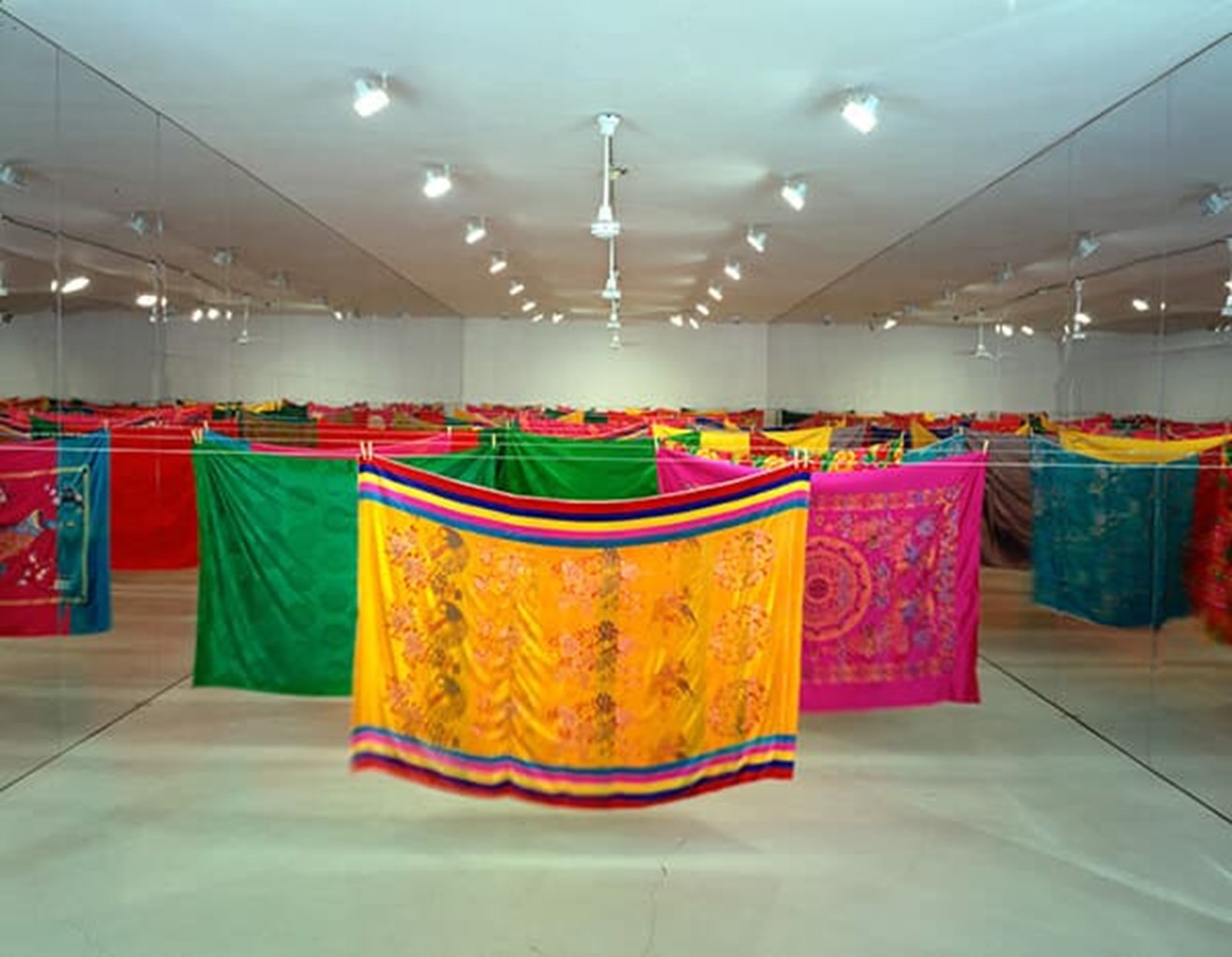
objects. Recently her works have evolved into installation works, which
accomplish a "unity with nature".
Kim Sooja's
work with cloth starts with the techniques of sewing and drawing. Her art life
started, she says, with the "unity of my thoughts, sensitivity, and
activity. They were caused by the everyday act of sewing bedcovers with my
mother."
Kim Sooja's
formative language comes from her tenacity, either conscious or unconscious,
for life. For her, formative works are life itself. She visualizes the essence
and specialty of life from repeated flower-patterned cloth and cloth striped in
red, yellow, and blue. Her formative language expresses not just simple sewing
but her internal world as well. Emphasizing the unity of the activity, of
sewing and her thinking, she makes them involve the "various memories,
pains, and affections which have been intentionally forgotten." For her,
this expresses "the meaning of desperate self-salvation."
Her
collages and object works, expressed in lyric abstraction, are intended to
sincerely expose her "tenacity and nostalgia for prototypical
things". After her sewing and drawing works, Kim Sooja's interest moved
from the two dimensional plane to three dimensions, to "object works
making unity with life tools", "unity with given space", and
"unity with nature". We find a sense of history and a feeling of
locality in the general character underlying her works — descriptions of many
unforgettable memories, beautiful colors and abstract forms of lyricism, and
experiments beyond the artificial frames of forms: there we can read a new
change in vision after Modernism.
Early
Sewing Works (1983-1988)
"My
object and installation works are extensions of the act of sewing." — from
Kim Sooja's Art Notes
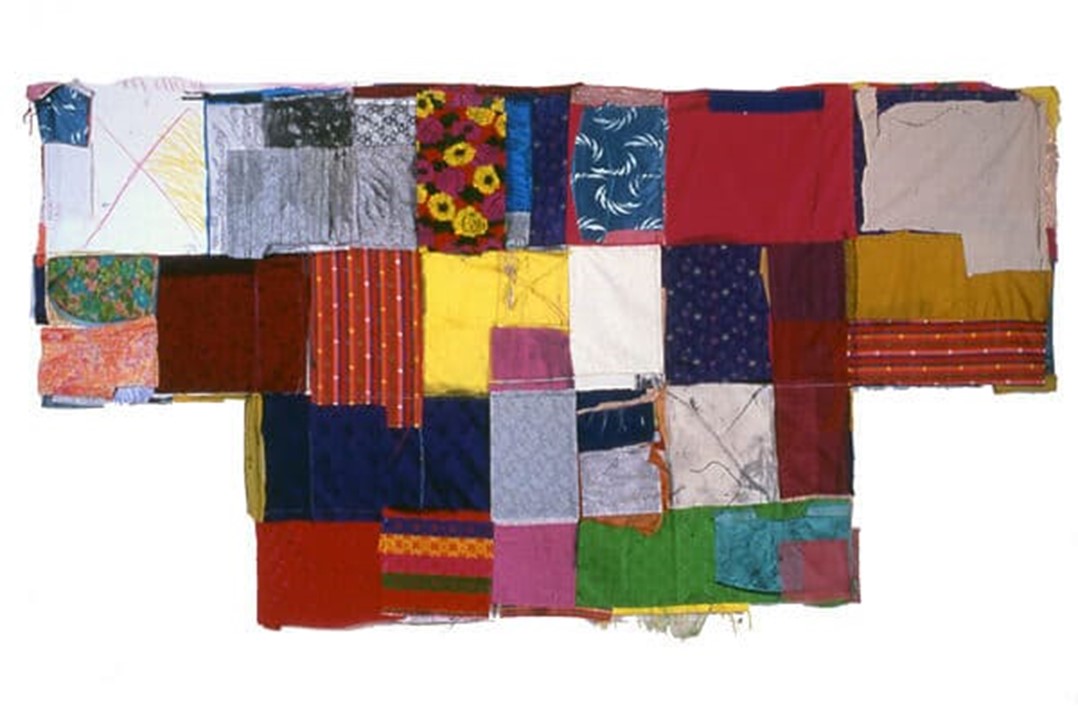
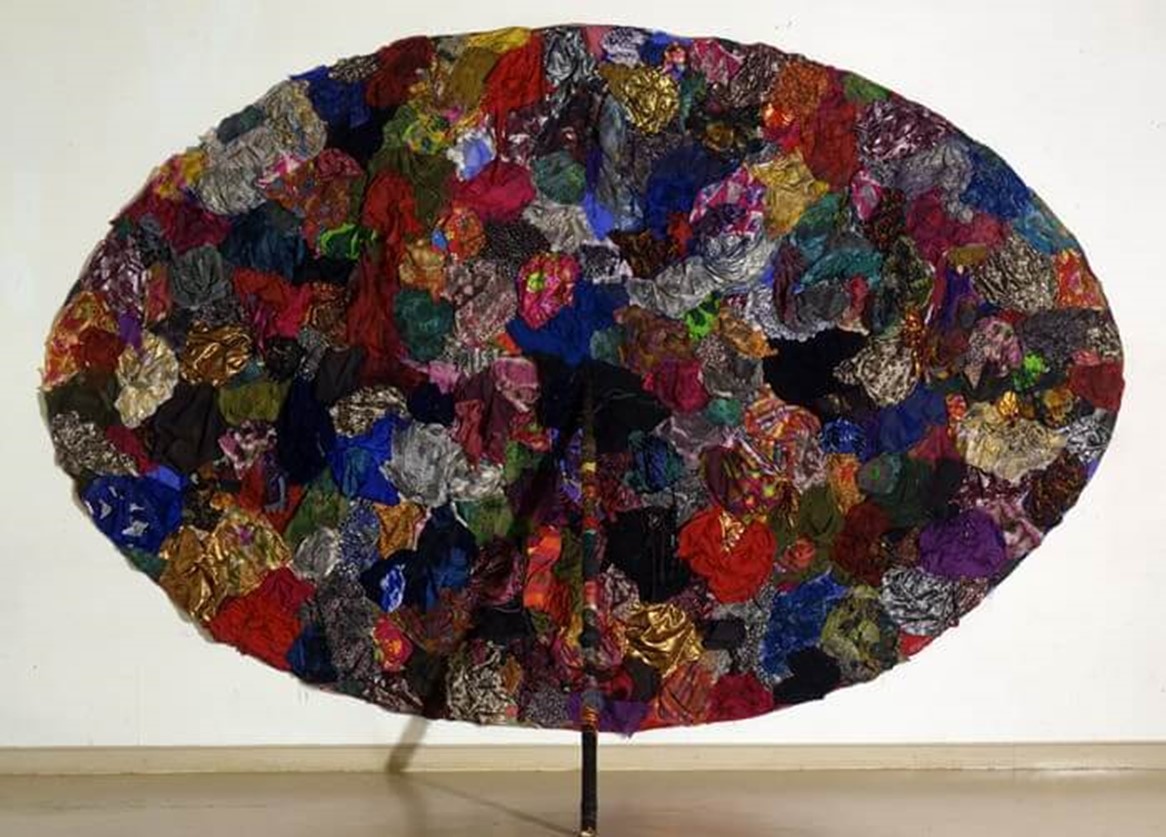
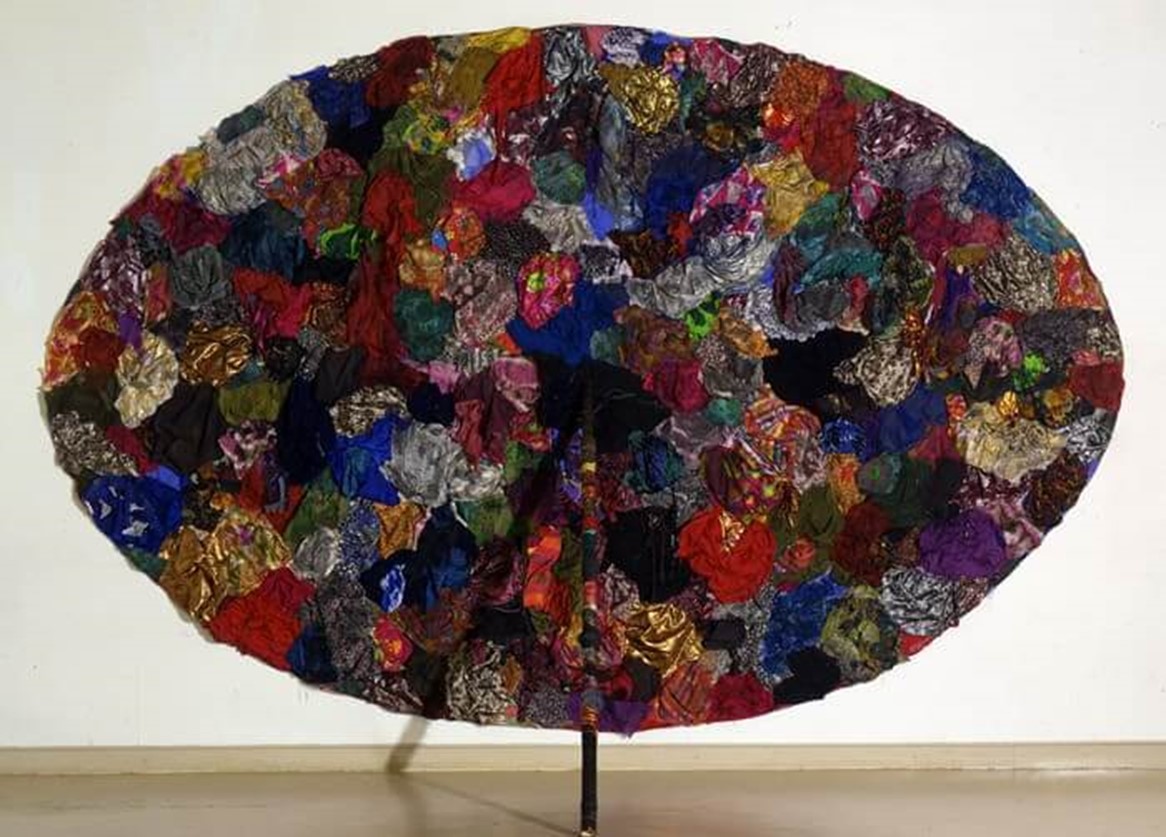
Kim Sooja's
early Sewing works, which she started in 1983, had a strong trend of color
plane abstractionism, free from frames. Trying to escape from the frame, but
still being attached to the character of the plane, has something in common
with Post-Abstractionism along the lines of Modernism. The quadrangular or
triangular patches of cloth she sewed show a strict geometrical beauty of
abstraction, and they make a picturesque world directly exposing human senses,
like that of Expressionism.
The color
plane of her Sewing works, like the structural relief, is neither concrete nor
descriptive. Viewers should be satisfied just by their pure formative
composition and various colors. Her Sewing works, with descriptive titles like
The Earth and the Heaven, The Earth, Portrait, and The Inevitability of Life,
continued until 1988. If we look at her works in this series, such as Fall 1983
or The Earth and the Heaven 1984, we can easily understand the evolution of her
art work during that period.
Kim Sooja's
colors are ready-made, artificial ones. The colors (red, yellow, black, and
white) are smudged onto cloth, and they reject any arbitrary happenings. The
features on her screen are also artificial ones in repeating patterns.
Moreover, she tries to escape from the plane of the frame and from quadrangles
in her works.
The above
works are variations of "combined painting". Kim Sooja's formative
specialty arises just from this. It is not constituted in a restricted space of
canvas, and it announces a birth of open space and open forms. Her canvases,
accordingly, escape from formal frames and restricted areas to acquires a
liberal way of thinking.
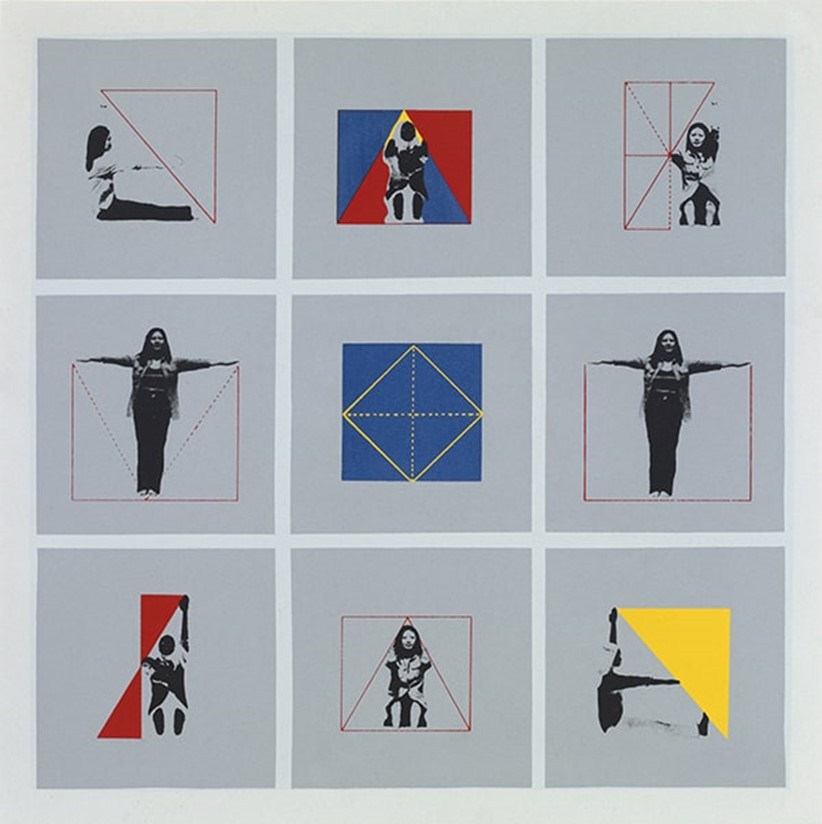
The
formative traits of her early Sewing series are irregular basic forms of
"X", 'W", "T", "+", or triangles. We come to
see various aspects of life from these unexpected basic forms. They are never
made by chance. Kim Sooja says, "They have something to do with the
homogeneous character of Korean culture, like the latticework of construction
and of letters." Variations of the basic forms make new spaces available.
Above all, "since it is a result of my wretched trials to overcome the
contradiction of existence, it means a desperate self-salvation."
The
unexpected liberal forms show, as completely independent abstract paintings,
the beauty of purely formative composition, and there we see a trait of action.
She wants to unify the trait of action with our identity. It can be called a
work of Modernism, in which a purely formative beauty is pursued in "the
paintings themselves" and it is also a creative formative language which
emphasizes the acts of human beings.
The Sewing
series continued during her study in France in the mid 80s. Representative
works of this period, like Blue 1987 and Black 1987, show more tension, with
heavy blues and blacks and with big quadrangular planes. The general feeling of
these is dark, from the big quadrangles and dark grey and black colors. But the
large and small mosaic color-planes pursue one goal in the open space.
These
works have a darker feeling than her early works, in which she portrayed life
more brightly. The divisions of the color planes are no longer clear.
Distinctions among planes are erased. Kim makes a formative search which
depends upon expression of the sense of Abstractionism rather than of spatial
composition. The cloth patches are not smooth as they were, and they portray
the pains of life like scars. The divisions of the color planes are not clear,
and the thick black color makes the bright planes of pure colors merge into a
melancholy sentiment.
Deductive
Object Series (1989-1994)
"Deductiveness
means reaching individual recognitions from general ones; inductiveness means
reaching general recognitions from individual ones." — Dictionary of
Philosophical Terms
From Kim
Sooja's early Sewing series, we see the problem modern painting has with
two-dimensional quadrangles. That is to say, it makes us realize that paintings
do not have to stay in the restricted frames of quadrangles. The peculiarity of
Kim Sooja's formative works are the various forms which have unexpected
transformations of space and which are free from quadrangles. But from the
point of view of form, we find that the transformation she tried to apply did
not overcome the two-dimensional restriction of conventional paintings. Though
she relieved herself from the forms of quadrangle picture frames, her works
where she keeps to two dimensions still force viewers to find an illusion.
When an
artist wants to establish a more concrete human relationship and present the
features of things in a way free of the visual imagination of illusion, he
chooses, without any hesitation, to get out of two dimensions into three
dimensions. This, as in Kim Sooja's non-illusionist Sewing works, bears a
peculiar formative language of the artist himself. It is an object of special
life which leads into individual recognition from the generally recognized
daily-life objects.
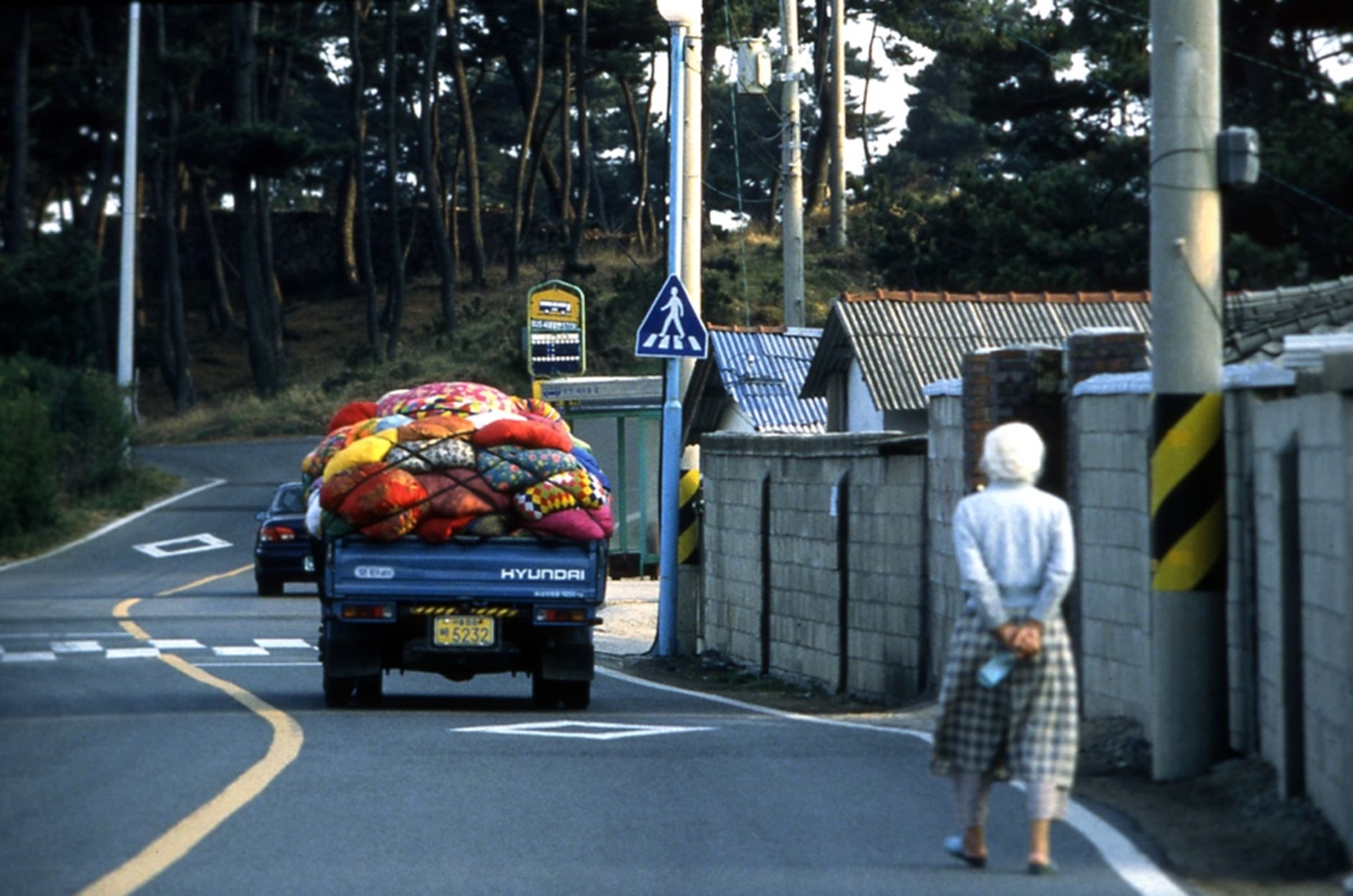
Kim Sooja's
Deductive Object shows folk customs and natural factors as they are. The
daily-life tools she chooses provide viewers with a unity with life, and makes
them feel the stream of ages-long time. In the 90s with Wall in the Wall and
Toward the Earth 1990-91, Kim Sooja started a new structure of formative works,
Deductive Object. She says that this experiment is an "act of
self-salvation resulted from the pressures of life", like the Sewing
works, in which she wanted to show Korea's unity and uniqueness.
The full
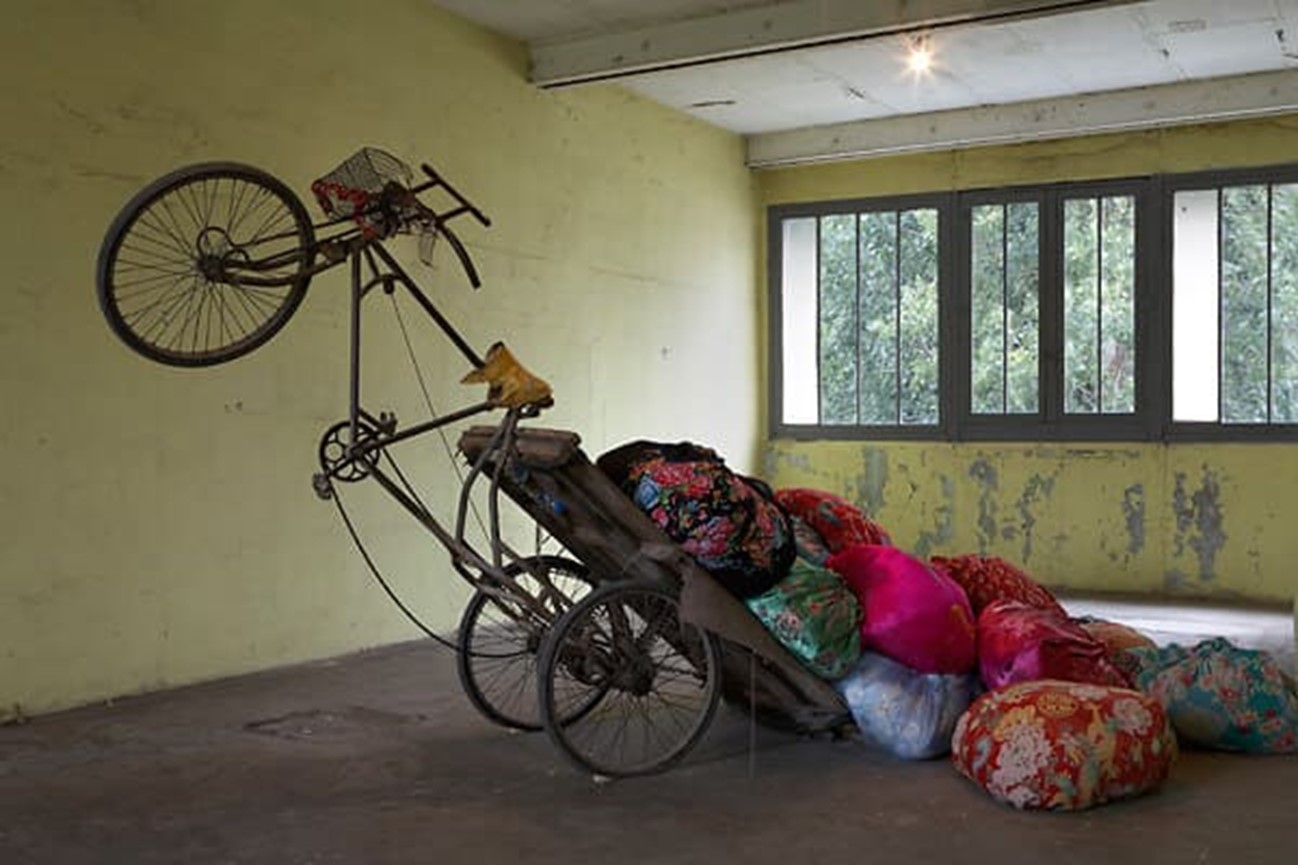
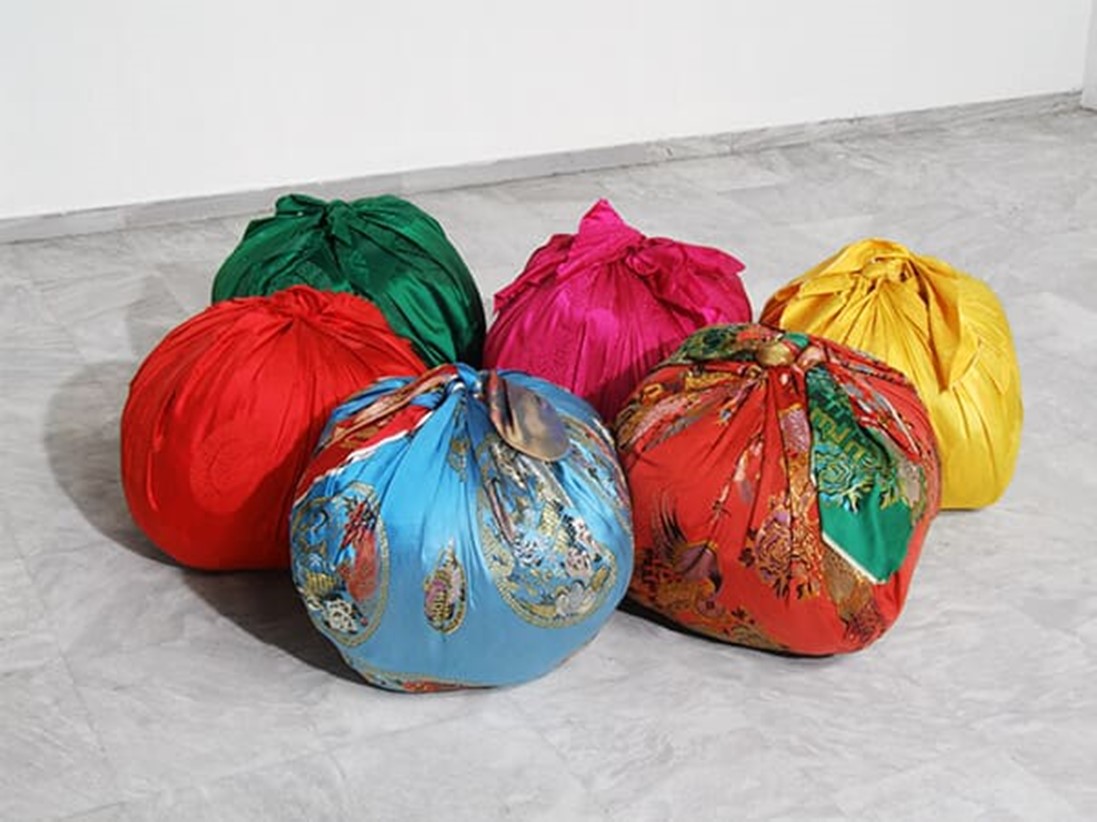
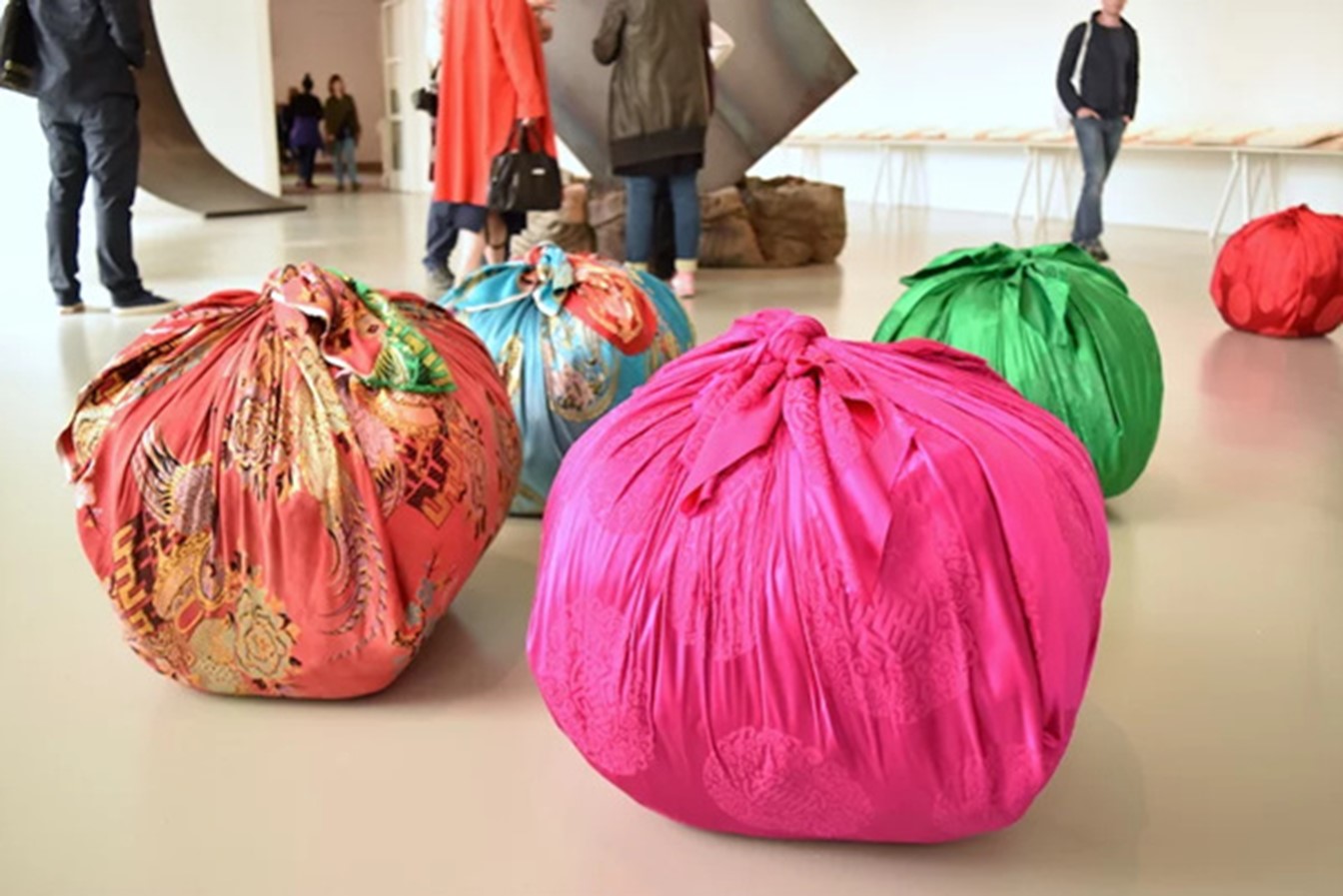
sense of her Deductive Object started in 1991. Many commonplace objects like
Deductive Object - Memory, Deductive Object - Reel and Spool, and Golden Flag
were made into works of special meaning. The meaning of objects and subjects in
her early works can be interpreted easily with their concrete objects.
Lattices, A-frames, kites, reels, small spools, and long pieces of
color-striped cloth are changed into objects of the Deductive Object and invoke
old stories.
"There
is nostalgia for village landscapes and trains and old and mysterious small
pieces of furniture and utensils found in the attic. Looking at that old stuff,
I find a structural beauty." This is a nostalgia anybody can have, but Kim
Sooja unbinds and breaks them up as if she were unifying knots and formalizes
them into concrete art works.
Not like
the Sewing works, which were full of hidden meanings and a search for abstract
pure formativity, the everyday objects in her recent works approach us as
independent figures. Kim Sooja takes old stories from the traditional tools and
changes them into three-dimensional structures, not into two-dimensional mosaic
paintings. It is what our daily lives are. They look lovely and even poetic,
inspiring our nostalgia.
When Kim
Sooja continued her work in America, at the invitation of P.S.1 Studio, a big
change in her Deductive Object occurred. Rather than being satisfied with the
classical expression of life, she pursued a unity with given spaces. Her work
began to consider the age she lived in. Though this was experimental work for
the short period of one year, it meant a struggle to search for a "unity
with given spaces" to actively show current life. Ladders, daily-life
stories transcending the character of time and space, American objects, exotic
colors, and some Korean features appeared in her work, and she tackled open
spaces in three-dimensional ways.
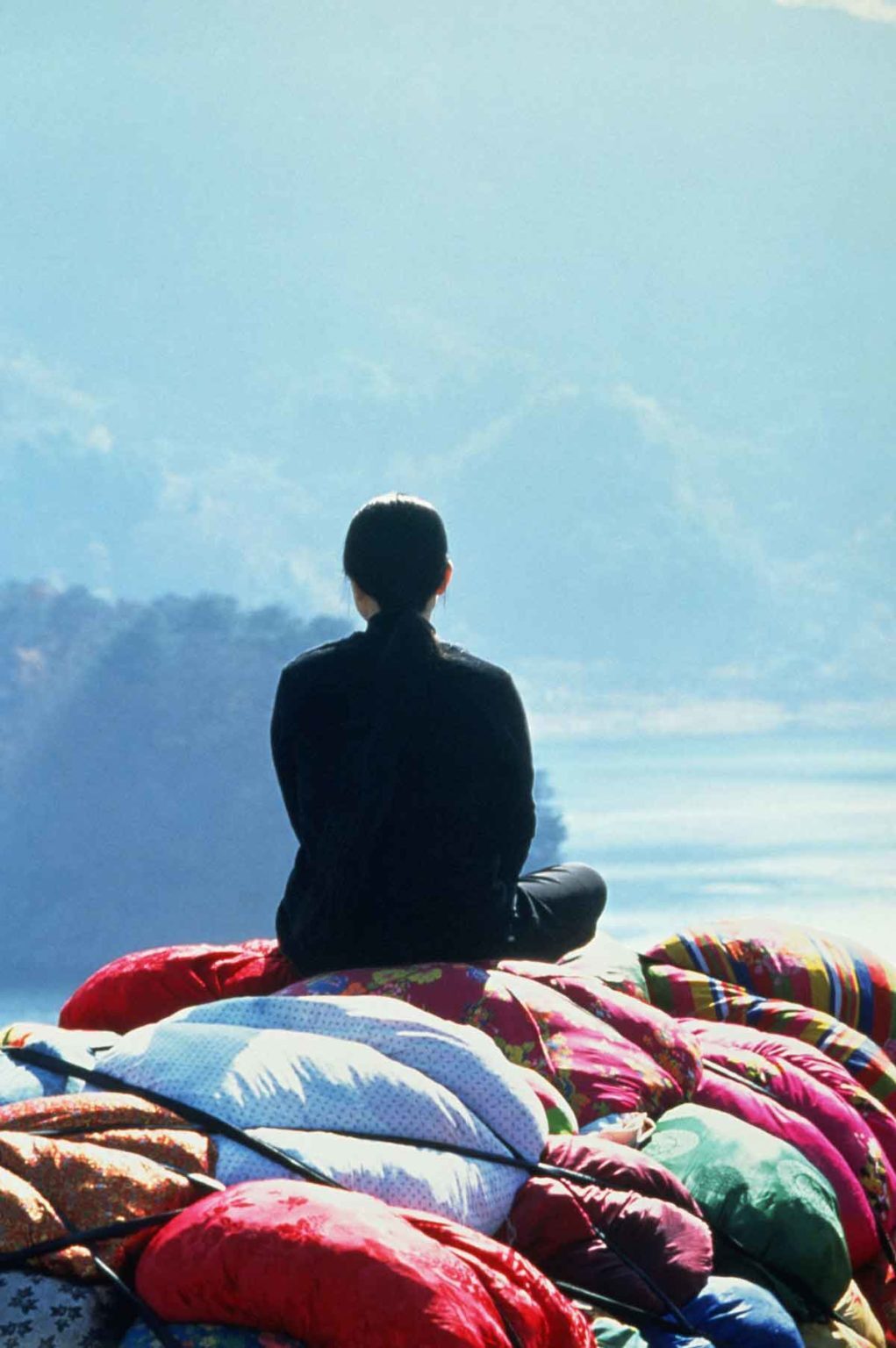
After she
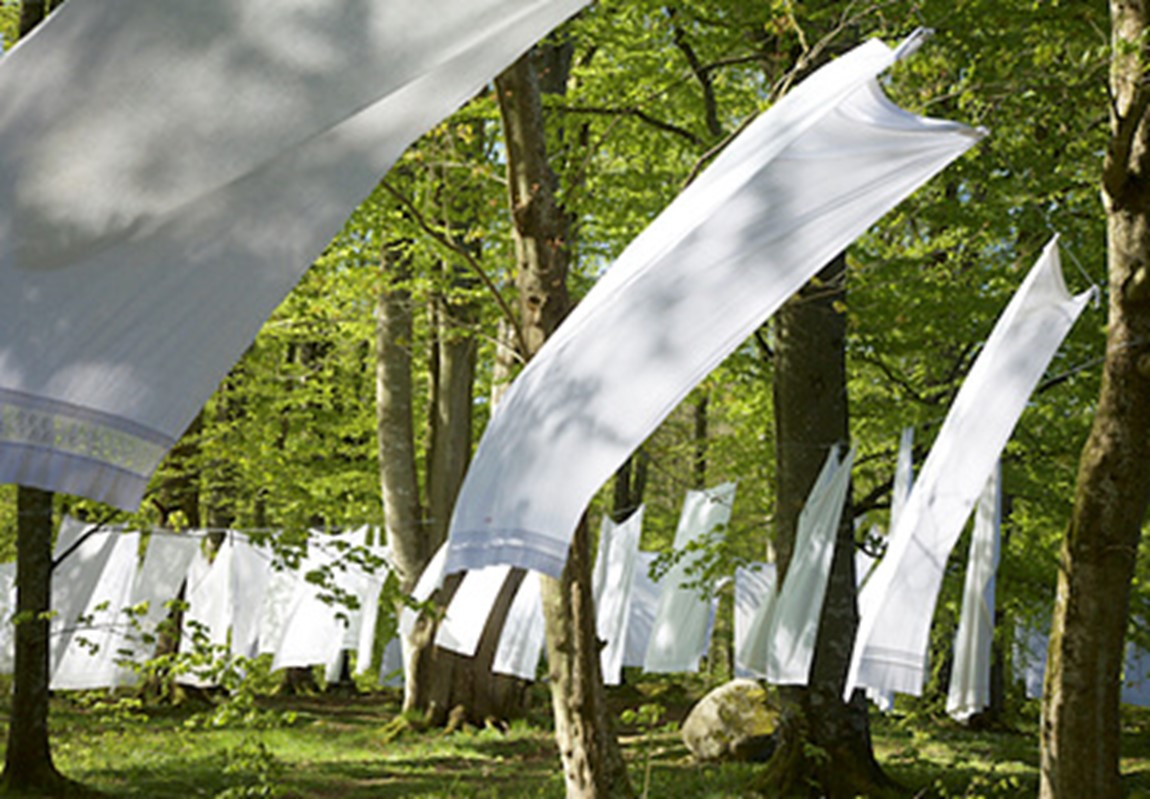
came back to Korea, these changes persisted. In her recent works, nature
appears in relation of unity with given space. It is not an accidental
encounter with nature but an intentional communication with nature. The unity
of human beings with nature is emphasized. Lying in the Nature 1994, which was
made in the valley of Oksanseowon in Kyungju, shows the unity of color-striped
cloth objects with nature. It is a feature of life which transcends time and
space.
Now Kim
Sooja's Deductive Object works have started in earnest. I think she wants to
revisit the past and also to emphasize current life. The endlessly changing
nature of Kim Sooja's pure forms show our past and present reality, as well as
the open world of our future.
In
conclusion, Kim Sooja's "combined paintings" — Sewing and Deductive
Object — might look unfinished. But they can be recognized as independent
formative languages which Kim alone possesses from her encounters with given
spaces or with nature. She does not stay still, and portrays the features of
life confidently. She frees herself from habitual aesthetic notions and
concepts, and portrays the features of liberal life. All of this make me more
attached to her works.
─ 『Soo-Ja Kim』(1994), Art Vivant No.21,
SIGONGSA, p.76