
To mark its opening on November 13, the National Museum of Modern and Contemporary Art, Seoul presented approximately 120 works by more than seventy Korean and international artists across five thematic exhibitions. Among them was an installation by Jung Seung composed of roughly four hundred stacked plastic fruit crates.

Designed as a structure on which visitors could sit and rest, the work combines a modular assemblage with a soundtrack of seemingly meaningless murmurs, projecting the complex layers of contemporary reality. By employing readily available everyday objects, the artist also invokes the industrial society characterized by mass production and mass consumption.

Incorporating elements of public art, the work uses infinitely reproducible fruit crates to reflect consumer society, while simultaneously twisting and questioning a reality in which individual identity and human dignity are consumed much like commodities.

A defining characteristic of Jung Seung’s practice is his transformation of industrial products into sculptural forms after stripping them of their original functions.

Through this process, he exposes the hidden irrationalities of a capitalist society driven not by production for human needs, but by production for the sake of production itself. This critical perspective can also be found in Spectacleless Complex (2013), a work the artist himself considers one of his most representative pieces.


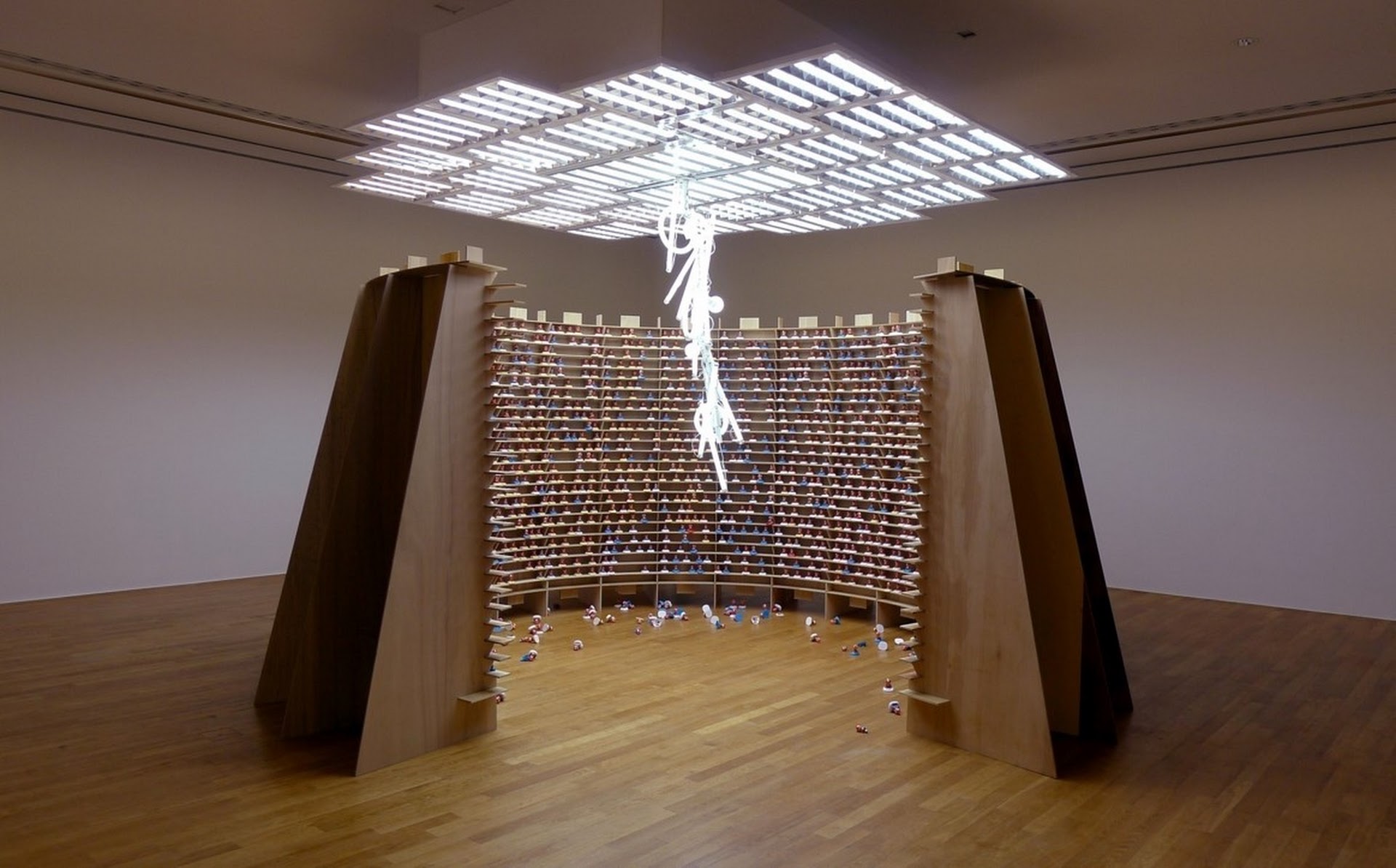
정승, 〈Spectacleless Complex (essaie II)〉, 2013, 노호혼 인형 2000개, 나무 구조물, 형광등 구조물, 600(지름) x 400 cm © 정승

Composed of approximately 2,000 Nohohon dolls—a type of figurine whose name connotes carefree ease—Spectacleless Complex arranges them densely upon a structure resembling an arena. The work is engineered so that the slightest movements generated as the dolls nod their heads gradually cause them to fall, one by one, to the floor.

In this way, Jung evokes the history of gladiators who perished in ancient Roman amphitheaters, drawing a parallel between those blood-soaked spectacles and a contemporary world in which survival often appears contingent upon endless competition.

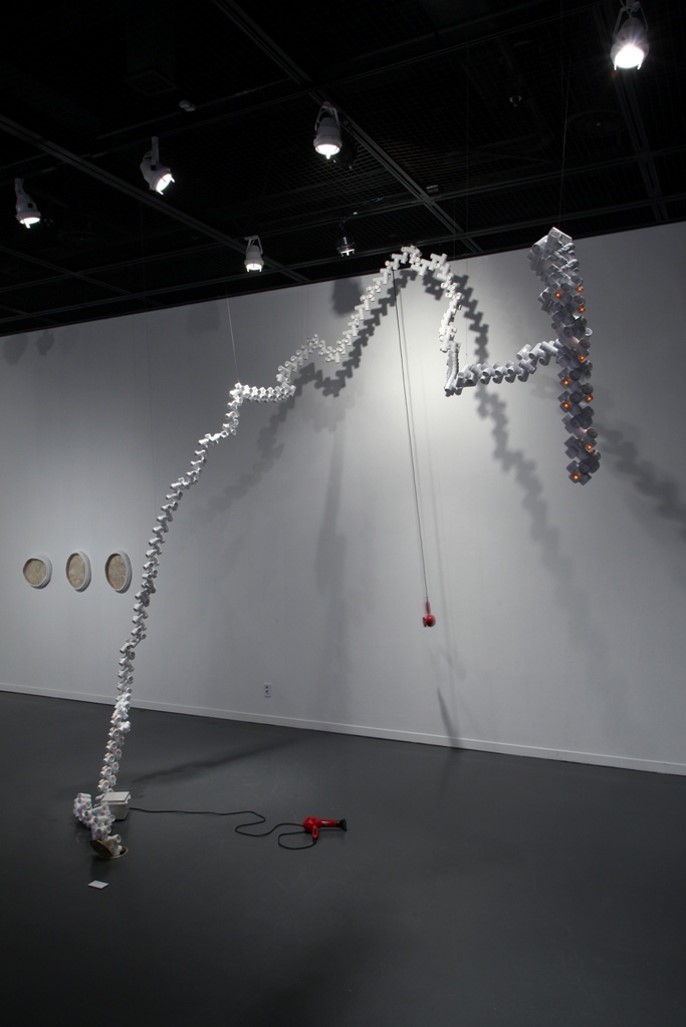
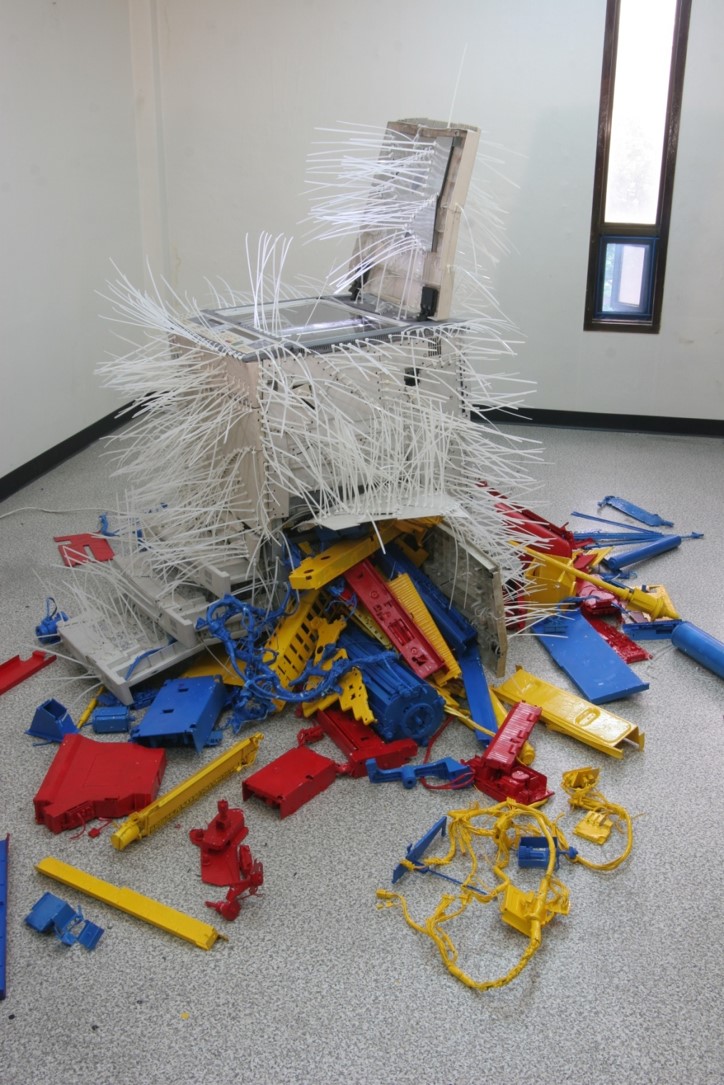
Spectacleless Complex differs from Jung’s earlier 'Automobile' series (2006), in which automobiles—the quintessential products of advanced technology—were cut into fragments and reassembled solely in outline using cable ties. Whereas those works addressed systems more indirectly, Spectacleless Complex engages more explicitly with the relationship between social structures and the human condition.

A comparison with earlier works such as 300 Chairs (2007), in which three hundred chairs were stacked into a contemporary Tower of Babel, or An Optical Illusion Of Contemporary People In Three Primary Colors (2008), which employed photocopiers as a metaphor for the age of infinite reproduction, further reveals a shift in the artist’s practice.

Rather than focusing exclusively on the forms of objects, Jung increasingly incorporates movement and sound—including the frictional noises of mechanical systems—to intensify the work’s spectatorial impact.

Through Spectacleless Complex, Jung examines the effects of capitalism’s mass-production system on the relationship between people and objects. Taking as its central concerns the systems of contemporary urban society and the alienation and powerlessness experienced within them, the work calls attention to the need for critical reflection on the anonymous structures that sustain, expand, and reproduce themselves.

The various objects that populate Jung’s installations function simultaneously as mirrors reflecting the absurdities of contemporary life and as stand-ins for individuals positioned like incidental props within the larger social order. The result is a mode of critique that is at once metaphorical and unsparing, one that reconsiders the role of art through a clear-eyed examination of reality.

Visitors to the opening exhibition of the National Museum of Modern and Contemporary Art, Seoul—which had been ambitiously presented as a landmark inaugural event—voiced criticism of certain sections of the exhibition, asking whether they amounted to a “Seoul National University alumni exhibition.”

The event became further embroiled in controversy when allegations emerged that works by specific artists had been removed under pressure from the presidential office. One is left to wonder whether the irrationality and anonymous structures that Jung Seung has persistently interrogated throughout his practice had, in fact, also cast their shadow over that institution itself.

References