Introduction
Regardless of the times, the most urgent and the most important rarely refer to the same. On the one hand, urgency is clearly proven through the voice of the majority driven by its many requests or rallies. Sometimes, importance comes from being obvious or urgent.
On the other hand, what is important does not always seem urgent. If we may deem “classics” those works that the public has revered since their birth and celebrated time and time again, then it could be said that there must exist something that has always been held important in art.
In other words, what is important remains important even after hundreds of years, standing separate from the specificity and preference of the subject, who assigns and calls for this importance. If there is one important value that has stood the test of time in the history of art, it must be newness.
Newness has been experimented with, exploited, challenged, and considered cliché, only to be resuscitated and endlessly discussed thereafter. Newness in art has not been a value strategically required for social transformation, cultural discovery, or overthrowing tradition, as there is innate motility sufficient to instigate newness itself. Therefore, newness can be considered a classical value of some sort.
Then what can be said about the proposition that there is no more newness? Is it a manifestation of arrogance, a kind of renunciation, or merely pedantic rhetoric? Given that art is not created for the sole purpose of serving newness, the arguments run extreme on either side and may have been exaggerated.
Nevertheless, judgment on what is new is inevitably fraught with immense limitations based solely on the experience and knowledge of those who make the judgment. This signals suspicion that “I,” the sensory receptor perceiving and interpreting these senses, may have become outdated myself while accumulating various experiences over the years.
Furthermore, “I” can stay alive for a mere one hundred years. Even if “I” tried, no way could “I” obtain full knowledge of the past 2,000 years. This renders “me” insufficient to judge whether an artwork will become a classic in the future. In such a sense, artists might be those who must strive to be both the most trusting, especially when it comes to the senses, and the most excluding of themselves.
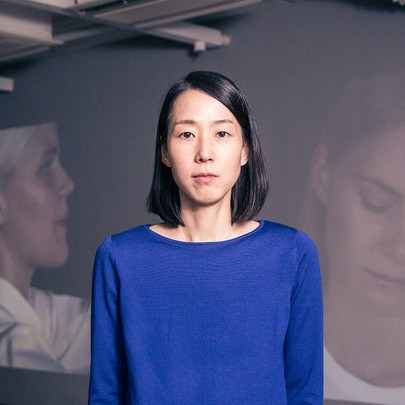
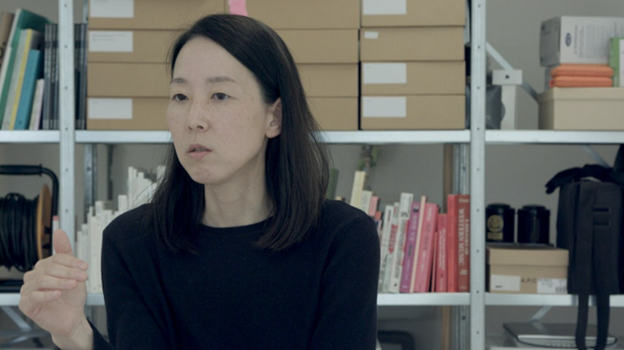
Oh Min is one of those rare artists who continually strive to expand their scope of knowledge while not hesitating to question what they supposedly know. Her expansion of knowledge does not necessarily pertain to the time that has yet to come, nor to the time that has already passed. Such tendencies make the system of knowledge she is constructing all the more distinctive.
In a way, it seems as if she has a sense of mission, although, interestingly enough, one without a goal. More precisely speaking, the lack of any goal makes her sense of mission all the more interesting. The goal here refers to something beyond reaching fulfillment and being fulfilled by a certain action.
It refers to employing action as means to earn something, a result entirely separate from the pure joy that arises from the action itself. For any human in
action, and for an artist in particular, technē and methodos, as well as action and choice,1 carry enough meaning as is. That is why we are curious about the motivation and process behind her actions, what she seeks, and what she tries to avoid. This writing follows artist Oh Min’s perspective on art, her attitude and point of view, and her practice and program.
The writing also attempts to answer the question “Would it be possible to discuss all of Oh Min’s works without listing the inherent uniqueness in each and every one?”
Technē and Methodos, Action and Choice
“So if what is done has some end that we want for its own sake (prakton),
and everything else we want is for the sake of this end;
and if we do not choose everything for the sake of something else,
then clearly this will be the good, indeed the chief good (ariston).
Surely, then, knowledge of the good must be very important for our lives?”
― Aristotle, Book I, Chapter 2, Politics as Master Science of the Good, Nicomachean Ethics2
Oh Min has always said that musical performance is her mother tongue. It is difficult to tell how proficient she is in her mother tongue, or whether she still has affection for it, from such a statement alone. However, as inherent in the origin of the mother tongue, it is possible to surmise that the artist would have spent a long time in such a language.
That would have been a process of refining her body and thinking with the perspective and attitude of a performer. So what is this perspective of a performer? How does it differ from the attitude of a painter or the perspective of a sculptor? It is alike in that all three involve practice. Nevertheless, the resulting sound makes the performer’s practice distinctive.
Heavily impacted by the “passing of time,” sound is made only to disappear, which is as natural as the providence of the universe. However, this disappearance of sound — or, in other words, the direct confrontation of the passing of physical time, inability to fabricate indestructibility or leave behind visible material, and the world of musical performance that cannot pose as infinite — seems to have left Oh Min with a notable question: what is really happening while time passes?
Oh Min has been asking whether art has accepted time as its material. Given that history and time are inseparable topics in art, what made such a question possible? Oh Min seems to refer to time in art as the “notional idea of time,” such as implied time, time accumulated as depth, time not exposed, nonlinear time, stopped time, and time not heard.
Such a notion of time has indeed served as an essential factor that has given birth to exciting works. However, it seems Oh Min could not overlook the cruelest aspect of time, the changes it creates as each minute and second pass by. Then what is “time as a material” to Oh Min? First, we must look into her definition of art materials.
Historically, art materials have expanded from those traditional and physical to the intangible, such as light, sound, or movement. Oh Min further adds, “Representation in art incorporates events, history, and culture as its materials, which indicates that content matter or themes can also be considered as material.”
She continues by saying, “Forms, questions, and reason are also in the realm of material,” stating with certainty that “understanding the properties of a material as well as an artist’s attitude towards it is part of material research.” If so, what are Oh Min’s thoughts on the form of art?
She says, “Form can be understood as physical, conceptual, and historical relationships established among expanded materials, as well as the organizational structure resulting from such relationships.” She also adds, “Form offers a chance to glimpse into the method of reflection, as a tool and result of said reflection.”
In other words, for Oh Min, art materials are not limited to matter based on visibility. Her materials are both complex and pure in nature. Including gestures of the practitioner, thoughts of others, and audience experiences, she takes on materials that are in realms impossible to control or fully comprehend.
Such an approach fundamentally differs from the conventional, which had simply accepted the result of an uncontrollable event as a work of art. Moreover, to Oh, form goes beyond a frame that holds its content. Not the work’s outer appearance or its concocted method of communication, the content itself becomes equal to its form, as the work’s essential and true nature.
Then the artist’s technē and methodos, actions and choice, can finally address art’s material, form, composition, and relationships. Such a conversation begins with the artist’s self-definition, although, of course, such a definition never reaches completion. This impossibility may be said to be the drive that generates art or the immaculate pursuit of art.
Sufficient Conditions for a Radical Relationship
“The dividing line between authentic art
that takes on itself the crisis of meaning
and a resigned art consisting literally and figuratively of protocol sentences can be found in the following.”
— Theodor W. Adorno, Aesthetic Theory3
The most radical politics does not have an objective. This directly equates to the artist’s attitude regarding her reflections on the relationship between materials. Oh Min frequently questions the “equivalency between sensory materials” and the “state when nothing serves as a background for another.” The “equivalency” here must be examined. Equivalency is not a movement that negates the hierarchy of social status.
Treating variable materials as equal, alike, or impartial is identical to not making any difference; it is a declaration of refusing to make anything. Ultimately, relationships between the sensory materials are independent, considering the validity of unique properties that create their unique differences. It is only mutual recognition and deep understanding of each other that sustains this independence.
Therefore, “equivalency” becomes a sufficient condition for the pure pursuit of a holistic sensory state. In other words, the truly greatest of politics, in which actions without any purpose densely overlap with one another, is the state of “equivalency.”
In such a set-up of radical relationships, then, what conditions should be considered? Oh Min seems to begin her questions with those dependent or essential relationships that have been considered as given. A question such as “Is sound essential to music?” makes one wonder what conditions are necessary for something to constitute music. Such a method of inquiry leads to many relevant questions: Is image essential to art?
Is structure essential to reflection? The way of asking such questions puts a brake on almost everything we had deemed “natural.” It raises questions about common sense and conventional wisdom that construct our experiences, a process that is in itself a radical model of art. However, Oh does not stop at this radical gesture.
Satisfying an expanded notion of material and a radical conception of form by themselves are not enough to be discussed as art. In today’s exhibitions, however, “artists” seem content to call an arrangement a composition. Too often do we witness artists succumbing to this inertia of false self-satisfaction, calling a combination a creation.
The difference between experimenting with a role and abusing an appellation lies in how the composition of materials has been constructed. Oh Min says that composition is “a process of defining relationships between the materials within the frame of rationality within a complex activity of accepting numerous variables.
Composition comprises all large and small conceptual or actual relationships forged between the expanded materials within the expanded form, including the acts of choosing and deciding to form such relationships. It is about defining the movement’s relationship between the creator and the material that does not cease, not knowing where it is headed.
Composition is a collection of motility that encompasses the entire selection process of creative work.” What choice, then, do we face when confronted with artwork that is a collection of such uncertain motility?
What Do We “See”?
“I imagined a sock that, as it was being taken off, had been turned inside out;
but only in part, for its inside and outside to be seen at the same time.
I also supposed there was a constant motion that, in fact, stayed put in its coordinates. Meanwhile, I thought of a tree in a garden too, trimmed in such a way that it was difficult to distinguish the parts untouched from those that were cut. Inside and out; before and after; natural and artificial.
I pictured having two independent things in a state intertwined with one another, so complicatedly, intricately, and neatly that attempting to distinguish between the two becomes meaningless.”
— Oh Min, Jinan Kang, … 57studio4
Recently, I have often thought about literacy. Literacy has its basis in communicated language that is, in turn, predicated upon collective promise. Hence literacy also impacts how we perceive and think about the world.
While language is composed of letters and sensory information, there is more to understanding a language than simply looking at letters or taking in sensory information through our eyes. Reflecting what we see and understanding what we hear signifies that a reconstruction is taking place. Thus, literacy perhaps entails seizing a time in passing and inserting it into the area of understanding.
Then, what do we say the difference is between seeing something visible with our eyes and “seeing” what exists or occurs beyond the visible? The latter essentially describes “thinking.” Of course, “seeing” here refers to sensing all vibrations that come flooding in from the world onto our skin.
The act of facing time, thus, equates to watching some narrative. More coarsely put, time itself is a narrative, one that is constructed to be apparent and stubborn and discerning between microscopic yet massive discrepancies. And our way of understanding the nature of this narrative determines our way of perceiving time.
The creation and understanding of a narrative require many abilities. We must recognize that time flows in its construction while also connecting between the before and after, as well as the inside and outside, by mobilizing all our memories and imagination. When these connections are made smoothly, we regard their result as a conventional narrative.
For example, we are very quick to grasp the narrative of pop culture. It is familiar and predictable when it comes to creation and reaction. However, there are times when we have to mobilize everything, including our perception, cognition, reflection, knowledge, and imagination. For Oh Min, a narrative signifies “a flat structure and flow of time” and a texture “a vertical structure and synchronicity of time.”
Viewing Oh Min’s work is a process of confronting a mass of such narrative and texture as one solid world. In this world, therefore, there is an immense difference between “merely existing” and “existing while seeing.” Such a difference depends on the sensing individual.
Because seeing is equal to constructing in this context, Oh Min’s “synchronicity” can be seen as being constructed in reality and disintegrated by the sensor. Disintegration, thus, means reconstruction. The processes of remembering what we see, anticipating what we will see, and constantly slipping away from what we see are all open to infinite possibilities.
Impossible completions and open decisions
“There is a coexistence of two concepts in Études: ‘practicing’ and ‘ending.’”
— Oh Min, Études5
Oh Min once made a point of saying that “the opening of an exhibition does not necessarily denote the completion of the work.” Artists are often asked to determine the completion of their work, whether it be painting or sculpture. How do they know when their work is complete?
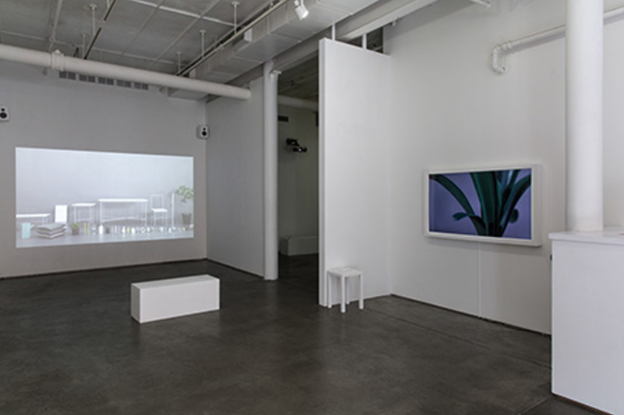
Often it seems that they judge by their “satisfaction” and sense of “sufficiency.” For Oh Min, however, the word “completion” seems to be a synonym for “variability.” It should be noted that Oh Min decided to call her “video” work a “time-based installation.”
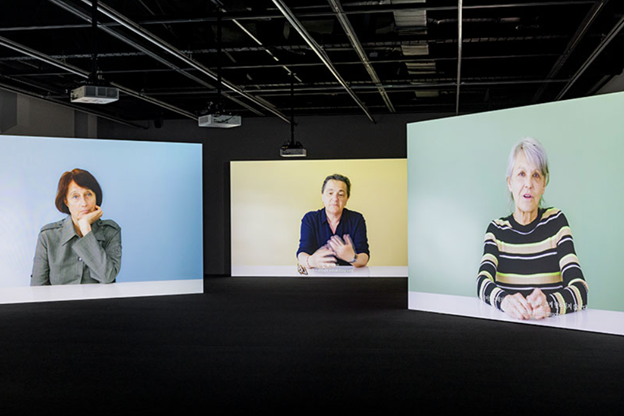
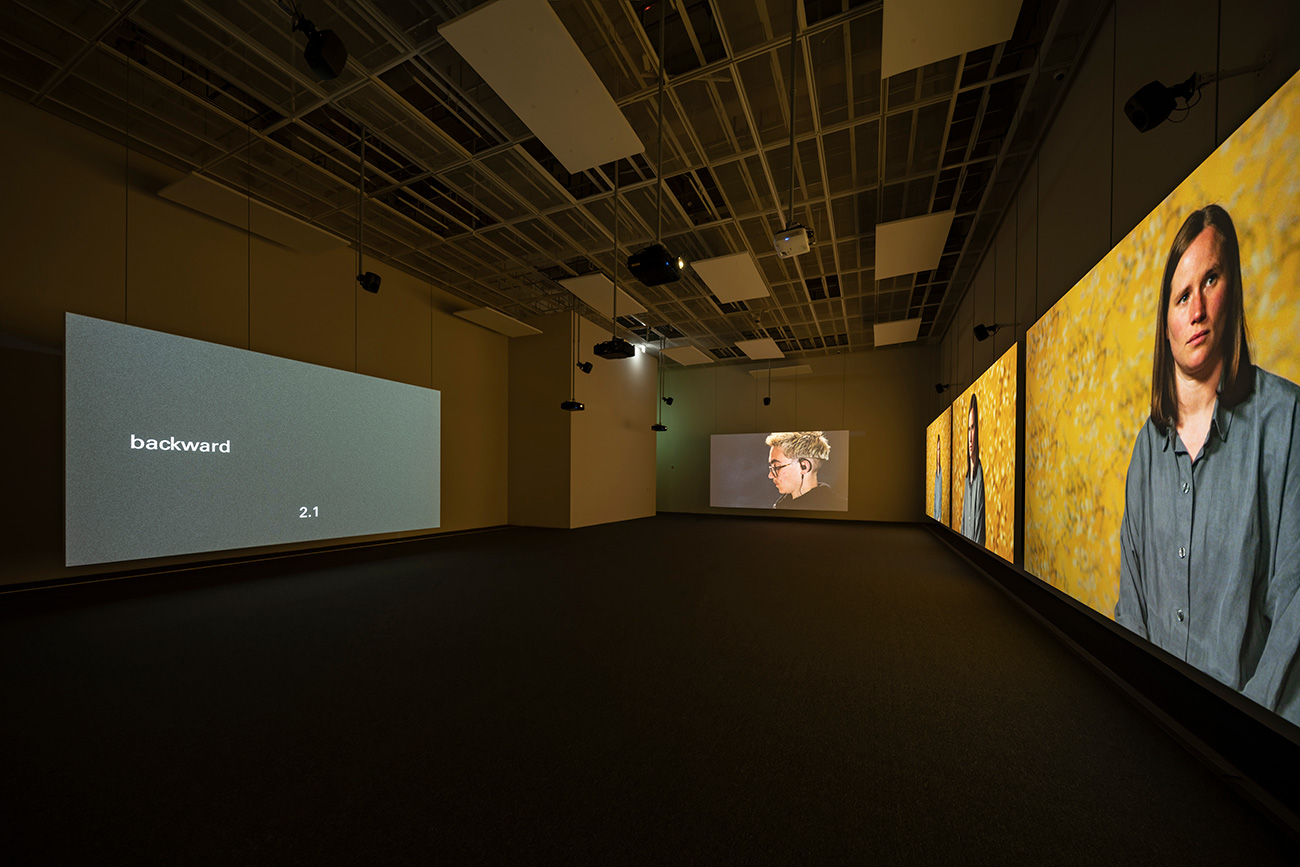
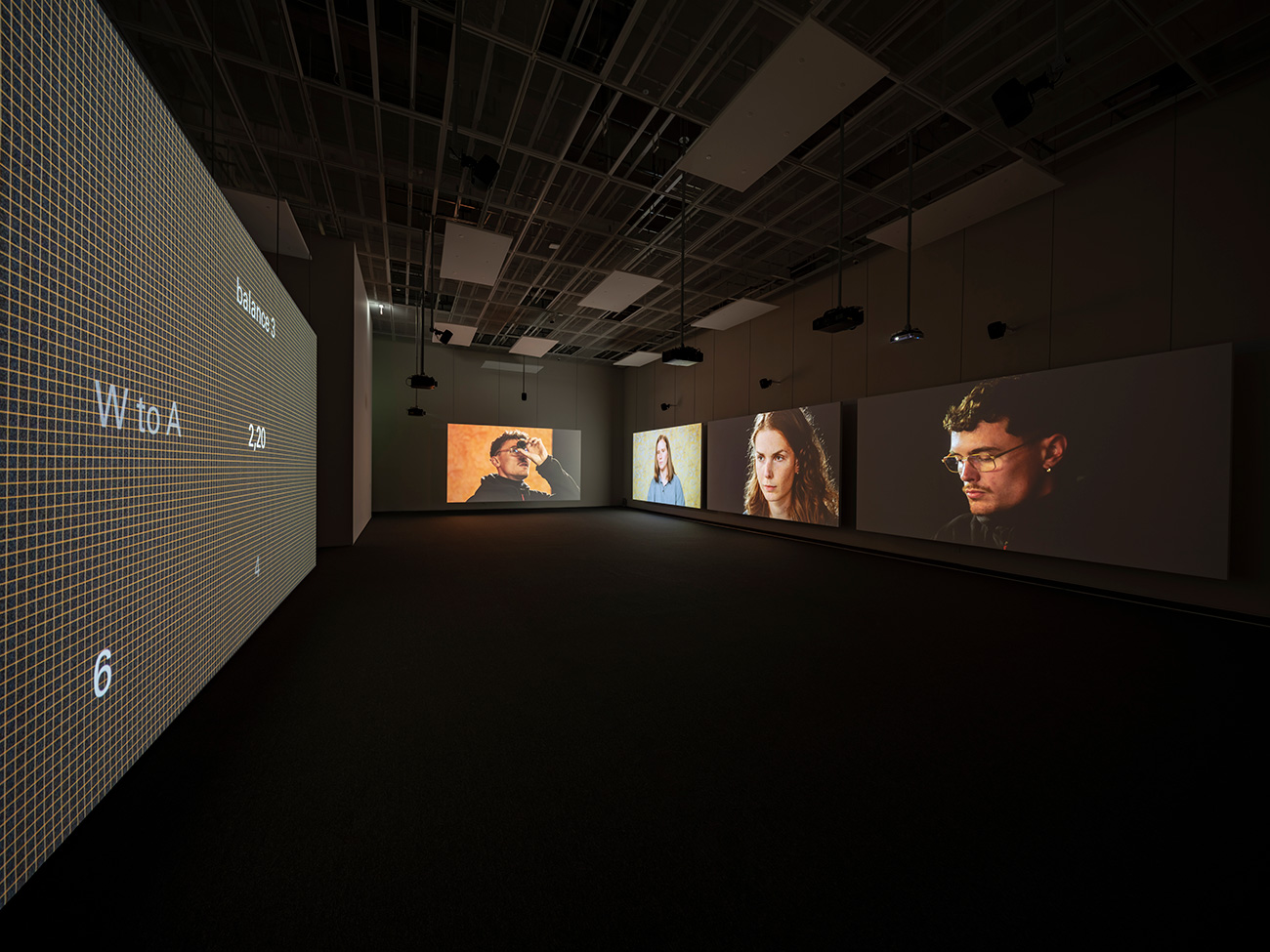
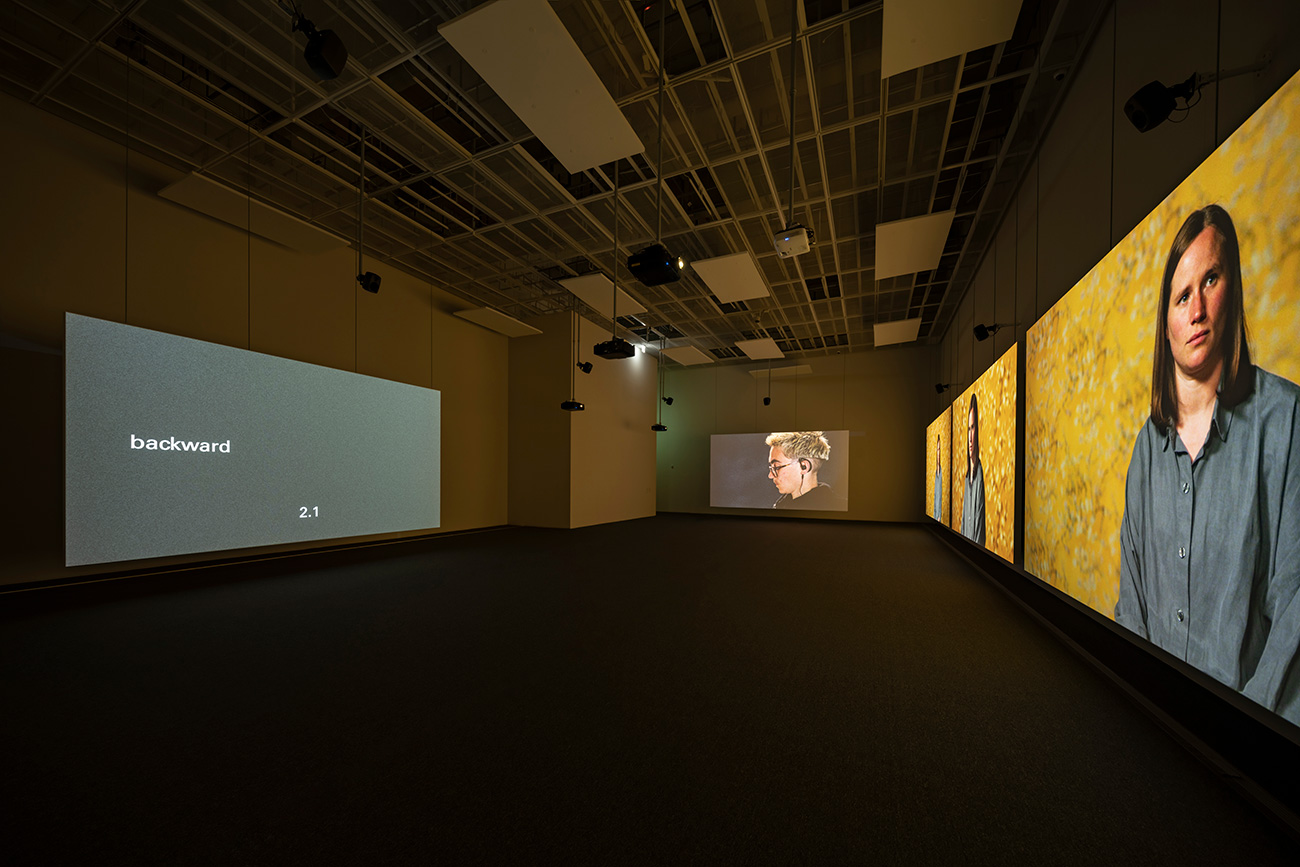
Video works are fundamentally limited in duration; they inevitably need to be constructed within a specific timeframe. But Oh Min’s construction does not focus on the arrangement of images; instead, she focuses on “movements” and “changes” that generate image and sound. Therefore, describing her work as a video, a very generous grouping of a medium, falls short.
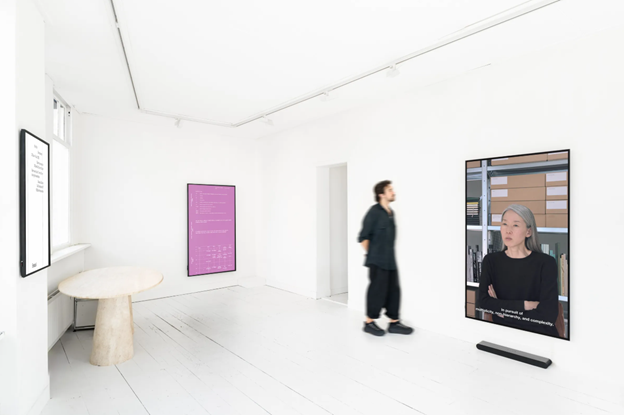
Further, defining the work as a “time-based installation” also considers that time, as the construction’s content and format remain the same, while its physical installation takes new forms in each of its displays. Furthermore, if the work is time-based, the completed work would naturally indicate time as arranged in space.
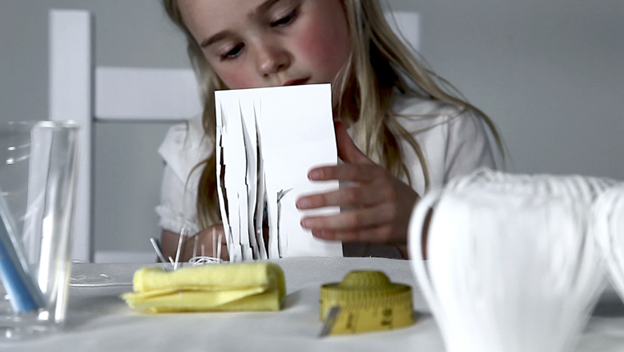
The series of works conceived from “études” also reveals the artist’s notion of completion. An étude refers to a simple piece of music made for practice. It is a textbook for helping performers practice their techniques and a piece of music in its own right composed with a high level of artistry.
According to the artist, a performer would select challenging parts from the entire score and practice them in tempo, rhythm, and accents different from the original piece before going back to the original interpretation. Through such practice, all senses, cognition, body, and sound surrounding the performer change, and the performance edges closer to the essence of music.
Here we must ask what the difference is between practice and completion. Does time distinguish them? Time is never practiced; it concludes newly to infinity. We all live without giving much thought to every concluding second, hoping that these moments “accumulate” to reach some sort of completion. However, such an idea is closer to an illusion.
Practice means many completions. In other words, a time-based installation can be deemed complete only in the sense of being a temporary original copy that perpetually delays the realization of the possibility of permanent completion that it possesses.
In an interview, Oh Min said that “time is ironic.” Time both generates things and makes them disappear. The here and now thus becomes a perpetually unreachable point as soon as it is met. Then what does a music score, which essentially records a performance’s organization, order, and method of execution, complete? What does it make possible, and what kind of incompleteness does it forewarn?
What does it mean for a score to be generated after time passes, instead of being prepared beforehand to instruct the time to come with its content and format? If it is possible to have a score that behaves as alive, confounds our initial questions, forces us to revert, doubt, and reflect, what does that look like? What if a score is no longer based upon shared rules, no longer instructs us not to deviate from its interpretation?
What happens when a score, instead of being a crystalized perfect record, follows the principle of constructing a here and now that allows infinite interpretations? Here, we must take a closer look at the question posed by Oh Min.
Excellence of a Question Total
A question is valid when it does not hint at an answer. Although we anticipate an answer when asking a question, the act of questioning helps us broaden our thinking.
Therefore, a good question behaves like a stepping stone that provides us with perseverance to explore the minute differences between reflections. It is also a firestarter that makes us passionately enjoy the friction created by those differences. A question, therefore, holds our thirst for what we have been curious about, as well as a response that can be predicted based on our
not-always-accurate knowledge. It is also interesting to see that a good question already has an embedded next question. Can a question, then, become a classic? Is there a question that can remain valid for hundreds of years and withstand the test of time?
Interestingly enough, the questions Oh Min poses are found far from a mechanism of advancement or development. The questions imbued in each of Oh Min’s works stay in the present in that they do not necessarily lag behind those of the past. Of the questions she brings forth through her works, none have been resolved and discarded.
Depending on the materials used, their relative placements, and the kinds of practice incorporated in each of the artist’s works, the key questions differ starkly from one another. However, it is not difficult to compare one work’s questions with another’s. Her questions thoroughly contemplate the many branches of possibility that are entailed before a generation takes place.
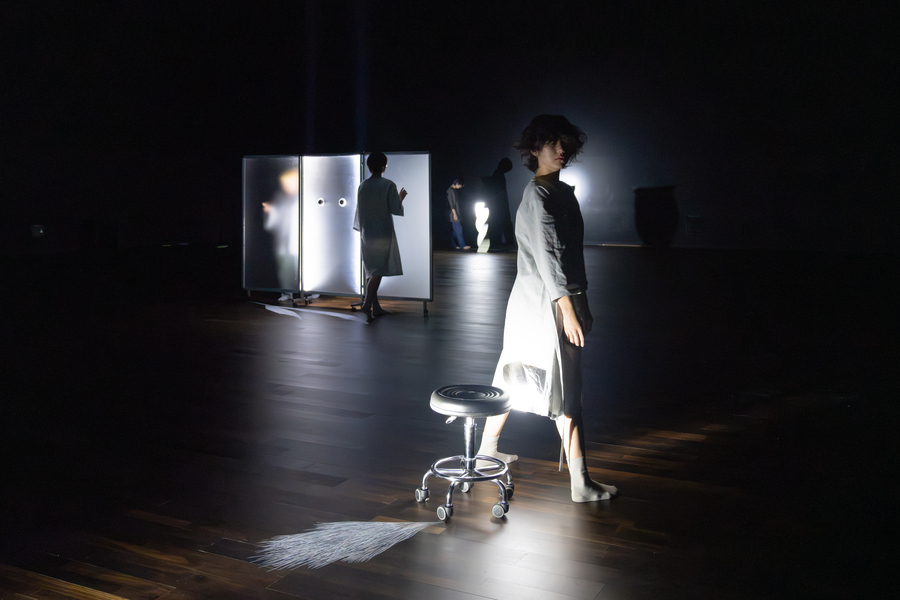
Questions that reexamine various factors found in the performance art itself, the difference between musical and dance performances, and the distinction between producing performance art and producing video works led her to ask whether a “time-based installation” could be made as a performance. These questions are not fragmented, but made whole through their differences and repetitions.
Oh Min’s questions make us contemplate the origin, but they do not lead to the birth of the universe or some kind of agnosticism. Her thoughts on relationships pose questions about the close connections between objects while also recognizing their relative independence. And this relative independence opens space for abstraction. The fact that everything changes does not necessarily throw one’s doings into the shade.
Rather, does it not allow us to argue, struggle, discuss, and explore amid all the changes related to the here and now due to our willingness to invest time and space to gain reflections generated between changes? Assuming that we need to consider “questioning” for the next 30 years, what notions of questioning will we obtain? How far can we take thinking? Up to what level of detail can we examine?
Integrated awareness and detailed discovery sustain each other. Like that one book we thought we had read enough times but end up encountering phrases that appear new whenever we open it again, Oh Min’s works are joyful in themselves for rediscovering questions.
Highest State of Alert
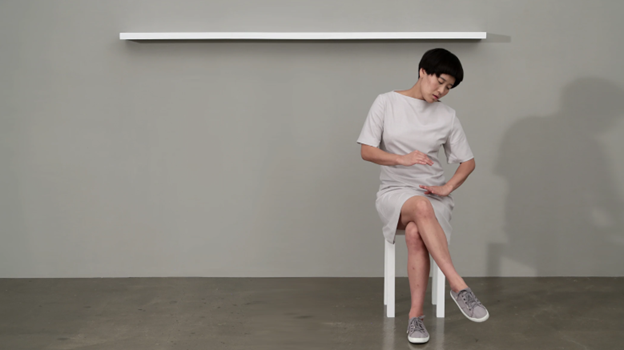
“In my videos, often seen are practitioners who seem to sit still.
But in reality, nobody ever just sits still.
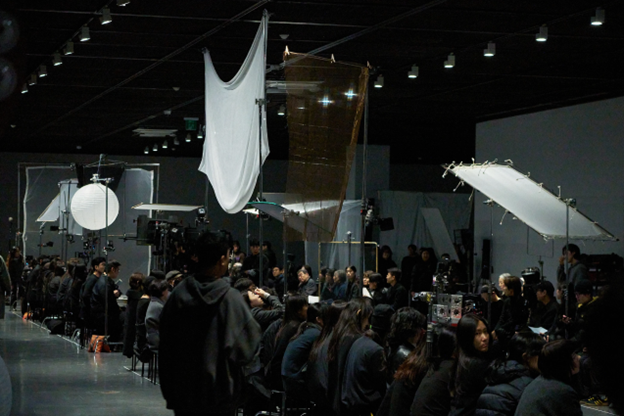
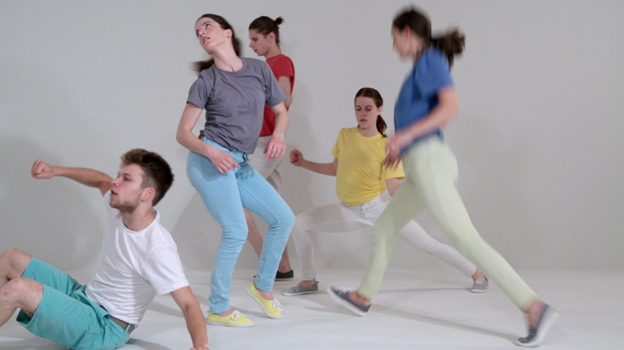
Most of those cast for my works are trained dancers and are seen acting out an intricately composed score.
— Oh Min, from 《Oh Min: Invitee, Attendee, Absentee》 (2020).
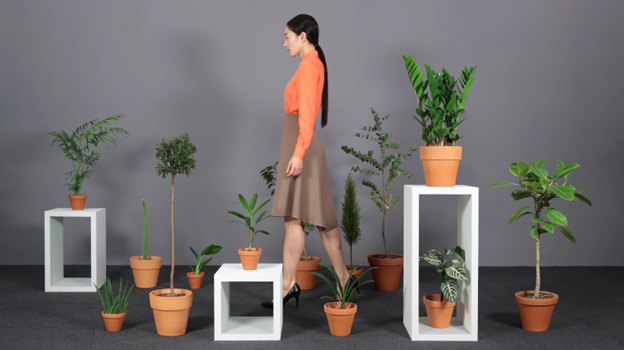
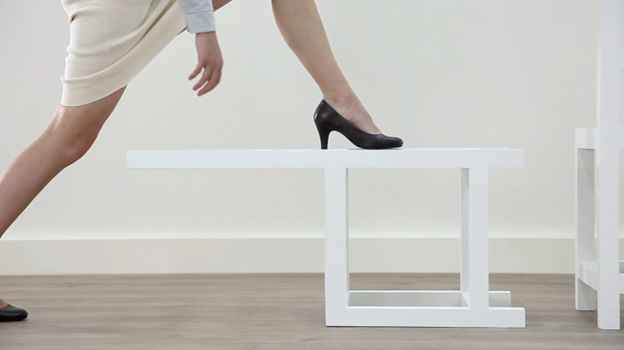
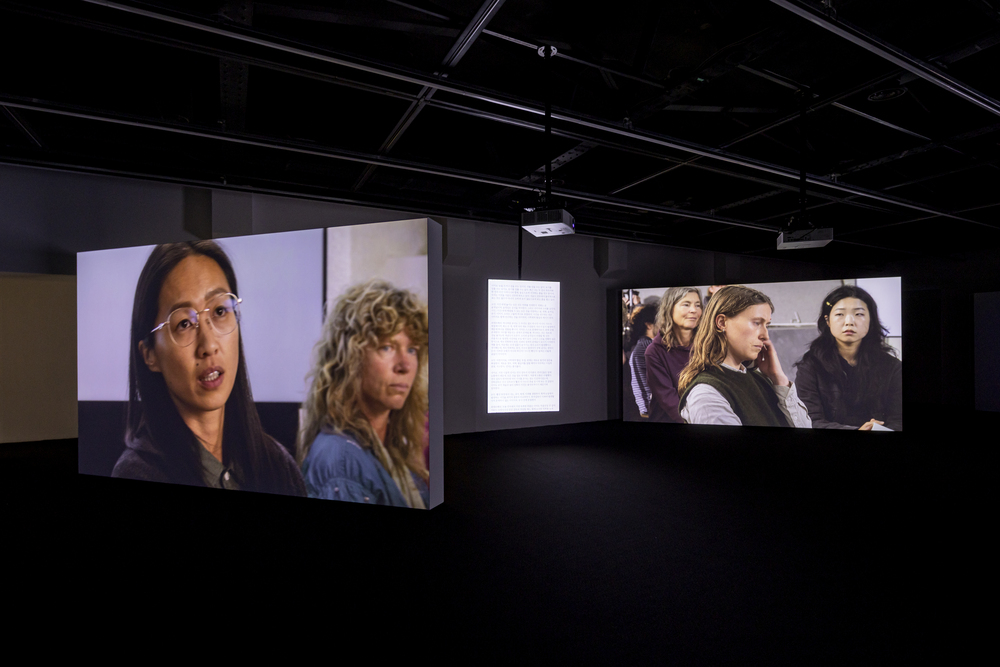
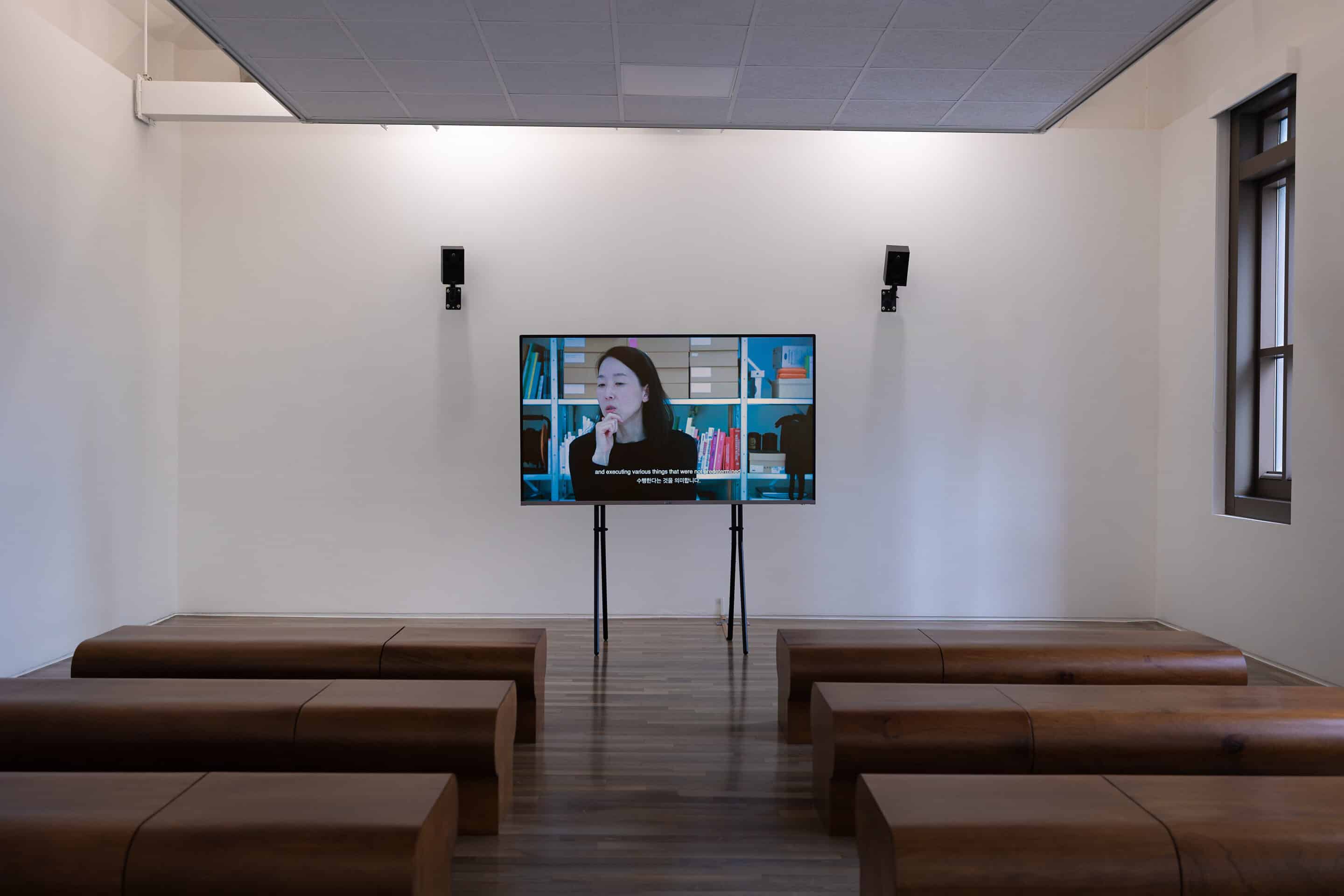
There are times when we can hear but not see what is moving or who is practicing in Oh Min’s works. It is possible to witness the practitioner engaged in practice, seeing, listening, and thinking in the same space as the moving object or person. As the artist said, everything is composed very intricately. Then where and how is the artist positioned in Oh Min’s artworks? Since Oh Min regards music performance as her mother tongue, does she weave
herself into her work or put herself outside it? Her works range from films and live performances, and she is always engaged in some type of practice. She often cites a choreographer as an example; the choreographer who created the performance is the one who enjoys the performance the most.
Following this example, the person who can enjoy Oh Min’s works the most is probably Oh Min herself. As the artist, she is positioned to sense the most minute differences, and also differences created from repetitions. Regardless of the relationship between the artist and her artworks, Oh Min’s physicality and reflection go between the repetitions of here-now and never stop.
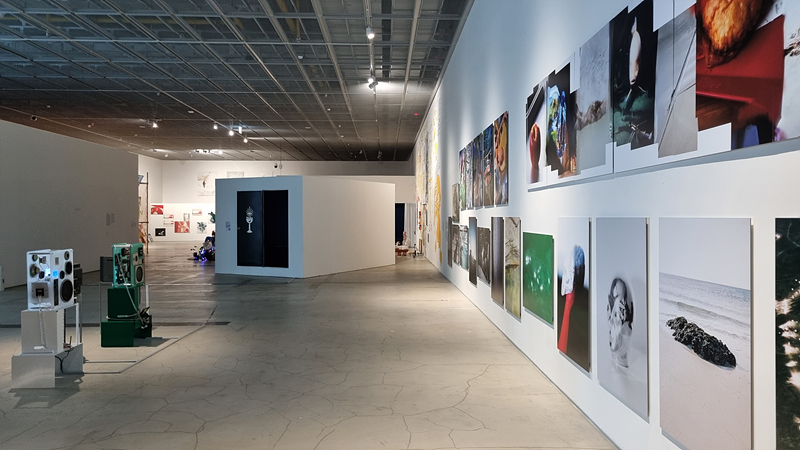
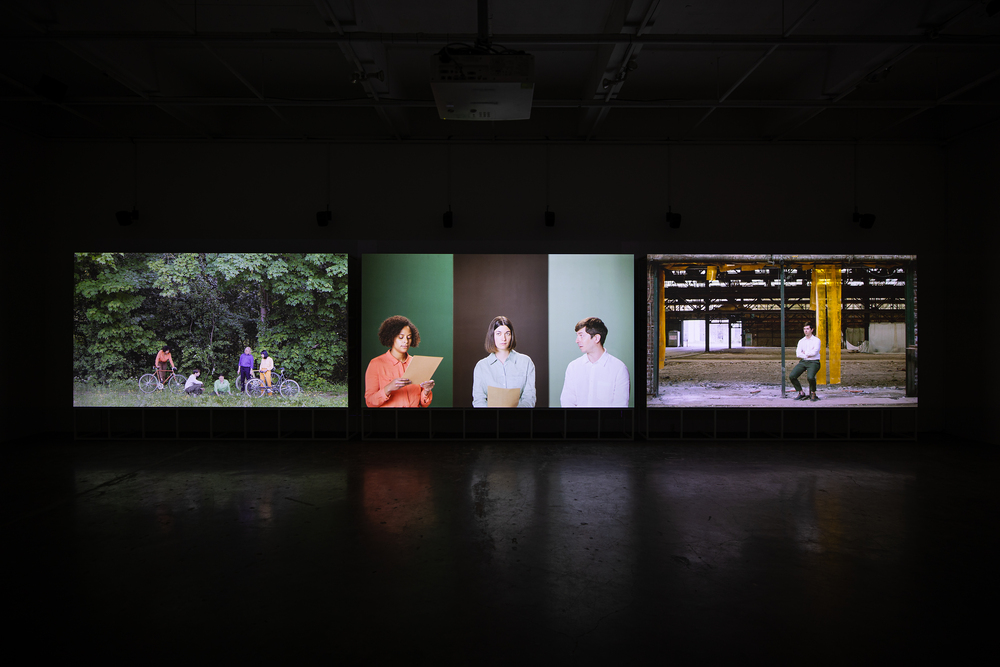
The same goes for the audience. Through a single channel or more than two, the number of ways to view her work can be amplified into the infinite. Things happening inside the channel, things that can only be identified with the channel, and even the conditions of the venue where the channel is installed become time that occurs for the first time every minute, every second.
Additionally, the channel here is again divided into a channel for projection and a channel for sound. This is because different viewers see the works differently. More specifically, the factors of seeing, hearing, and thinking change with the situation. In other words, that nobody can see the same work in the same space and time puts Oh Min’s here-now in a unique status.
At the same time, the habit of trying to identify the visual origin of a sound or story while looking at images sometimes hinders enjoying the art. It is almost impossible for everyone to know everything simultaneously, especially when an artwork is constructed from various directions, colors, focuses, distances, balances, textures, noises, speeds, sounds, orders, patterns, counts, gestures, expressions, thoughts, and memories.
However, we might have a chance if we see it many times and practice viewing it. At some point, the viewer’s body should enter a state of alert. And training in viewing, attempting the impossible, transfers the viewing of the artworks into another dimension.
Connecting to Oh Min’s here and now, which creates newly constructed time within the entirety of time, is simple yet complicated. Once one attempts to access multiple here-nows, the most urgent and the clearest here-now make one present in the “highest state of alert.”
Therefore, putting Oh Min’s art into words makes one wonder whether it has to attempt to write each and every time-space with its infinite possibilities or just transfer time-space itself as one mass. The experience of existing in the awakened state is multi-dimensional and intense.
Closing
With the 1990s as the turning point, the art world has come to focus on the “topic” of newness. While exploring various theses and global issues, today’s art world’s “newest” topic seems to be the factors related to “justice, righteousness, or equality.”
There are only a few ambiguous positions that artists can take: becoming a public whistleblower by visualizing social issues from an artistic perspective, persuading people to apologize for their human-centric attitude, or immersing themselves in contextualizing the subject of creation by borrowing from trendy topics of the time.
This is why people tilt their heads in doubt; the “topic” seems to change only every three or four years. It is relegated to a mere tool to make people think they are a part of “the new trend” rather than ingredients used by artists for reflection.
How does someone’s conviction gain trust? Inevitably, an artist can work for only a limited time; her artwork can flourish while she is alive or be appreciated after her death. An artist’s true ambition cannot be bound to her time. It takes at least one hundred years to be considered a classic. Therefore, the artist’s question should not be in the here and now.
However, today’s art seems to have embraced being a selfless response made to satisfy others’ expectations. An artist’s original questions are quickly replaced with questions seeking the approval of others.
Have we entered a timeline in which the existence of art has become the most precarious? So that the most political and the urgent here and now is, in fact, the here and now missing from such questions? It seems that Oh Min’s following questions already started to emerge a long time ago.
1 “Every art (technē) and every way of proceeding (methodos) are thought to aim at some good.” Aristotle, “Book I, Chapter 1, Good as the Aim of Action,” Nicomachean Ethics, trans. Sang-jin Kang, Jae-hong Kim, and Chang-uh Lee (Seoul: Gil, 2011), 13.
2 Ibid., 14.
3 Theodor W. Adorno, Aesthetic Theory, trans. Seung-yong Hong (Seoul: Moonji, 1997), 245.
4 Min Oh, Sungwan Kim, and Yeasul Shin, Jinan Kang, Yeonwha Kong, Minjung Kim, Sungwan Kim, Kitae Bae, Sulki & Min, Yeasul Shin, Jinyoung Shin, Woosup Sim, Min Oh, Sanghoon Ok, Minsung Lee, Sinsil Lee, Yanghee Lee, Youngwoo Lee, Taehun Lee, Hyewon Lee, Taesoon Jang, Kwangjun Jung, Joseph Fungsang, June Moon Kyung Hahn, Yunkyung Hur, Sungjin Hong, Chosun Hong, 57studio (Seoul: Specter Press, 2019).
5 Min Oh and Jihye Chang, Études (Seoul: Specter Press, 2018).