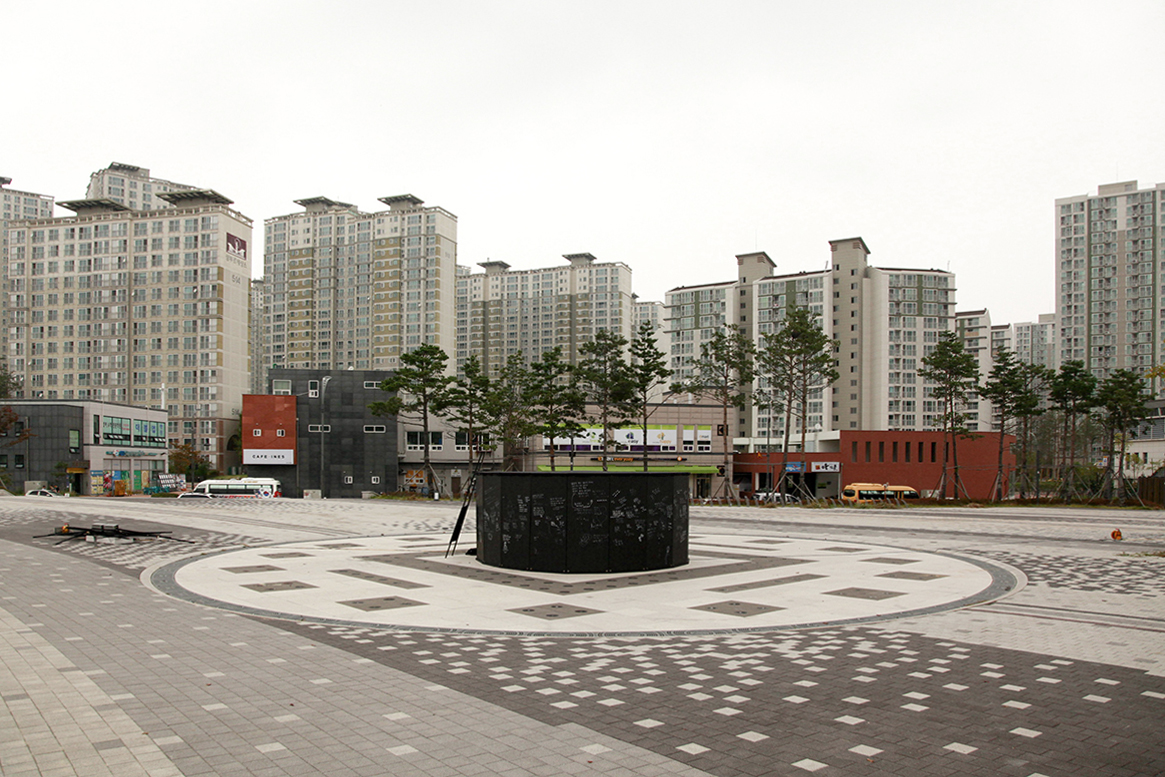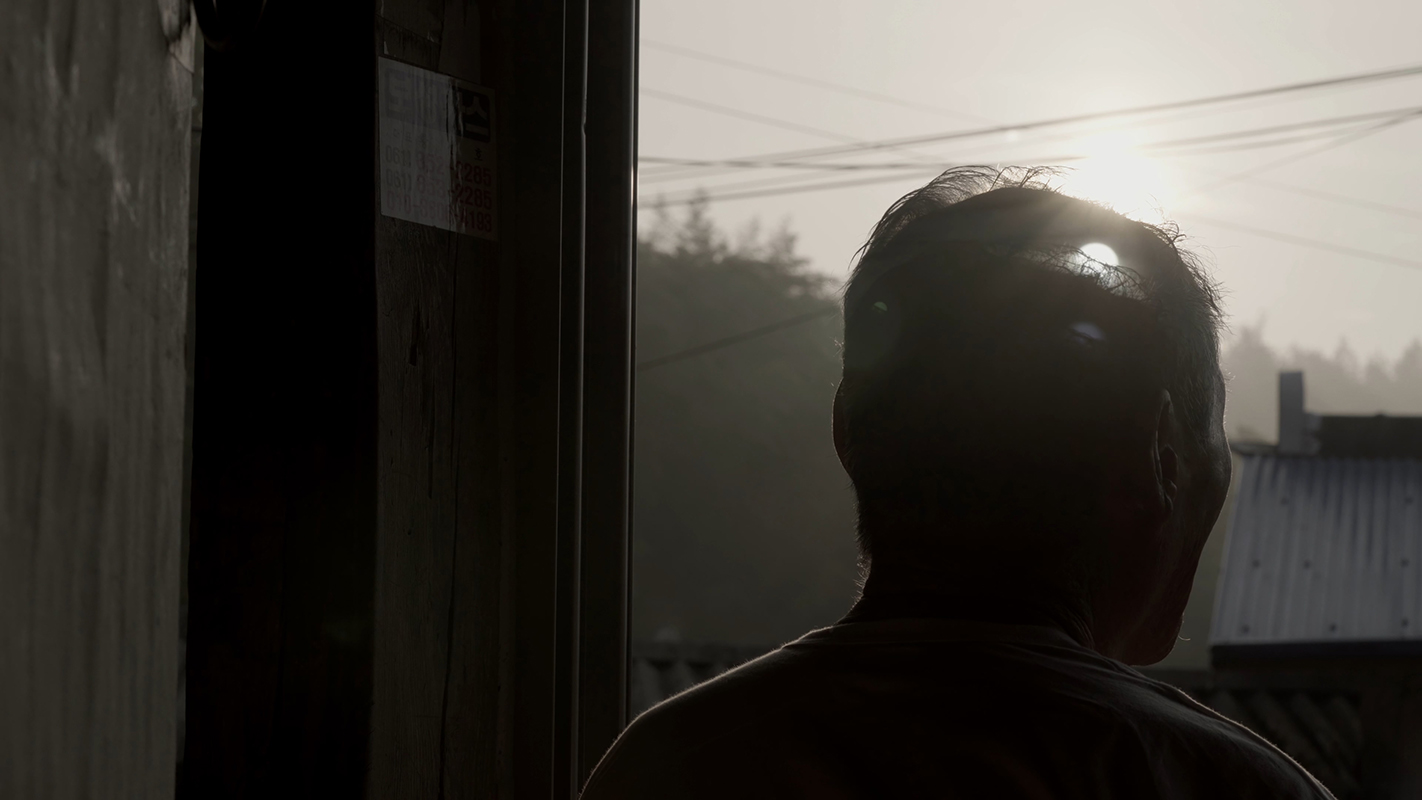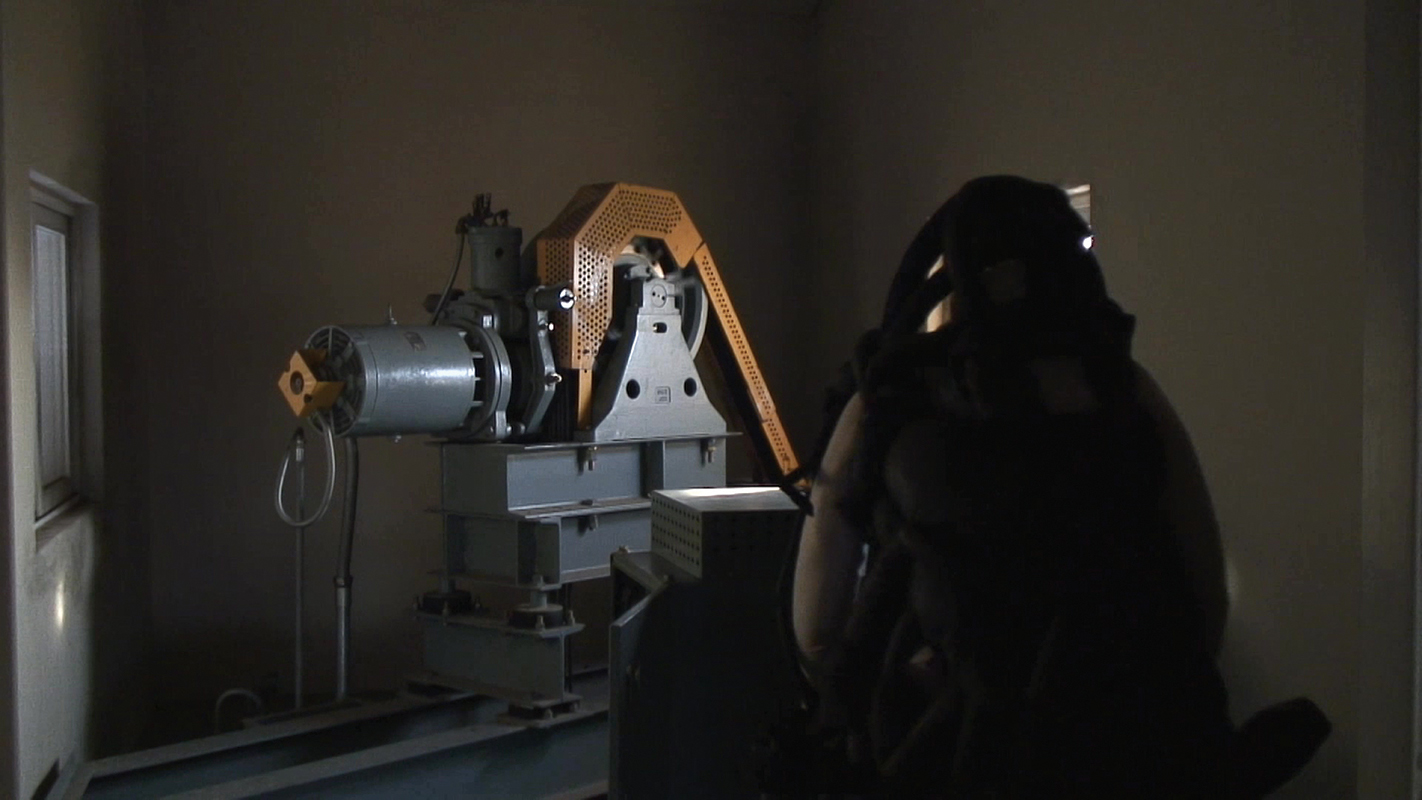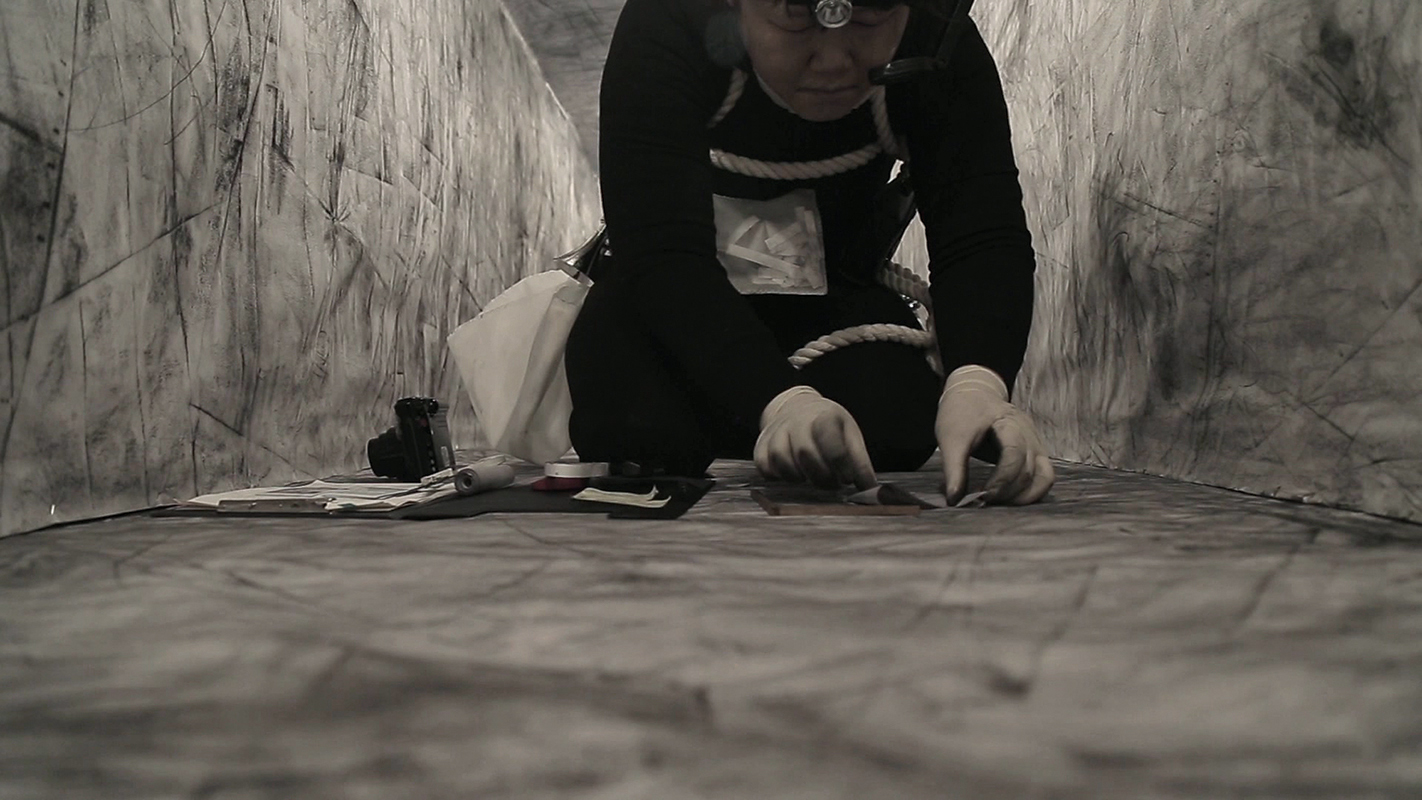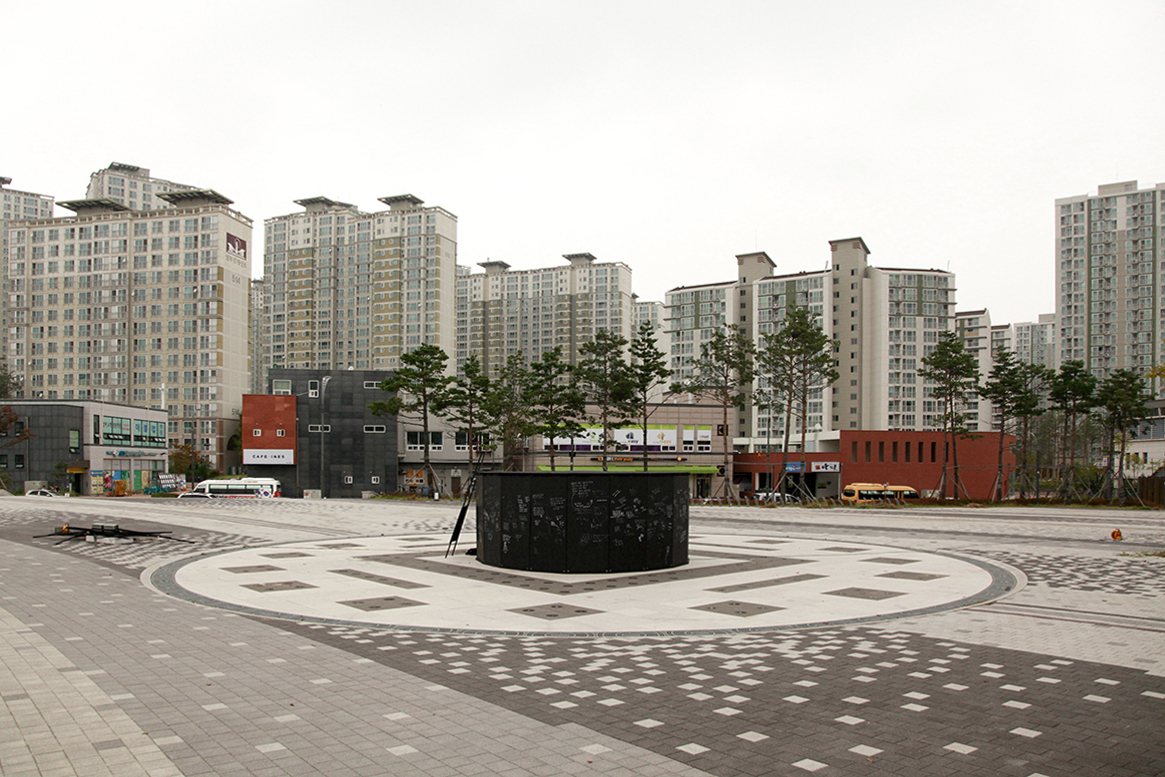

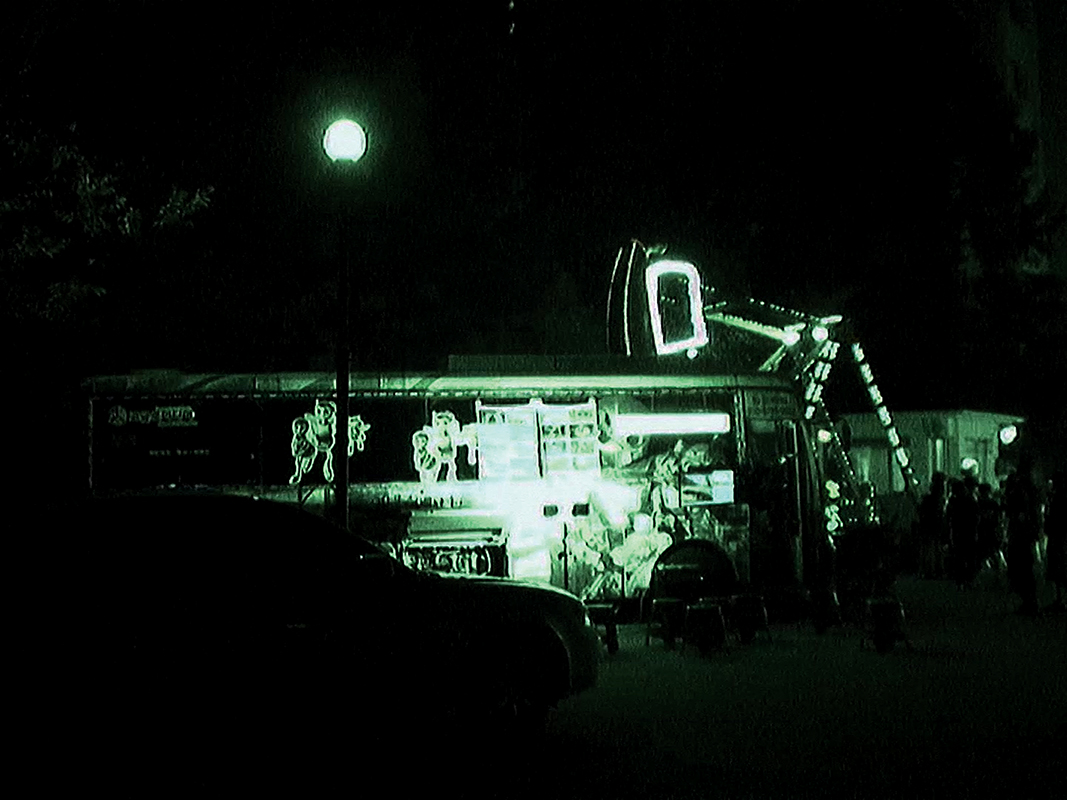
Moojin Brothers, The Field of M, 2014, installation view at Unjeong Health Park © Moojin Brothers

Black cylindrical structures with glass column in the center appeared throughout Paju one day. We cannot tell what the structure is until we enter it, and we realize what we’re looking at the moment we gaze upon the glass column.

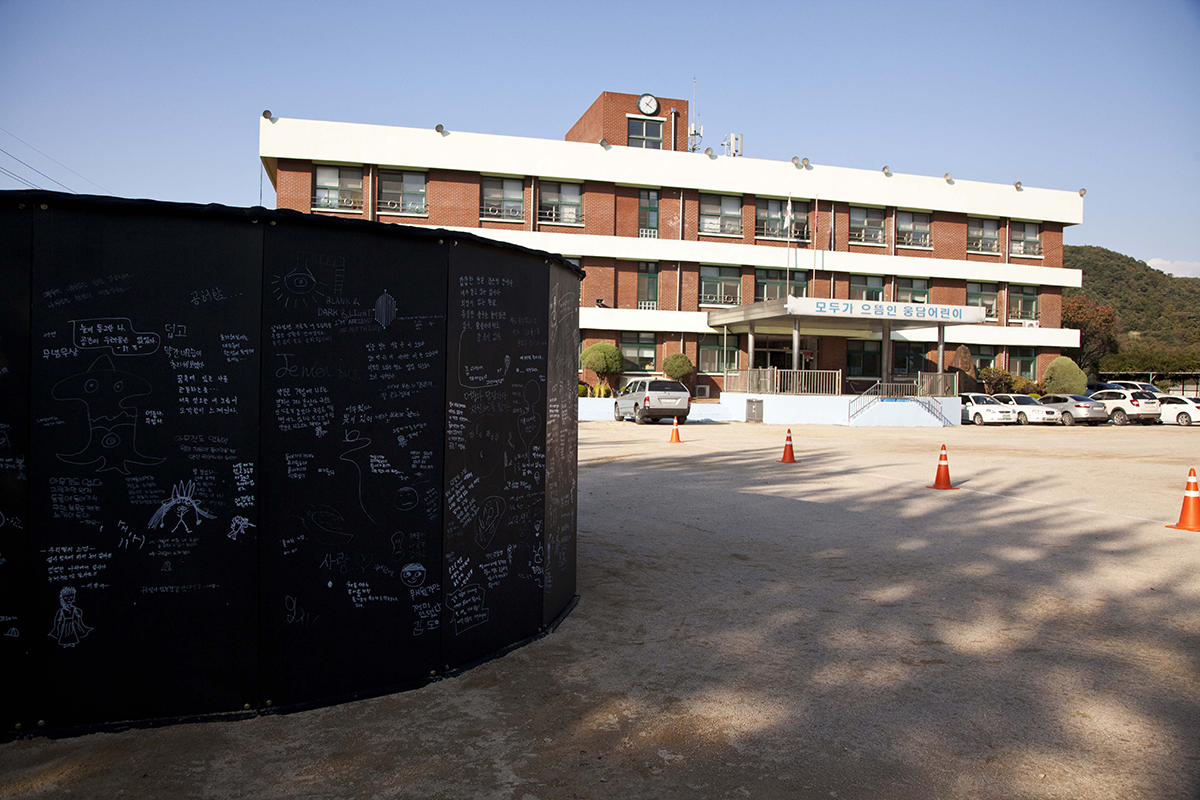
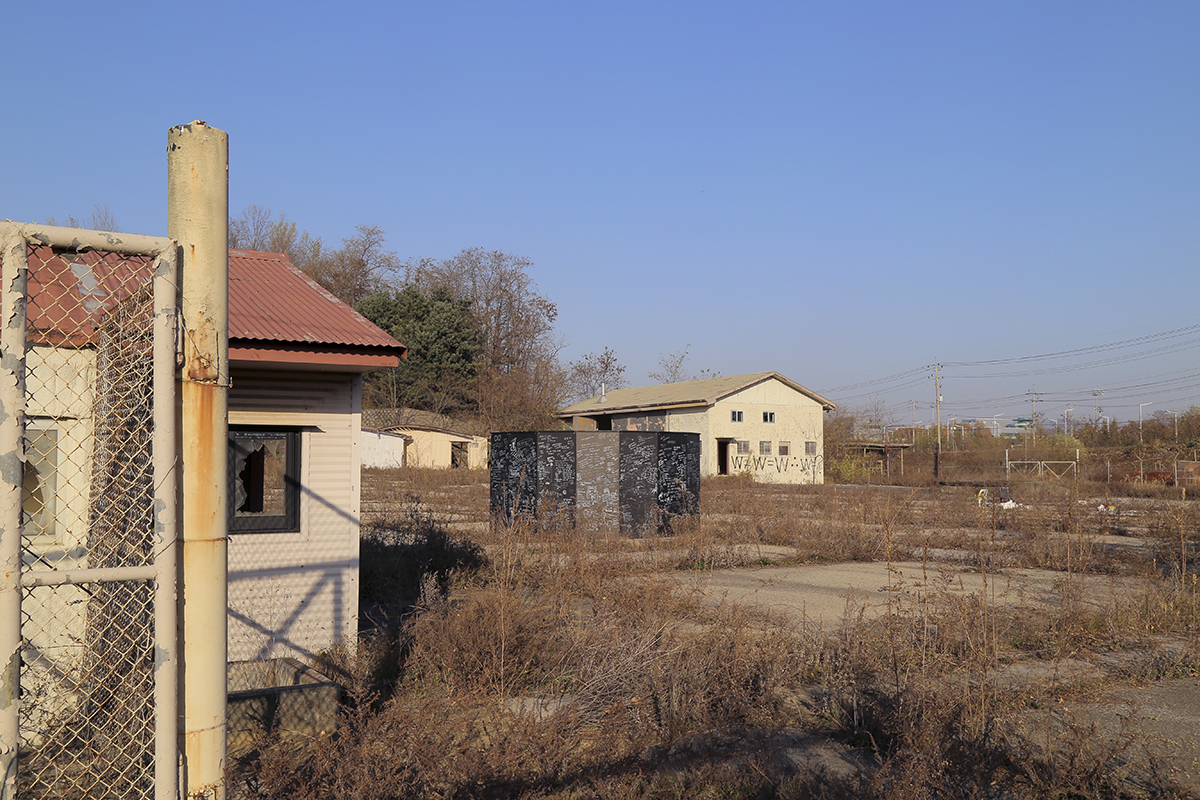
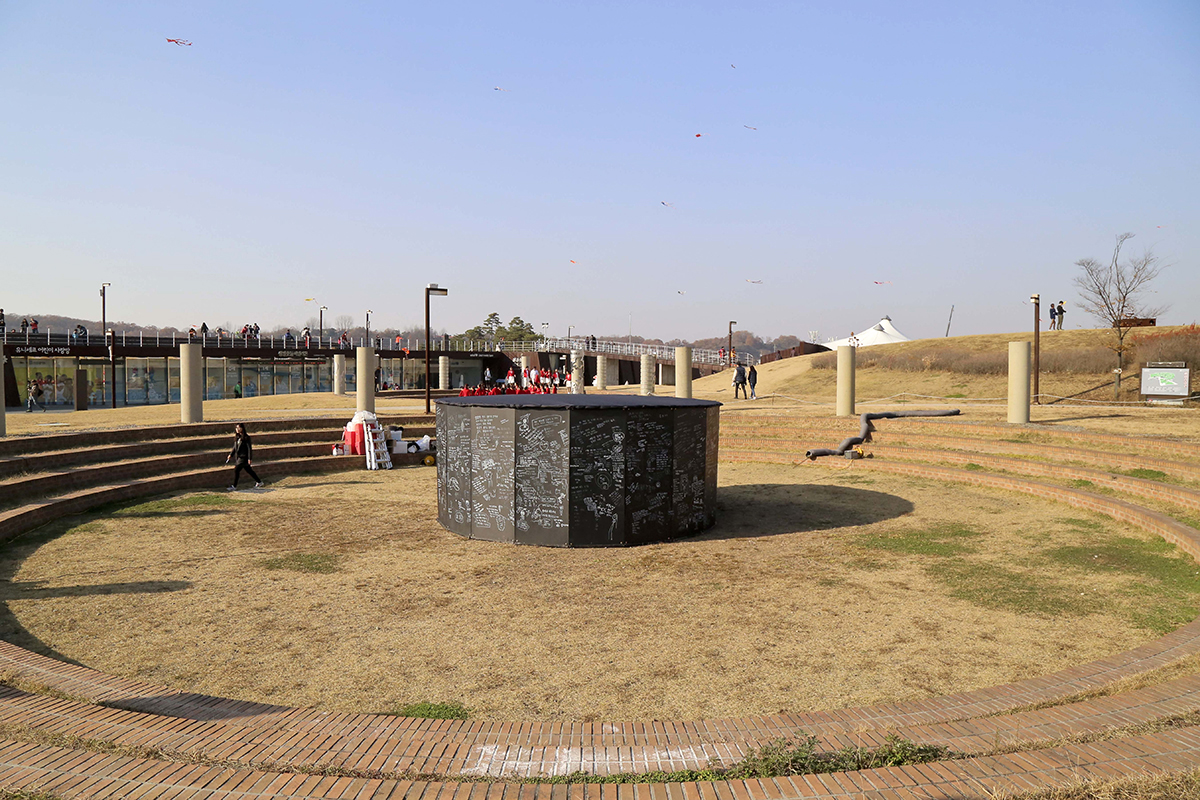
Named The Field of M, these cylindrical structures were installed at different times in four sites in Paju, including Unjeong Health Park, Ungdam elementary school playground, a US army base on the brink of being torn down, and the Imjingak Peace Nuri Park.

The Field of M, the first public project in 2014 by Moojin Brothers, is an artistic attempt to expand their customary visual act. The aphorism of life, which the brothers have persistently observed through their video works, now step outside of the camera, waiting for the approval and feedback from the audience.


Moojin Brothers, The Field of M, 2014, installation view at Ungdam Elementary School © Moojin Brothers

1.

(…) When we had no choice but to stop and look around, all we could see were brothers who were stopped by a sudden illness. Different in age, the brothers had clear hierarchy - and consequently function - in the family. However, the similarity in our fields and the same illness made the brother relationship and the lives we’ve lived so far seem like a gigantic obstacle. (…) - From Moojin Brothers’ artist statement

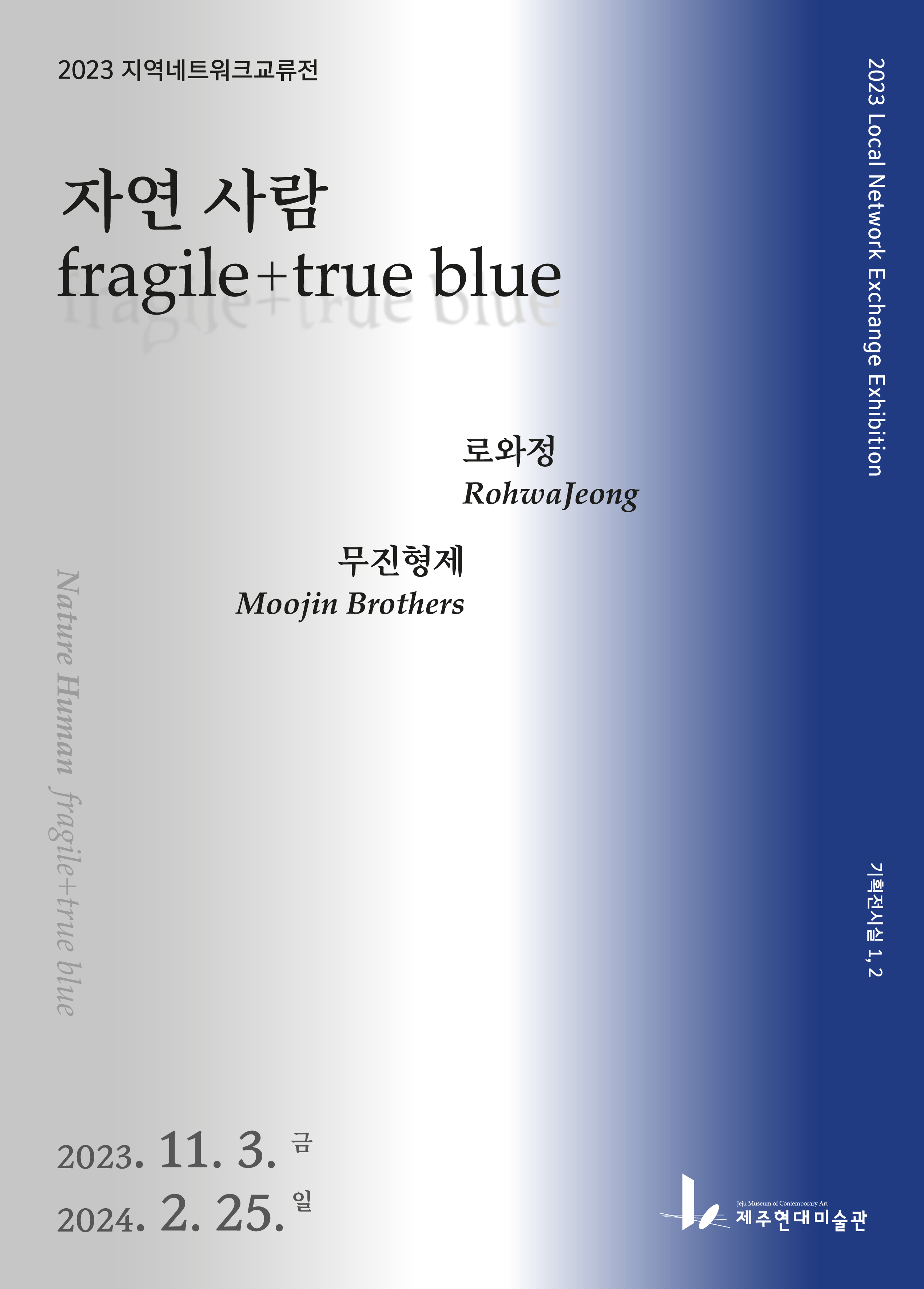
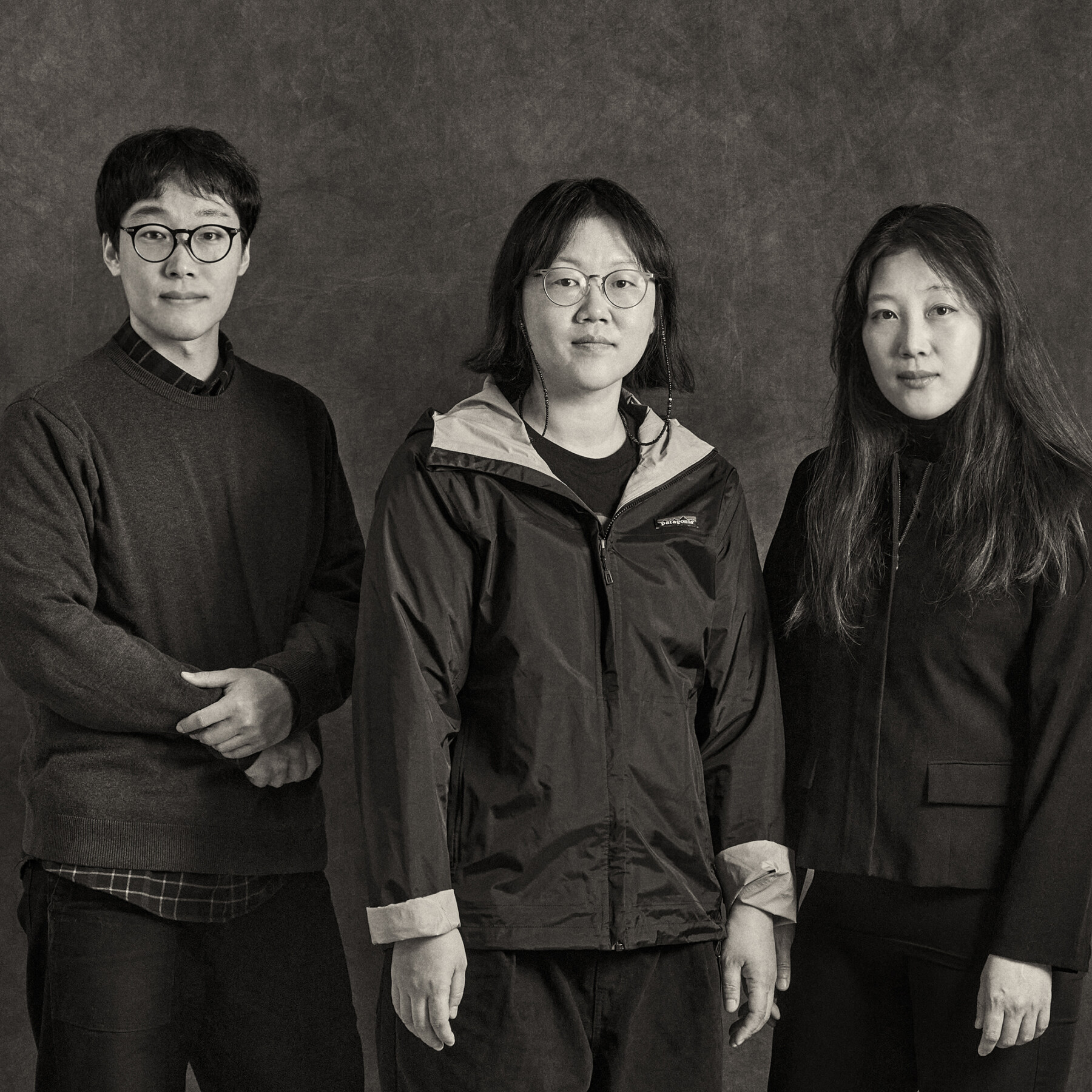
The oldest of the Moojin Brothers studied literature, while the second oldest is a sculpture-major who makes the props, and the youngest is a photography-major who’s in charge of shooting the video.

The three brothers seem like ordinary people who are devoted in their own field; however, what makes them special is that they share each other’s worlds through the different genres of literature, art and photography, while documenting such process through video and creating a wholly new language.

This artistic process of countless conflicts and oppositions produced a special language and power which can only be created with the union of ‘Moojin Brothers’, and is an instrument through which they stand as artists.

The three brothers with quite an age gap in between them lived their own lives doing their own things, until they became a team in order to help the second brother who was a practicing artist. However, during their first joint project in 2004, they realize that life of challenge and collaboration as artists is nothing easy.

They confessed that “It was so difficult to capture image with literature, narrative with art, and movement with photography.” Now, however, the brothers’ memory of their first work is charged with ‘angst’ and ‘pleasure’. Their reckless challenge became the reason for them to work ‘together’ until now.

Each of the three brothers still play his own role: The eldest brother Mujin writes the script, while the second brother Hyo-young produces the installation structure, and the youngest Young-don is in charge of the camera. This is how Moojin Brothers arrive at equations of life through their own collaborative formula, and it’s also how they live.


Moojin Brothers, The Field of M, 2014, installation view at the Former U.S. Army Building © Moojin Brothers

2. Paju : Site for M

Moojin Brothers work in Paju, a mysterious place of isolation where one can also find Heyri Art Village, Paju Book City, and the Imjingak. An everyday place where the brothers have resided for over 10 years, Paju is a place into which fragments of their lives are interwoven. New town development is taking place around the apartment where they live, and new buildings are being erected in the area.

Things that are familiar to them are suddenly being replaced with things that are strange and unfamiliar. The brothers studio is situated on their apartment rooftop which overlooks the Paju New Town, and the brothers have been observing and collecting the everyday life of unfamiliarity on their rooftop.

The Field of M began as a question about such habitual sensory act. According to the artists, ‘M’ can become any word and coordinates for infinite word; thus in The Field of M, there is no fixed meaning or interpretation.

Moojin Brothers installed black cylindrical structures in four sites in Paju. In the structures, they erected a glass column named ‘memorial’, and set up The Field of M. The park, school, and the deserted spaces that Moojin Brothers selected are ordinary places marked by symbols like any other areas in the map.

Moojin Bothers marked these sites as ’M’, and attempted to transform Paju, a space where they live and work, into a form deeply attached to life. The viewer comes to see him or herself when they face the memorial upon entering this cylindrical structure measuring 2.3m high and 6.5m wide. The image captured on the glass column can only be observed by the audience. 

Moojin Brothers can share the audience’s experience, albeit indirectly, through the three cameras in the column, which portray the audience real-time on the monitor installed outside of the cylindrical structure. After a short experience, the audience leaves what they feel or their stories about life in the form of writing on the structure wall.

Just as ‘the alphabet M becomes a site on which various words and meanings can be conjured up’, The Field of M by Moojin Brothers functions as an infinite point on which different memories and stories are constructed each time and expanded into a new meaning.

The everyday space - which has become customary for the artists and audience alike - transforms into a place of ‘Topos’ which houses discourses accumulated in the memories of many through language and culture. Thus The Field of M is recognized and archived as a site of imagination, thought, communication and discourse.


Moojin Brothers, The Field of M, 2014, installation view at Imjingak Pyeonghwa Nuri Park © Moojin Brothers

3. Site-Work-Participant, and Work

Artists never partake in interpretation of their own work. (…) Thus artists need powerful Super Viewers in order to find remaining meanings surrounding their work. - Marcel Duchamp, 1957

Moojin Brothers’ work is a feedback on the outcome of communication through their work, thus completing perfect cycle of communication. While audience’ interest and participation allowed for this communication process to take place, the discussion and criticism on the work provide the brothers with the ability to perpetuate the project.

The brothers wished to share the sharp pleasure of shedding new light on our life, through the various stories of the people they met on the four sites, including; athletes and their compulsive obsession for self maintenance, dreams of an elementary school student to become a government worker, people and their psychology to take whatever that equates to money from the ruins of US army base, and people who are still consuming history at the Imjingak River.

Such powerful encounter with their audience inspired the artists a great deal in the designing of their work.

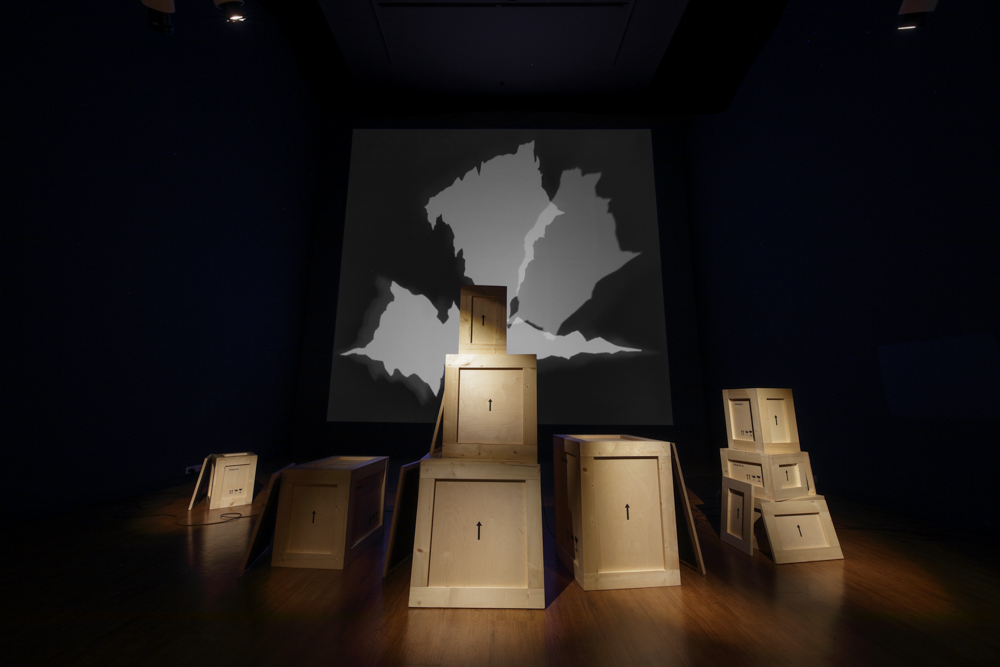
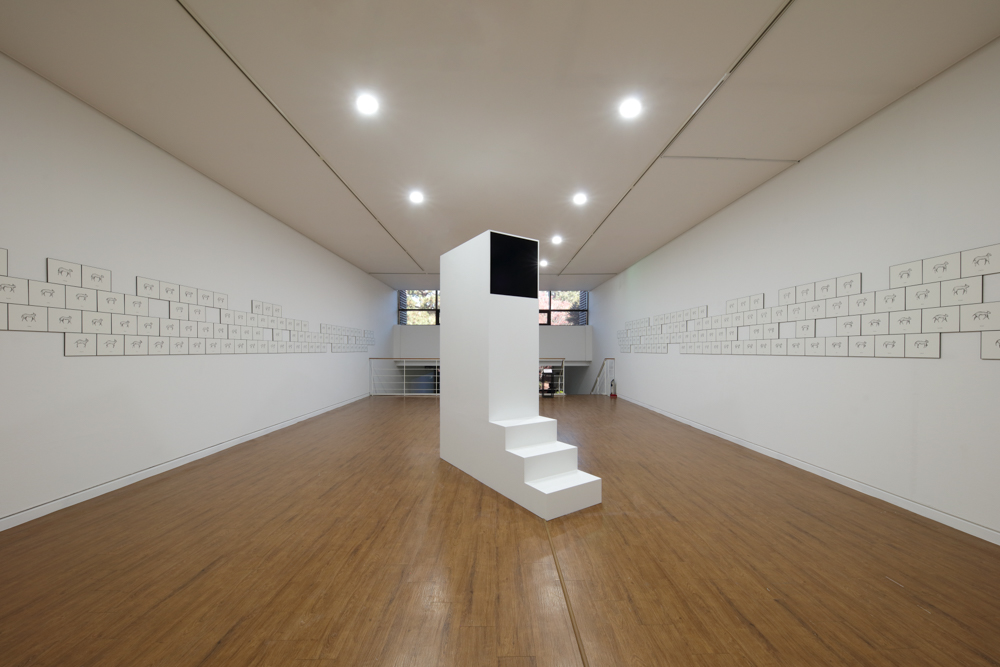
All the recorded video, documentation of the audience and their text at The Field of M were produced into a second work, and all the material collected from the area of the installation, along with three monitors, expanded into a new installation work.

While the context of viewer-participation communicates with the artists’ text, The Field of M becomes a completely new creative outcome. The expanded chain process observed in The Field of M produces the new public possibility in art.

To Moojin Brothers, video provided a framework for their practice as a form of understanding and harmony in working collectively through issues and problems.

On the other hand, The Field of M is significant in the sense that it generated a participatory cultural process which actively intervened the audience in the ‘public communication process’. Moojin Brothers work ‘together’ not only because of the blood ties as a family or the common artistic language which unites them. 

Their work, possible only when the three works together, demonstrates unique elements of mediation and exchange that cannot be found in models of collaboration between other artist teams. In that sense, The Field of M is the brothers’ own unique artistic performance as well as a dynamic experimental site which has evolved from non-mainstream collective. And this is the hands-on act of art through which Moojin Brothers communicate.

References