As Suki Seokyeong Kang’s ambitious Black Mat Oriole
project evolves nomadically across continents – from the Gwangju Biennale,
where it debuted in 2016, to Philadelphia, Liverpool, Stockholm, and, most
recently, Shanghai – she has begun to reify her terminology. Kang’s precise and
unwavering language posits Black Mat Oriole as “the minimal space each
individual in this society is provided with, upon which to stand and sustain
one’s weight.” In this malleable, multisited installation she deftly utilizes
the choreographic to produce video, painting, and sculpture that give form to
the premise that we are always already inscribed within systems of domination.
Drawing upon research into traditional Korean painting, music, and
dance, along with her nascent knowledge of Western art history, Kang harnesses
the latter’s fascination with the Cartesian grid to create videos and
installations rooted by the logic of Korean historical references. Though Kang
is aware of artists associated with the form, such as Agnes Martin and Sol
LeWitt, the grids in Black Mat Oriole function adjacently to
Western art, as distant aesthetic allusions but not sources. The theoretical
origin of Kang’s grid is the jeongganbo, which Kang views as a “living,
breathing” spatial construction. This fifteenthcentury Korean system of musical
and choreographic notation was created concurrently with Korea’s alphabet,
which is based on the gridded movement of the tongue within the mouth. It is
this movement of flesh within a geometric space – speaking tongues, grasping
hands, and choreographed figures – that drives Kang’s work.
The jeongganbo grid is composed of square jeong – which translates
to the noun “well,” but here functions as a musical note – within which
duration, pitch, lyrics, and choreography can all be transcribed. Kang was
attracted to the multidisciplinary nature of this form of measurement as it
evolved through the historic texts she encountered in her research. The
earliest known appearance of the jeongganbo is in the Annals of King Sejong the
Great (1447), who revolutionized Korean culture through a series of advancements
that distanced Chinese influence. Previous forms of musical notation – borrowed
from China – did not account for duration of notes. Alongside the creation of
new Korean instruments and tones under Sejong’s purview, Korean court music
evolved to include notes held for a longer period than the Chinese system
allowed, requiring a new form of transcription. The flexibility of the Jeong
inspired Kang to expand it beyond a unit of measurement towards a more
conceptual framework, one that positions the artist’s body as the primary
metric.
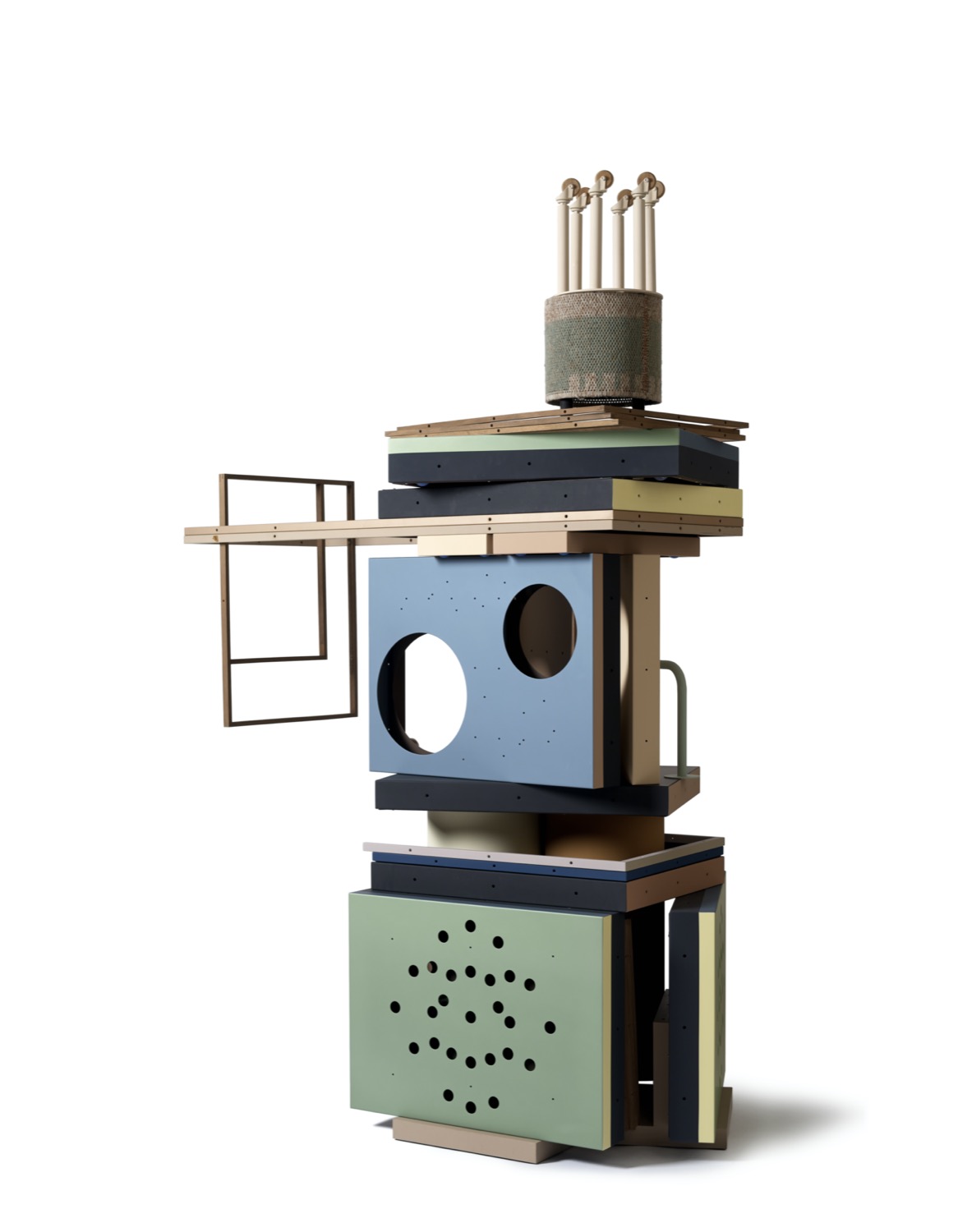
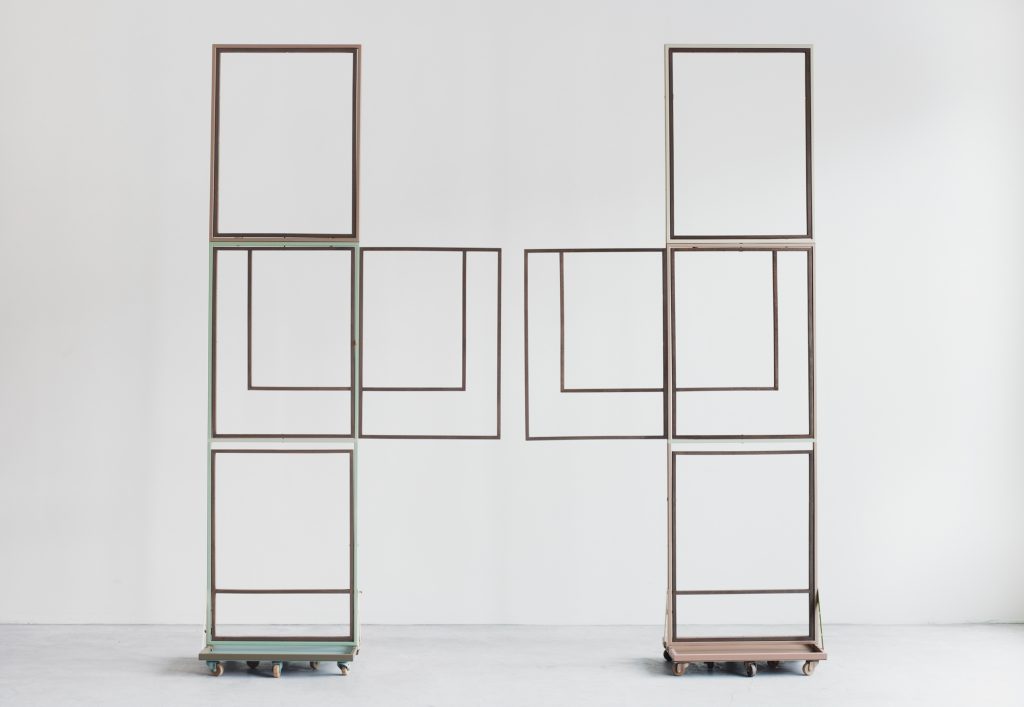
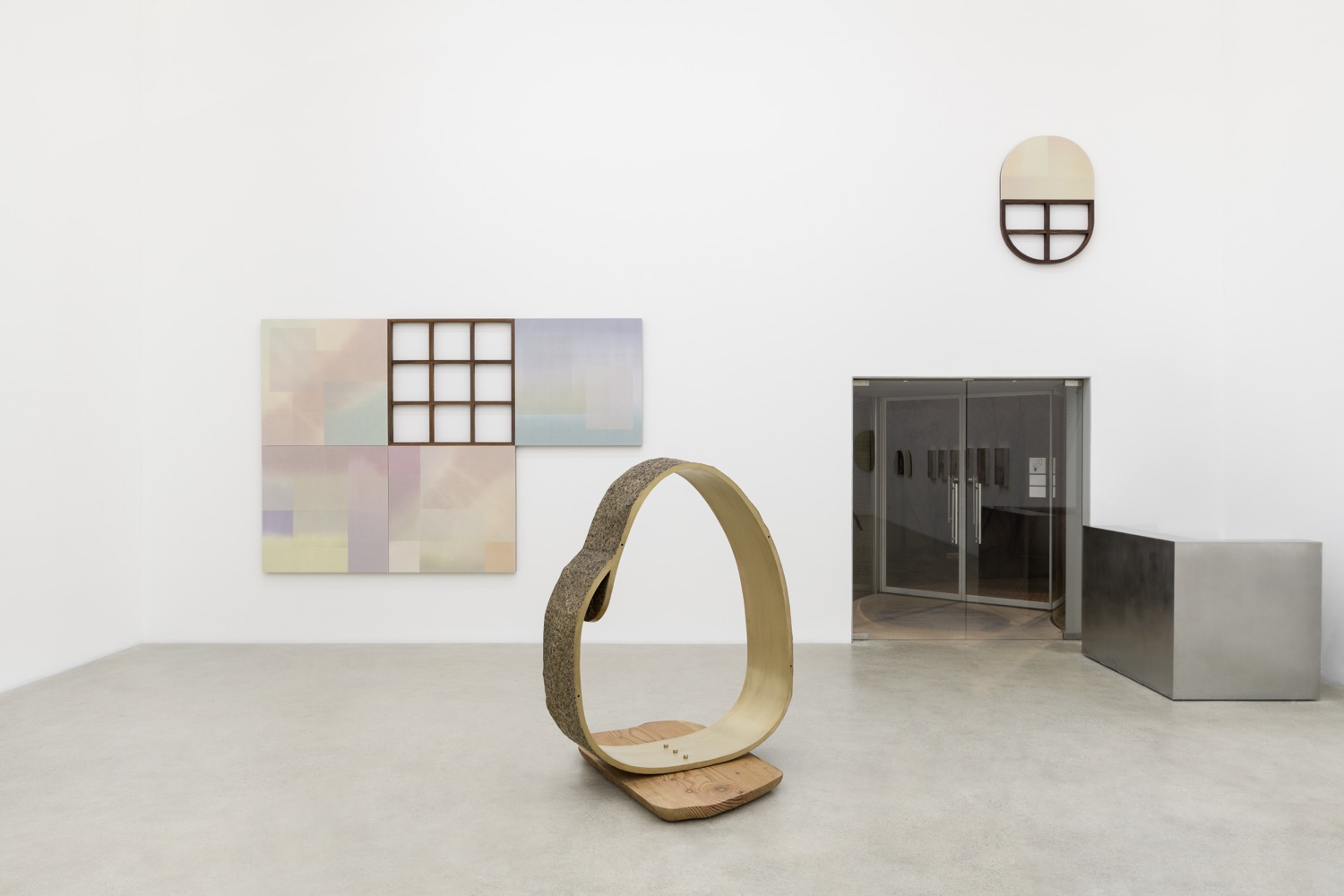
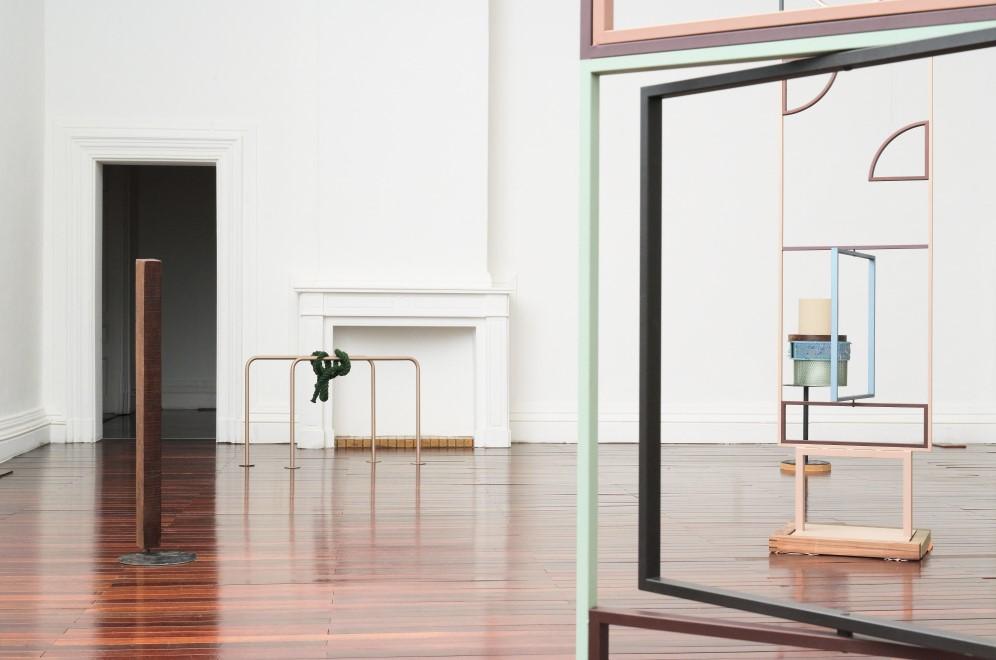
The elemental objects in Black Mat Oriole are
24inch by 32inch rectangular painted steel sculptures – enclosed rectangular
cuboids (the ‘Black Mat’ series) and frames (the ‘Jeong’ series) whose varied
and gradually expanding dimensions have been loosely determined by the body of
the artist. The size and heft of these works are also limited by Kang’s own
strength: her installation method of moving and arranging the sculptures herself
over many days requires that the artist’s body sets the parameters of how heavy
each work can be produced. This rectangular unit – Kang’s principal jeong, her
original “note” – assumes various configurations. These works double, half,
quarter, and third her originary dimensions, taking the form of painted
mulberry paper and canvas (the ‘Mora’ series) and steel paintings (the ‘Mat’
series), along with objects found or produced along similarly fixed units of
measurement.
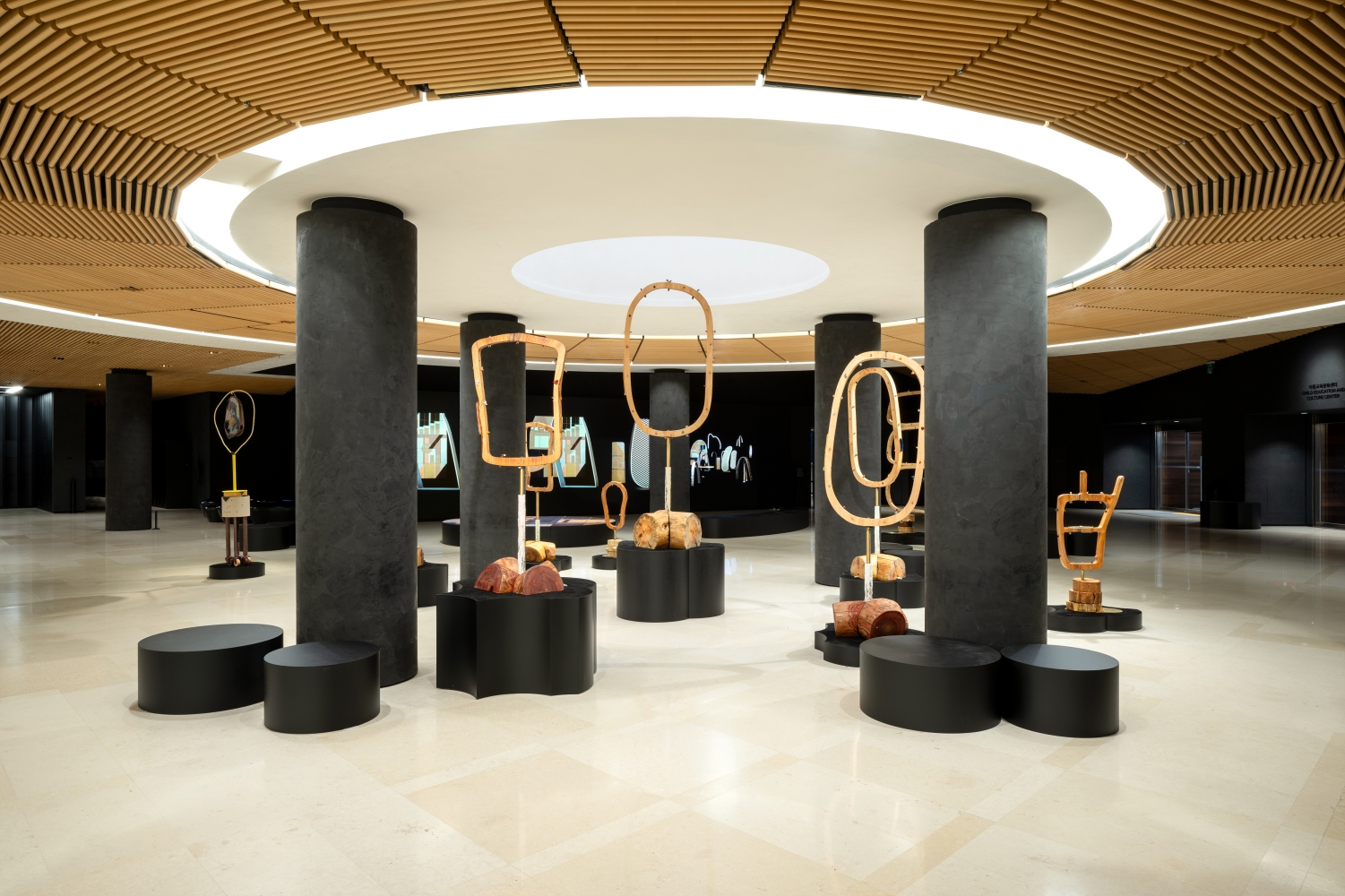
Steel cylinders are painted or perforated and woven with thread,
their shape and size based on a found object that Kang has refabricated (Warm
Rounds). A cut wooden log included in the ICA exhibition provides the
dimensions for a second series of cylindrical forms (Heavy Rounds).
These circular shapes puncture the Black Mats and Jeongs, providing hollow
spaces that are either filled or left empty by the artist. Kang has also
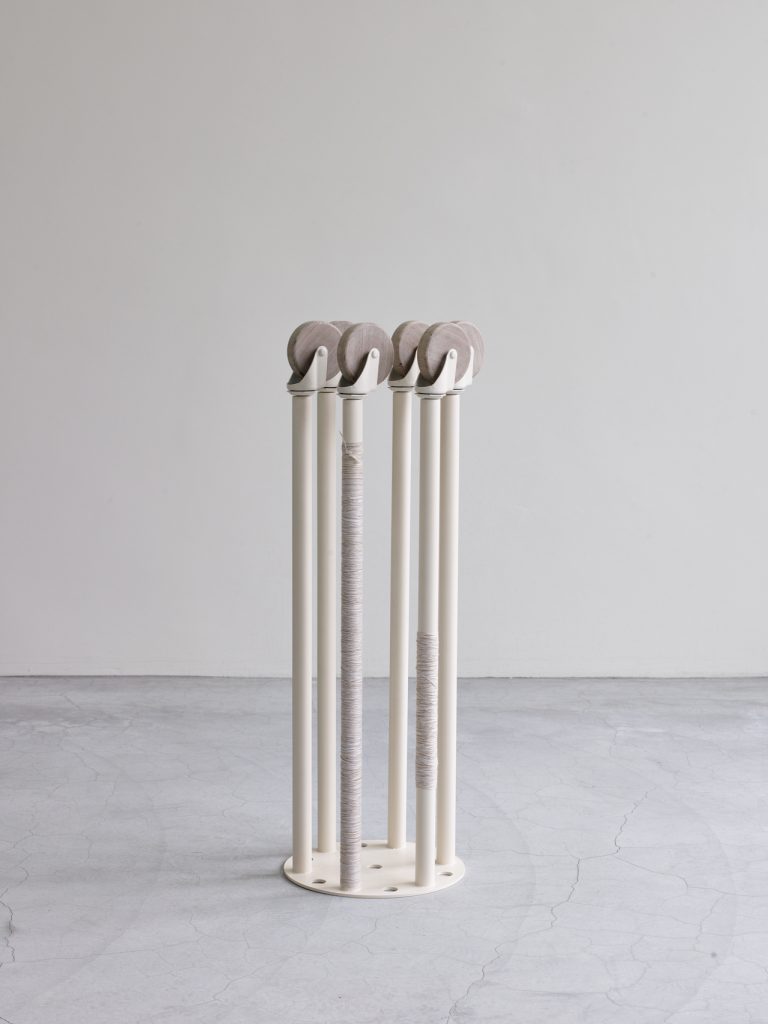
created a series of stackable supports for the various Rounds – steel legs with
wooden wheels made of walnut or cherry (Six Legs) and
spoolshaped steel (One Foots and Two Feets). Each of Kang’s
singular objects stands as both a discrete artwork and also as a unit that can
be combined and recombined in myriad variations to create larger sculptural
works. Installed collectively, they create unlimited iterations of Black
Mat Oriole based on the specificity of each exhibition space.
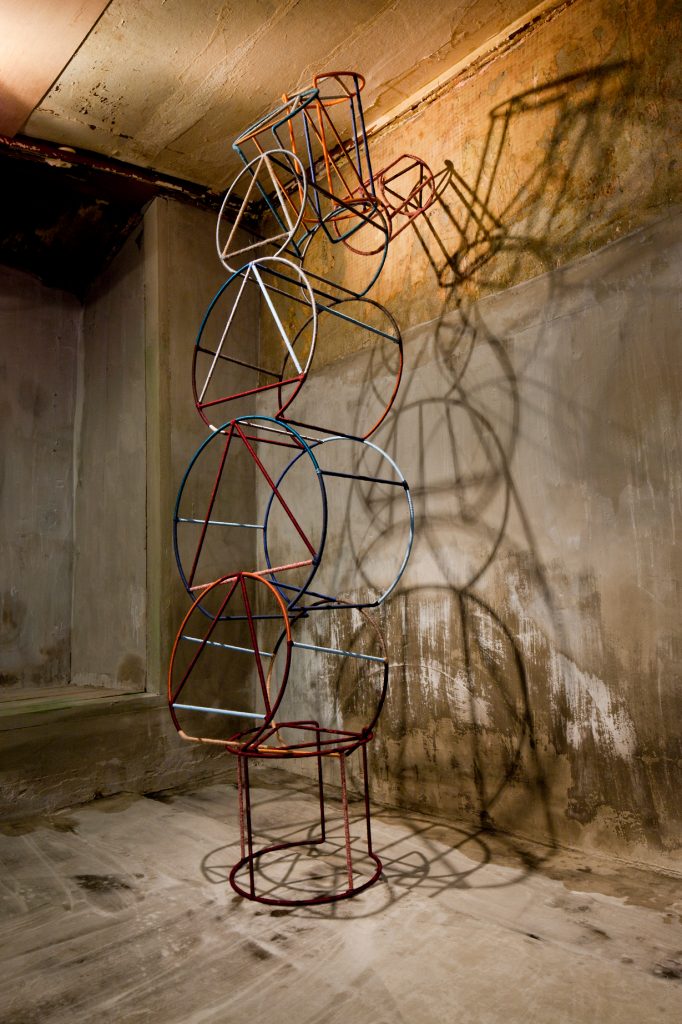
Many of these individual sculptures are drilled with multiple
holes at strategic points, which allow them to be joined by brass screws and
bolts in a variety of heights and angles. These couplings create structures
that hug the floor or balance their way upward, stacked vertically and
horizontally. Grids extend outwards from the floor, framing views of the
exhibition, or are affixed high on the wall, casting angled shadows across the
gallery. Through this multitude of parts, Kang builds threedimensional spaces
stratified with personal, historical, and philosophical references.
The entire Black Mat Oriole project stems from
Kang’s early consideration of corporality and the grid. The first iteration of Black
Mat Oriole debuted at the Gwangju Biennale and included the video Black
under Colored Moon (2015), which features performers Sunmee Kim and
Kaynam Myung, both in their 60s. The grace that Kang affords the aging actors
in this video, coupled with ongoing references to her grandmother, firmly fix
Kang within a lineage of artists who, as art historian David Joselit has
posited, fill their grids with “allusions to the domestic everyday world and to
an intense and palpable presence of the body.” [1]
The initial work that prompted her series, Grandmother
Tower, functions as a kind of homage to both the dignity and
mortality of Kang’s grandmother as her body – increasingly folded forward over
a walker and struggling to stand erect – aged. The curved metal structure of
the walker and its wheels have been transmuted through Kang’s objects over the
years, reappearing in Circled Stairs and Legs,
and most recently revisited in GRANDMOTHER TOWER – tow (2018), a series
that further embodies the precarious balance that inspired the initial work.
Sculptures titled Belly or Circled Stairs,
based on guard rails that Kang has miniaturized and painted teal blue, are
placed in front of hanging artworks in the ICA exhibition. Intended by the
artist as humorous moments, they simultaneously read as the “grab bars”
installed in bathrooms to aid those with mobility problems, often the elderly.
Kang’s tenderness for the aging body manifests more fully through the
revelation that her initial palette was loosely inspired by a private memory of
her grandmother.
Unable to effectively paint the metal surfaces of early Grandmother
Towers and related works, Kang turned to the castoff threads of the
Korean textile industry, augmented with purchased material, to color her
pieces. The slow process of wrapping these works – initially a necessity – is
now a conceptual choice. Kang labors for dozens of hours to clothe each piece,
swathing the armatures of the ‘Jeongs’ and the legs of the ‘Six Legs’ and ‘Two
Feets’ series, slowly weaving the porous Warm Rounds. The
soft, nubby tactility of these handmade surfaces is heightened by their
proximity to industrially produced metal, and one can imagine the sweep of her
grandmothers clothing across a metal walker as she moved through the world.
Black Mat Oriole is defined by a distinctive
paint palette – muted, muddied colors that veer into the pastel range. The
fiber she uses is similarly hued. Drawing on her training in traditional Korean
painting and its use of black ink, Kang develops her colors by mixing deepblack
pigment into blues, pinks, greens, yellows, and, most significantly, the
peaches and browns that produce her fleshtoned shades. Flesh in its weight and
texture, in its grip and vulnerability, is one of Kang’s central concerns.
Flesh acts as both shield and weakness for the human body, an aging, sagging
organ that reveals the effects of gravity and time. To fasten her objects, Kang
employs scraps of leather to protect the painted surface of the sculptures as
they press and scrape against one another, bound tightly by brass bolts or
delicately balanced in columns, pieces of dried and cured animal skin that
cushion within folds of cold steel.
Kang’s amplification of one’s corporeal awareness is the initial
prompt of the exhibition; viewers enter the galleries through panels of linen,
velvet, and synthetic black fabric that act as light blocks to the video room.
Through this coupling of texture and color she forces the viewer to reach out
and explicitly touch the work, beginning with the large velvet drapery that
opens the exhibition and has been handembroidered with the words, “Black Mat
Oriole,” in both Korean and English. Though the remaining exhibition objects
cannot be handled by visitors, Kang’s haptic intent lingers throughout the
gallery.
The domestic everyday finds further resonance in Kang’s
incorporation of mats called hwamunseok. These deceptively sturdy objects are
draped across Jeongs; rolled, stacked and folded into Black Mats; concealed
through the perforated steel of the Mat Black Mats; and spread across the floor
of the gallery. Woven from rush, hwamunseok mats are the floor coverings that
have occupied both palaces and the homes of the Korean artisans who produced
them for centuries.
In recent decades cheaper versions manufactured outside of
Korea have dominated the market, and traditional culling, drying, dyeing, and
weaving skills have gradually eroded. Inspired by the Chun aeng mu court dance
of the seventeenth century, which is performed on a hwamunseok, Kang
collaborated with weavers on Ganghwa Island, near the border of North and South
Korea to produce a series of specially dyed mats. Made from regional grasses
that are exceptionally white, this specific material allows for the dye to take
better than alternately sourced rush.
Hwamunseok continue to be made by women, a form of gendered labor
that echoes within Korea’s contemporary textile industry and the long history
of women textile workers leading the country’s labor movement. Already gridded
through the warp and weft of the weaving process, Kang has further structured
these mats by personally hand weaving cryptic geometric patterns in thread.
Layering the labor of her own hand over the labor of the rush weavers is a
rhetorical gesture, a generational and geographical collapse between the
traditional rural crafts that the government is attempting to preserve – named
and numbered “Cultural Treasures” – and the rapid urbanization the country
underwent in the twentieth century. The hwamunseok are produced on an island
within sight of North Korea, which furthers this precarious balance between
past and present.
The breakdown between medium and mass in the Black Mat
Oriole installations – that the work can be read as a whole (the
installation), as smaller parts (the stackable, malleable large sculptures), or
as the smallest parts (such as a Jeong) – is augmented by
video, which brings the latent dynamic energy of her objects into motion. What
connects her disparate disciplines into a seamless, if malleable, whole is the
moving body, the choreographic foundation that propels the project forward.
In
earlier projects, Kang often photographed her work in motion or being held.
Blackclad bodies move quickly across the frame carrying artworks, anonymous
hands grasp at the Jeongs. These images predate any intent on Kang’s part to
include performance in her work, and yet the urge is apparent. Kang is already
moving towards the choreographic, and her encounter with a seventeenth century
royal dance provided an allegorical platform that shifted the work further in
this direction.
The Chunaengmu, translated by Kang as the ‘Dance of the Spring
Oriole’ of her title (commonly referred to as the Nightingale Dance), was
performed for a court that adhered to strict modes of etiquette. Kang was drawn
to the Chunaengmu for its rare moment of political breach: a singular
occurrence during the dance where the female performer moves to the top of the
hwamunseok and bares her teeth at the king in a smile while holding her hands
behind her back, exposing her neck. A form of condoned transgression that
simultaneously signals vulnerability, this gesture fascinates Kang and acts as
an allegory for contemporary political subjecthood: her project finds this
metaphor in the choreographic, in the disruptive potential of moving bodies
through space.
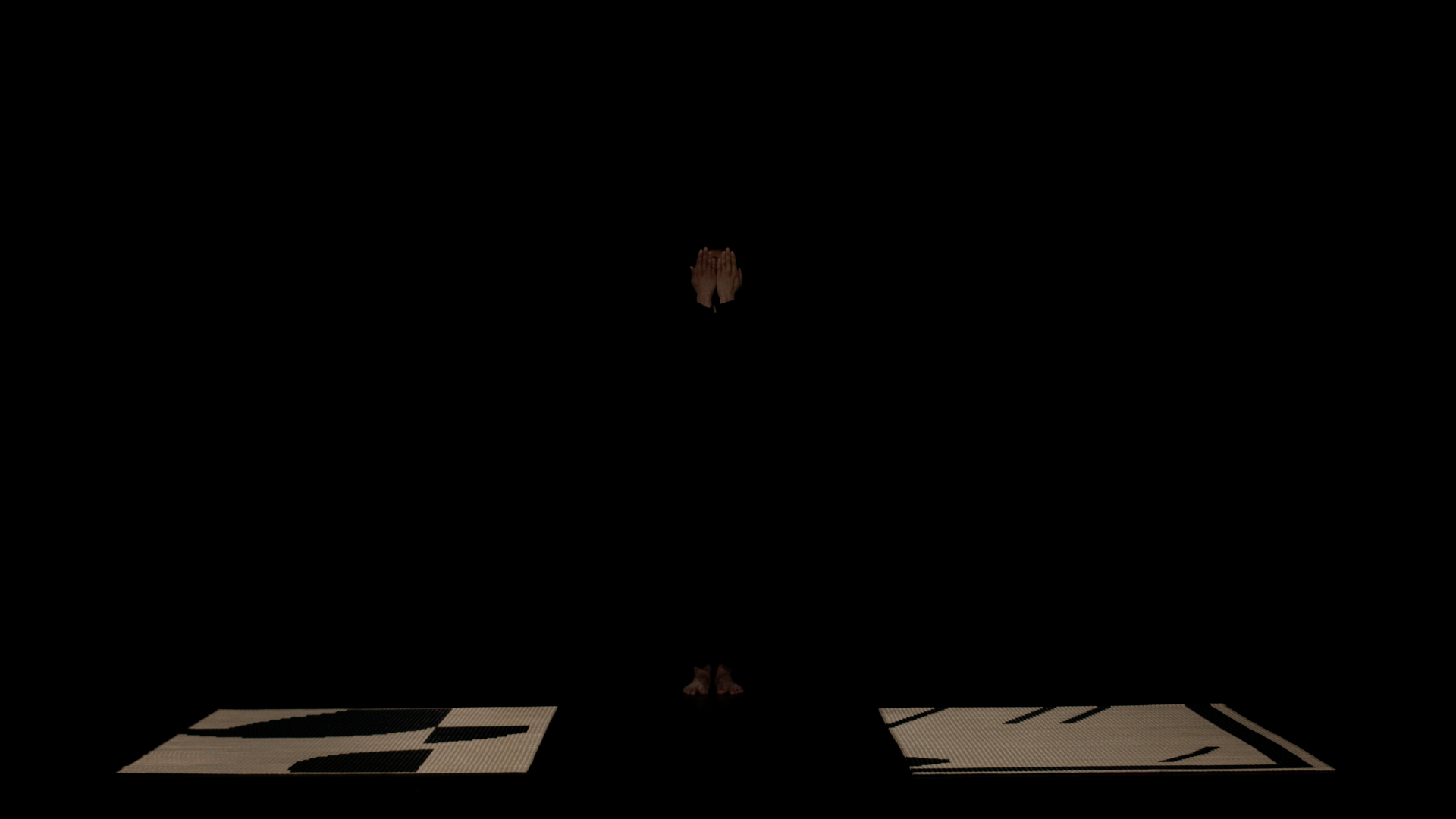
The performers in her videos are scripted. In Black Mat
Oriole she forgoes senior actors and pivots instead to a younger
cast. Their black clothed bodies move through the depthless space of a
three-channel projection, maneuvering and manipulating a collection of Kang’s
sculptures. She intended this to be the first room that visitors encounter as
they enter her ICA exhibition, a black box that tempers one’s sense of time,
its meditative pace set through minimal sound design by Jiyoen Kim. The
eight-minute video installation begins and ends with a “bak” clapper, a
traditional wooden instrument made of six wooden slats used by the conductor of
Korean orchestras to begin (one clap) and end (three claps) a piece. Kang
utilizes this object as one would a director’s clapboard in film, and it is the
only instrument shown onscreen. The interdisciplinary spirit of the project
finds a brief visual moment as film and conducting are intentionally conflated.
Kang’s nod towards the orchestration of sound in her work
emphasizes the Jeong as a centering device. In addition to its revelatory
synthesis of pitch and duration, the jeongganbo was the first Asian notation
system to allow for multi-instrumental scores. In Black Mat Oriole, single
piano notes are sustained over sparsely layered strings in minor key. The
actions of the performers are amplified by intersections of sound and movement,
such as when a young girl places a cylindrical Round into the matching hole of
a Black Mat, which signals the end of the video cycle before
the credits roll accompanied by three bak claps.
This echoes the opening of the
video, which features the same performer removing the Round, which soon appears
to roll of its own volition through a set of objects. Across three screens,
Kang focuses her camera on bodies as they interact with her objects, stacking
Black Mats and Jeongs on their bolted intersections. The imagery is often
somatic: disembodied hands embrace from behind, feet curl around sharp corners
of steel. There is a somnambulistic quality to the performers, a tinge of
alienated labor to their movements, even futility. They remain expressionless,
disassociated from the actions they endlessly execute. Though the video is
looped, there is narrative time, a beginning, middle, and end that Kang further
signals with opening and closing credits.
The gridded architecture of Black Mat Oriole is
softened during scheduled Activations, live performances
that take place throughout the run of the exhibition. Kang deliberately avoids
using the terms “dance,” “dancers,” and “choreography.” The word “scripted” is
deemed more accurate, and Activation is how she titles the
performances she stages within her exhibitions. These gentle, slowly scripted
movements produce a heightened understanding of the body within Kang’s space as
performers use their arms and legs to frame, point, and obscure the sightlines
that she has so carefully developed within the installation. Working with
contemporary choreographers yeongjun Cho and Hongseok Jang, Kang reimagined the
Chunaengmu; glimpses of this historic dance can be gleaned in the Activations
she developed for ICA, residual gestures within the pas de deux.
Set to minimally scored sound, two performers wearing black pants and shirts
move through a set of prescribed expressions while staying within the confines
of 24inch by 32inch Black Mats, one black steel and one a black hwamunseok.
Kang has also produced an Activation Manual for viewers based on the original
choreographic transcription of the Chunaengmu. This printed booklet illuminates
the forward and reverse linearity of her Activations: the second performer
repeats the manual backwards. As Black Mat Oriole has
progressed since 2013, the Activations have evolved from peripheral to
emblematic as Kang increasingly focuses on this aspect of the project, her
installations progressively shaped as stage sets that frame the performances.
Kang’s concern with temporality in Black Mat Oriole
finds its fullest expression during Activations, when the lived time of the
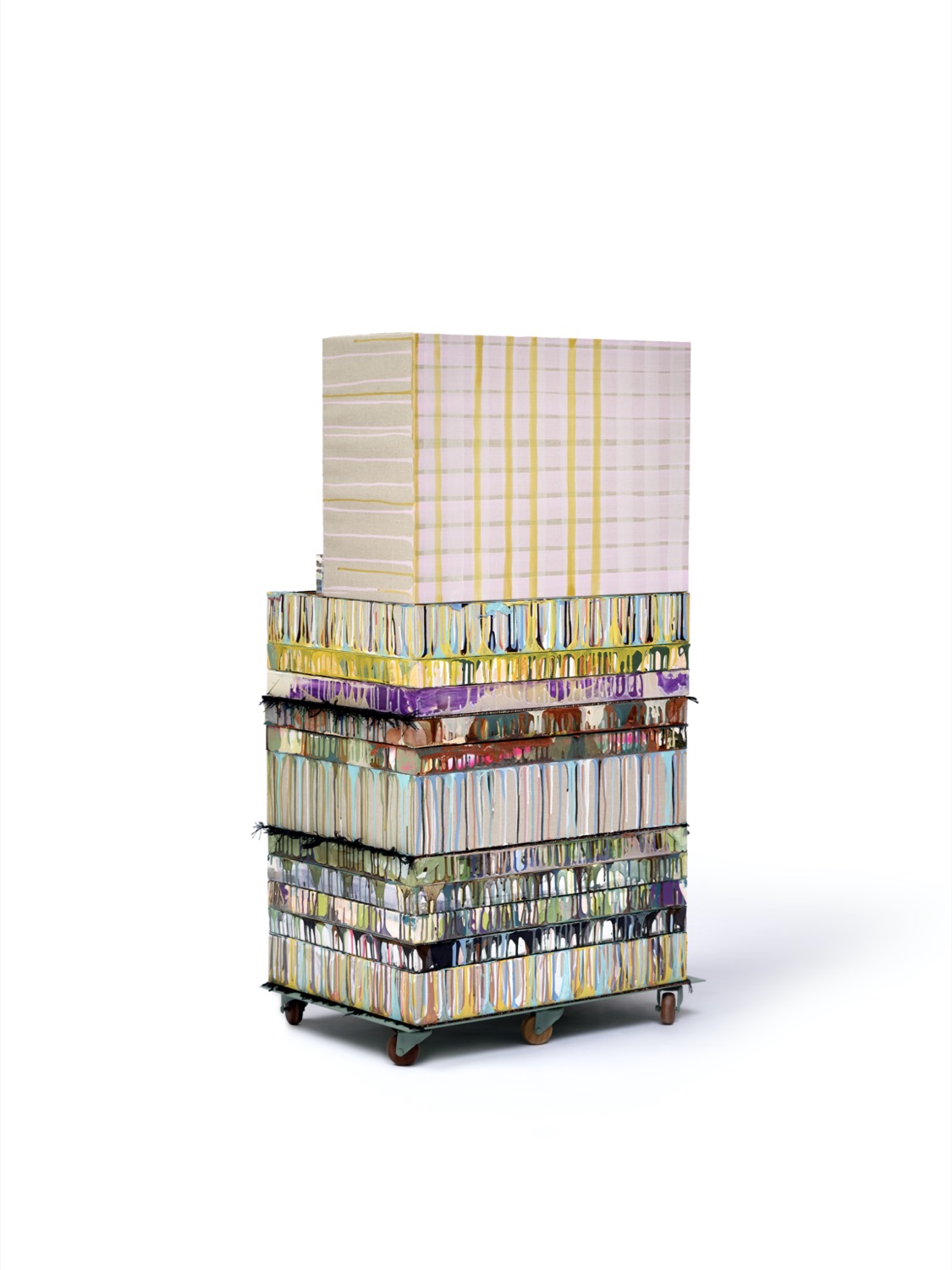
performers is contrasted with the linear time of the towering Mora
sculpture that looms adjacent. This stack of paintings, each also titled Mora,
refers to a linguistic unit found in several languages that is shorter than a
syllable and temporally based. Kang views this body of work as representing
units of time. As her artistic education included training in both Korean and
Western painting, she continues painting as a daily meditation, a moment to
interface with the blank surface of the canvas and its intersections of
historical weights.
The Mora function as moments, as
measures of time that ground her practice in a specific medium. Originally
installed on gallery walls, for the ICA exhibition Kang has stacked them to a
height that renders their surfaces illegible, intentionally obscured from
sight. The Mora stand ominously behind the performers,
marking what Kang refers to as “vertical time.” They are a record of her
practice, a spatialization of time.
Kang’s initial ‘Activations’ were performed by choreographers
Hyeongjun Cho and Hongseok Jang, who worked with her for several months
developing the movements and offering an ideal form for the Activation before
it evolved in a more egalitarian direction. Subsequent performances at ICA were
completed by professional dancers who used Kang’s manual and instructional
video to learn the proper choreography, while Kang further democratized the
project at the Liverpool Biennial (2018) by incorporating people with no dance
experience to perform.
For her presentation in fall 2018 at a local community
center in Stockholm, organized in collaboration with Tensta Konsthall, she
invited local residents to bring their own “mats” – yoga mats, small rugs,
towels – and follow along to an Activation video. Though Kang is expanding Black
Mat Oriole in a democratic gesture of inclusivity, she insists that
the Activations be performed on a mat, that you are free to interpret her
script but confined within your own space.
Space is, after all, a framework of power. Though Kang is familiar
with Michel Foucault, the theory of power Kang develops within Black
Mat Oriole springs directly from the Chunaengmu and its negotiation
of political freedom and transgression, between boundaries and the pleasure of
breaking them. The dancer of this seventeenth-century score bares her neck with
a smile, signaling a challenge to the sovereign that is simultaneously one of
submission. Kang recuperates this gesture within the galleries and biennials of
the twenty-first century art economy, the white cubes that circulate billions
of dollars worldwide. She does not provide an alternative, but simply a space
within which you can move your body with other people, communally, and with
purpose.
1.David Joselit, “Mary Heilmann’s Embodied Grids,” in Talking
Painting: Dialogues with Twelve Contemporary Abstract Painters (New York:
Routledge, 2002), 107.