Making is the thinking, and thinking is the making; and the
painting is the thinking, and the thinking is the painting.– Suki Seokyeong Kang[1]
In his critical study, “Painting as Model” (1993), art historian
YveAlain Bois attempted to reconcile how painting – especially
nonrepresentational painting – could be interpreted without adapting it to fit
theoretical paradigms or resorting to pure formalist readings. Instead, he
proposed that a painting be approached as an epistemological frame in which
form and context come together to create another system of inquiry. Is there a
“mode of thought of which painting is the stake? Can one dream in painting as
one can dream in color?”[2]
For the artist Suki Seokyeong Kang, the answer to
these rhetorical questions is an emphatic, “Yes.” In her ambitious
constellation of works, grouped together under the title Black Mat
Oriole (2011–2018), Kang formulates what she has termed an “attitude”
to painting.[3] This attitude is at the core of an evolving body of work that
encompasses what might traditionally be read through the discrete domains of
painting, installation, sculpture, craft, and video art. However, to approach
Kang’s project solely through its mediumspecific properties is to potentially
miss both the more allusive gestures that permeate her work and the systematic
structure by which that work is made legible.
In order to address Kang’s “attitude” toward painting, it is
important to have a sense of the phenomenological experience of encountering
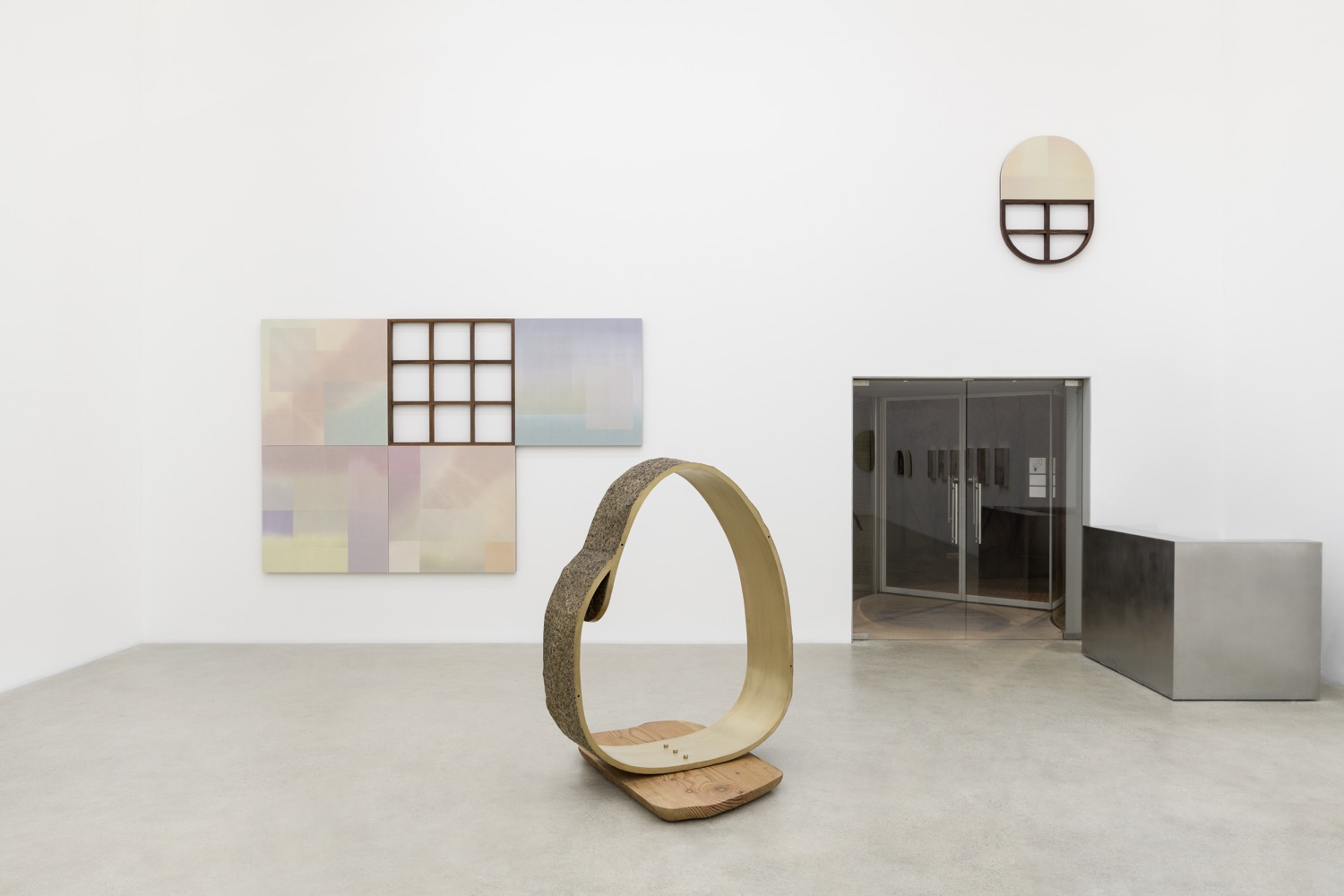
her work. As viewers enter the exhibition at the Institute of Contemporary Art,
University of Pennsylvania (ICA) they pass through a specially designed black
curtain with the title of the exhibition, 《Black Mat Oriole》, sewn in English and Korean, foregrounding text, touch, and
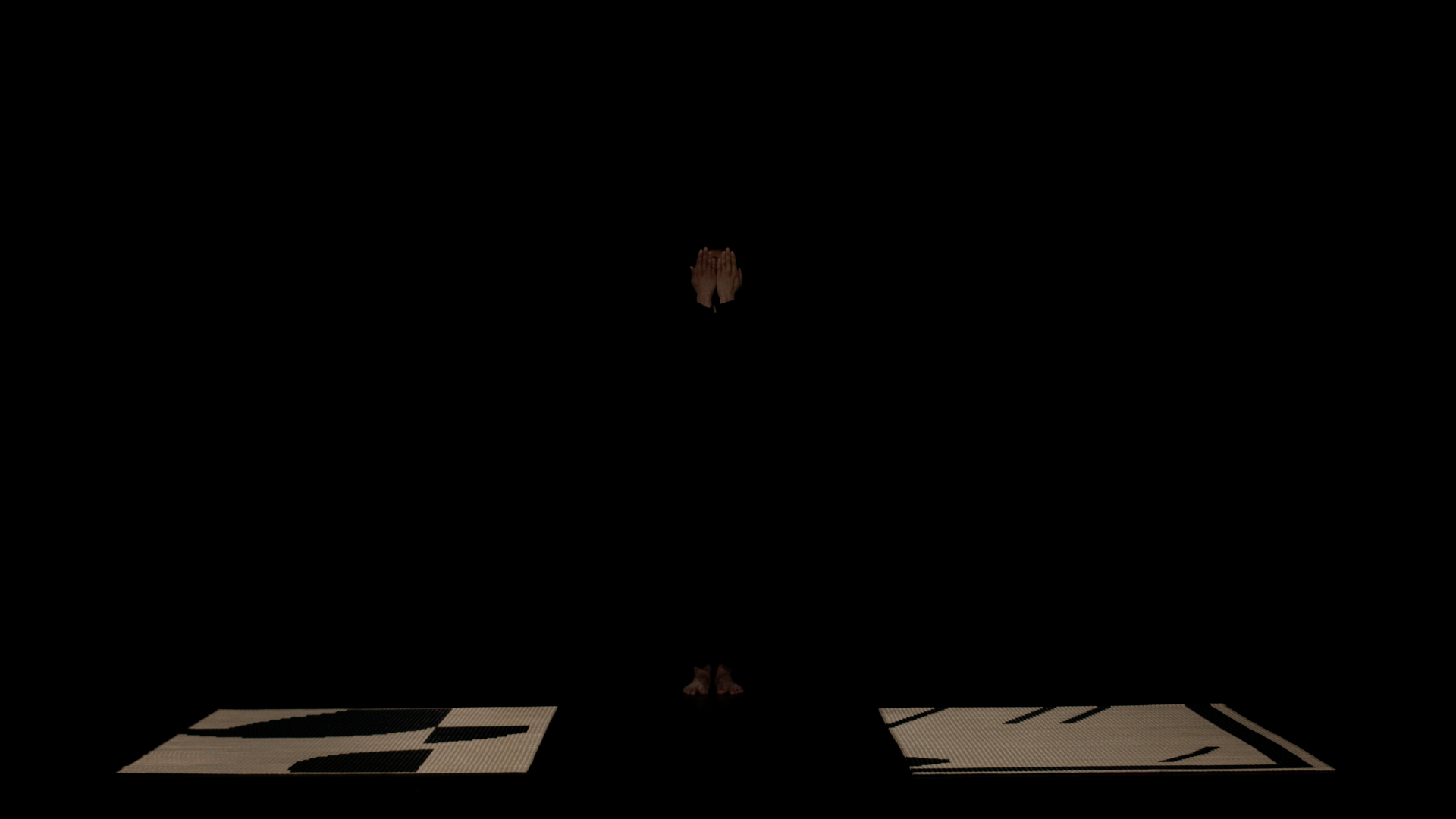
color. Inside they encounter Black Mat Oriole (2018), a
video triptych in which Kang’s sculptural objects, some of which have wheels
that roll and hinges that swivel, are both activated by actors and seem to move
magically of their own accord, accompanied by a minimal score.
In one frame a
young girl places a sculpture inside the hole of another sculpture, while in
another a plain white cylinder rolls across the screen. Exiting the room and
passing through another black curtain, viewers enter a brightly lit gallery
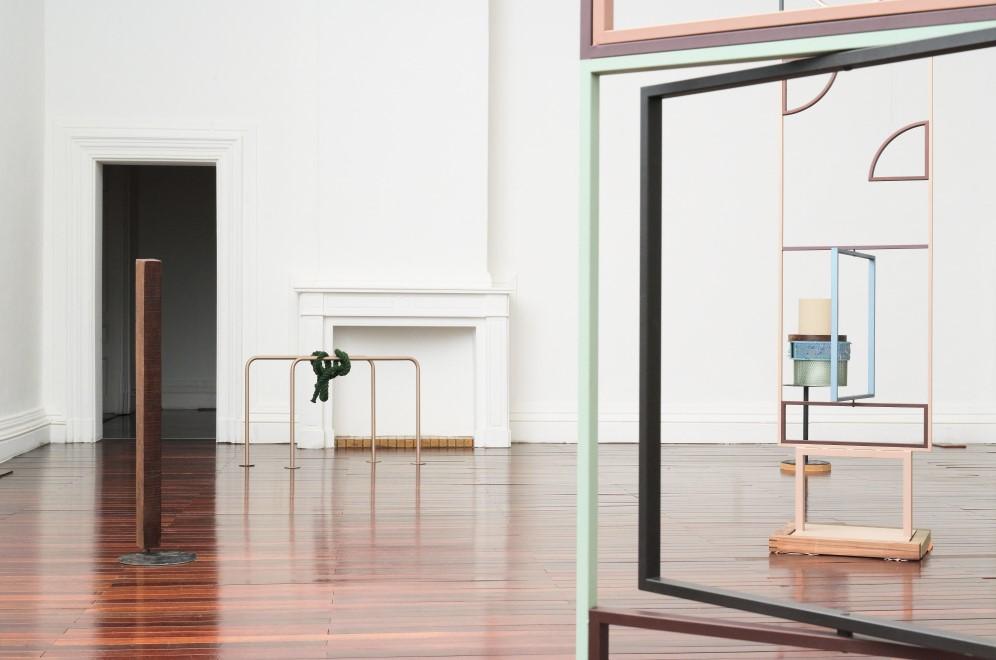
with an installation composed of paintings and sculptures from the video. Although
the objects within the room remain static, the video has prepared the viewer to
intuit their kinetic potential.
Among the numerous discrete artworks that make up the
installation, it is worth attending to Kang’s Mat 55 × 40 #18-01
(2017–2018) as a way to consider the interdependency of form and concept that
undergirds her “attitude.” Hung on the wall of the gallery, the object can be
approached frontally in the manner of a traditional painting. However, instead
of a canvas, the viewer is confronted with a light gray rectangular steel form.
The front is punctuated by evenly spaced, striated openings that run vertically
on the top section and horizontally on the bottom.
Upon close inspection, it is
discovered that buried inside the steel frame is a handwoven mat, dyed black
and brown, hanging suspended by multicolored threads attached to the interior,
its tassels threatening to poke out. Looking closer one observes that these
threads also extend outside of the steel box through three holes in the base,
wrapping around the bottom. Stepping back, one’s attention is drawn to the
sides of the object, which are punctuated by metal screws with bits of leather
in shades of tan, gray, and yellow. Without knowing anything about the logic or
formal strategy behind the making of Mat 55 × 40 #18-01, we
can begin to decipher some of the key components of Kang’s painting practice.
Here, a painting is many things: it is a three dimensional object that is
simultaneously a window, a container, and a screen; it is both manufactured and
handmade; it is regularized and unbalanced; it is a barrier and a support
structure.
Reflecting on the recursive event of the “death of painting” – a destructive
and deconstructive impulse that would seem to haunt, if not define, the Western
modernist project – Bois sympathized with the pressures automatically placed
upon painters working after his canonical examples of Marcel Duchamp,
Aleksander Rodchenko, and Piet Mondrian. While the reverberations of these
projects undoubtedly inform our contemporary moment, the stakes for and
associations with abstraction have been complicated anew in the twentyfirst
century. The recent resurgence of abstract painting has been alternately
characterized as a response to the industrialization of the image and its
digitization; a symptom of the breakdown of global finance capital; and as pure
commodity or marketfriendly pastiche.
Furthermore, if today the earlier debates
surrounding Abstract Expressionism or Dansaekwha feel at a generational remove,
so too are their respective political contexts of Cold War nationalism and the
aftermath of the Korean War, during which the rift between North and South,
colonial trauma, and the rise of dictatorial rule were not only recent events,
but lived experiences. The predicament for any contemporary artist’s engagement
with painterly abstraction is thus how to consider, if not contend, with these
crosspollinated histories and legacies, while also situating oneself in the
present. As the urgency of these sociopolitical contexts is historicized,
artistic actions are retroactively codified as genres and become internalized
as formal and conceptual strategies that can create direct lines of influence
just as they can produce unintended affinities, unconscious alliances, and
surreptitious synergies.
In response to these challenges, scholars such as Joan
Kee have proposed a methodological approach that navigates “points,” which Kee
defines as moments of encounter, and “lines,” which “denote lines of thinking,
embedded lineages, or trajectories of behavior” as a way to evade the
“artificial distinctions pitting a center against a periphery, tradition
against modernity, form against content, and perhaps the most commonly invoked
of all, the local against the global.”[4]
Kang’s proximity to these art histories is admittedly multivalent.
While she acknowledges Western modernism’s project of reduction and has found a
kind of retroactive kinship with the projects of other artists such as the
minimal grids of Agnes Martin and the performative textiles of Franz Erhard
Walther, her relationship to abstraction is firmly grounded in her formative
training in traditional Korean painting. She began her studies in high school
and continued on at Ewha Womans University in Seoul, where she became skilled
at ink painting. As Kang learned classical techniques, she internalized what
she describes as, “a different way of seeing and of acting with her mind and
body.”[5]
This approach is central to how she defines her attitude toward a
contemporary art practice. It is also an important key in differentiating her
work from an older generation of Korean abstractionists working in the 1970s
and 1980s, associated with Dansaekwha (translated as “monochrome painting”),
who were celebrated for their commitment to repetition and nonfigurative
painting, as well as a bodily relationship to their materials. While Kang
recalls learning about twentiethcentury painters, such as Whanki Kim and Yun
Hyongkeun (whose own black paintings merit further consideration in relation to
Kang’s work) in her textbooks, rather than explicitly draw upon these
references from the near past, she instead embarked on a deeper consideration
of the historical registers of ink painting, asking what such an investigation
might mean for a project of painterly abstraction in the present.
Kee has
referred to ink painting as the “suppressed other of contemporary Korean art,”
yet in traditional ink painting, Kang developed her own approach to how space,
color, time, and language could operate.(6) While artist Lee Ufan reportedly
refused to use black specifically because of its association with ink painting,
Kang’s palette is decidedly grounded in the black of ink. For Kang, black ink
is not just a material, but a physical reference to the written word and to the
hue underlying the full spectrum of coloration. She explains, “The black ink
for me, it’s not only about the color. It’s more about the material that
contains possibility. The possibility to mix with water. For me, the black ink
is more like the land, or a platform.”[7]
If, for Kang, the picture plane is representative of a kind of
landscape upon which to stand, it is also indicative of the perspective of the
individual. This concept was in part derived from her understanding of trueview
landscape painting. Popular during the later part of the Joseon Dynasty
(1392–1910), the trueview painters turned away from the cultural influences of
China to focus instead on a celebration of the beauty of the Korean landscape.
In these depictive works, Kang found inspiration in the direct experience
between the artist and the environment which lead her to consider the position
of her own body, her gaze, and her actions towards the greater whole of
society.
Through her longterm engagement with ink painting, Kang internalized
the piece of paper and, in effect, the canvas as a horizontal field. Unlike art
historian Leo Steinberg’s theorizations of the flatbed picture plane – in which
he argued that painting had moved from the vertical orientation of representing
nature to a horizontal plane that receives culture – for Kang, this
horizontality is representative of a physical space to be occupied. Approaching
painting as a spatial problem gave her permission early on in her career to
work in an expanded manner that fused traditional methods with unconventional
formats such as timebased media, including film, animation, and installation.
It has also informed an approach to flatness perceived in the round.
This is evident in both her video triptych and the sculptural
arrangements that form the 《Black Mat Oriole》 exhibition at ICA, where
the composition of the screens and the objects placed within the gallery are
all determined in relation to the precise measurements of Kang’s gridded
system. In art historian Rosalind Krauss’s 1979 essay, “Grids,” she positioned
the grid in opposition to language, proposing one model that folds back on
itself, referring only to its own frame, and one that attempts to address the
exterior structure of the world. Writing on the problem of feminist abstract
painting, curator Helen Molesworth, further reflected on Krauss’s polemic:
“[L]ike all structures, it contains within it the traces of historical forms.
So, on the one hand the grid signifies the infinite space of art’s autonomy and
on the other the symbolist window.” For Krauss the “symbolist window” is
likened to a “trauma that must be repressed,” yet as Molesworth observes, this
need not be oppositional. “[T]he grid always contains both modalities.”[8] As
Kang likewise reminds us, the grid can be a formal system that also points
outwards.
Kang’s grids originated within the parameters of the page and
continued with her investigation of the jeongganbo, a musical notation system
developed during the Joseon Dynasty that is distinct in the way it is able to
precisely communicate duration and pitch. Within this structure, each note has
its own square, or section of the grid, which metaphorically relates to Kang’s
preoccupation with individual agency and in effect, political space. For Kang,
the spatialization of the paper extends to the architecture of the gallery,
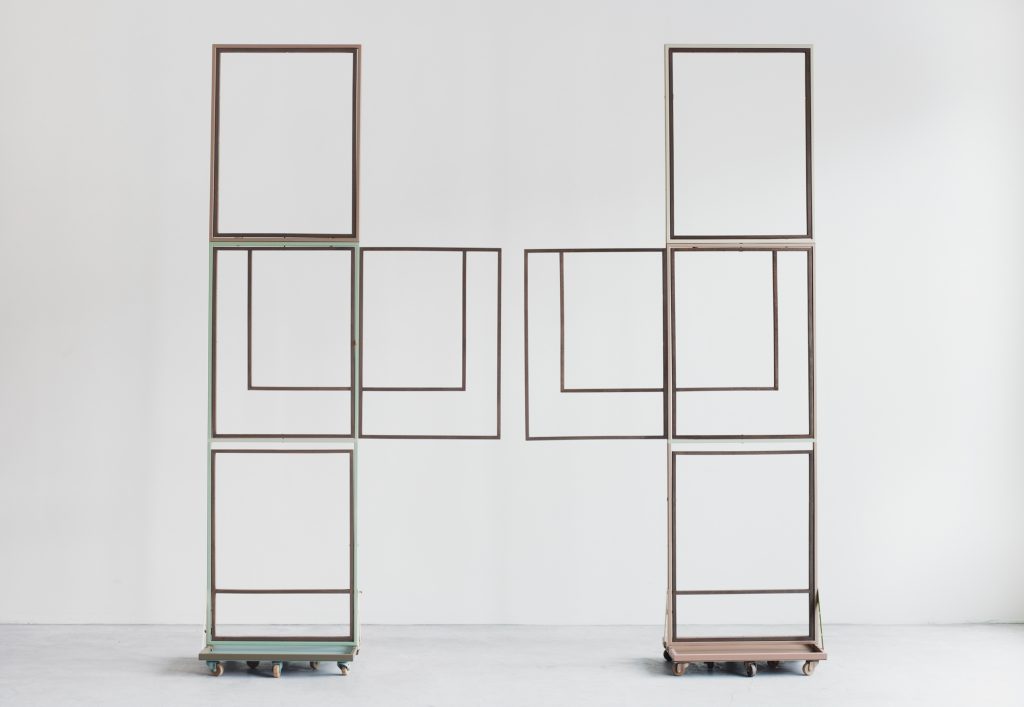
which itself becomes a part of her painterly grid. Within this system are
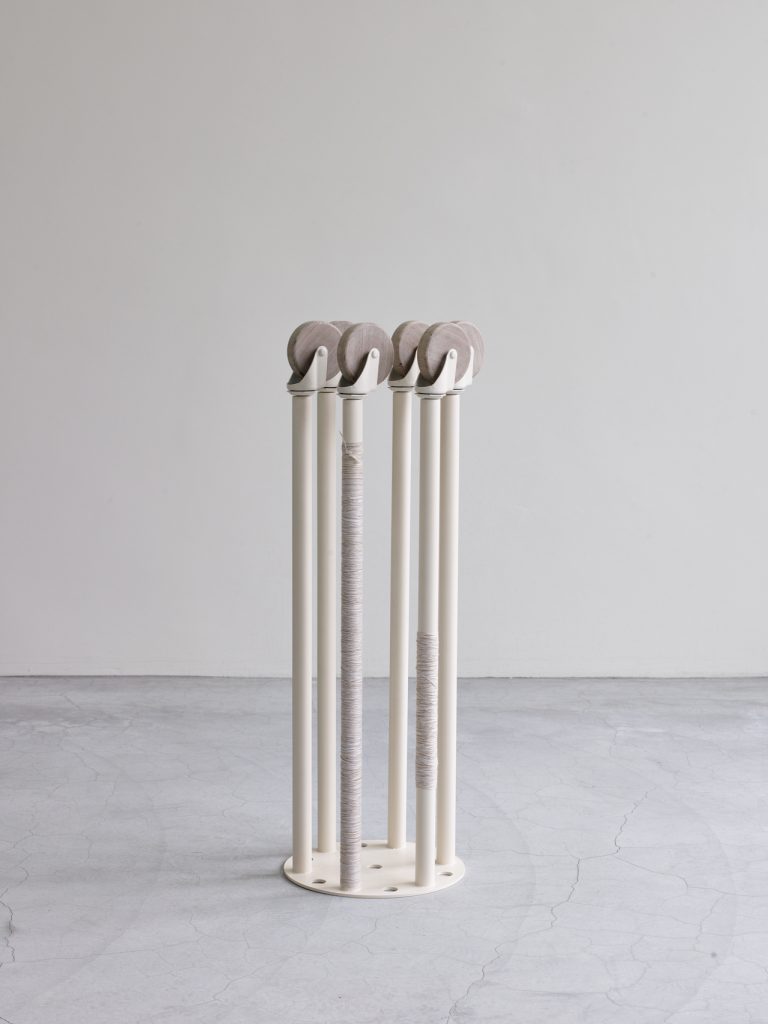
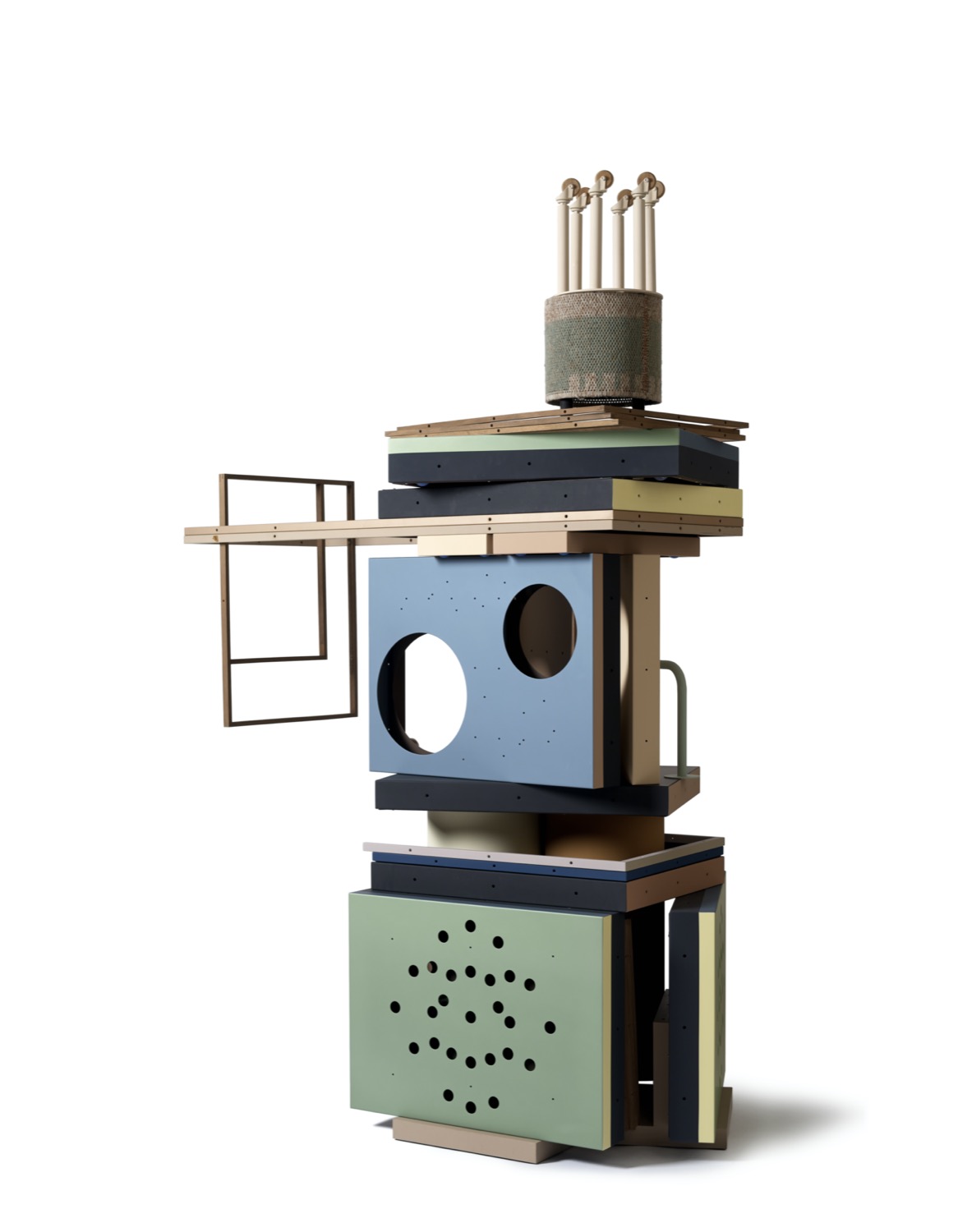
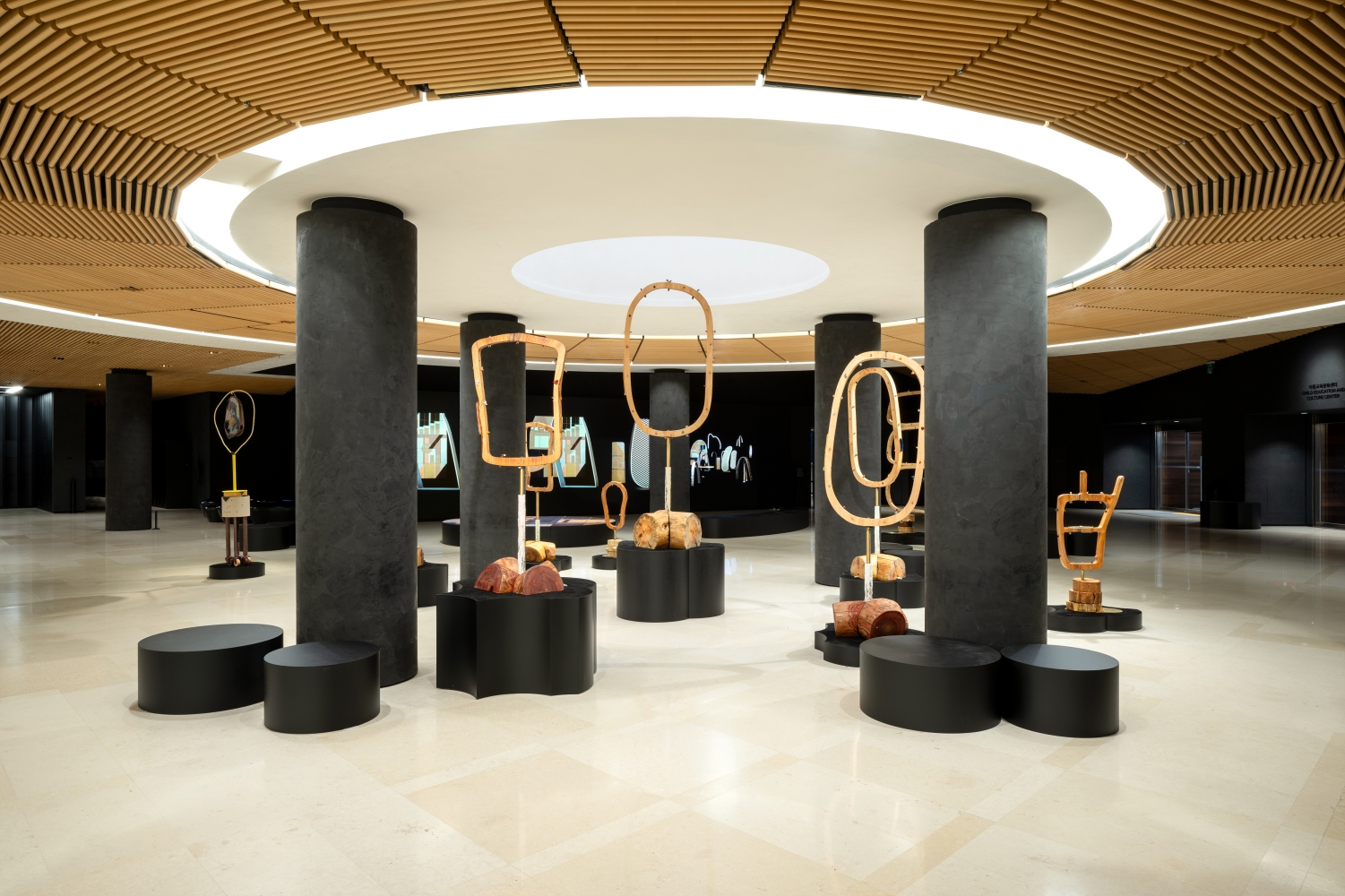
individual ‘jeong’ – wooden skeletal sculptures that Kang produces in relation
to the measurements of her Black Mats. Hinged together, they
can swivel to fit the space, acting as frames for bodies and objects.
Within
the ICA installation they appear clustered together in sculptural formations,
sandwiched in between other objects, and hung as racks for handwoven mats. They
are also installed protruding out from the wall where they are transformed into
windows, as if to suggest the gallery space as a standin for the grid of the
city. In urban theorist Kevin Lynch’s book The Image of the City (1960), he
refers to the visual memory of pedestrians as they make their way through an
environment as “imageability.” This is perhaps helpful in thinking about how a
viewer might navigate Kang’s installations, which are filled with sensual
beauty and uncanny moments. Similar to Lynch’s observation that urban
pedestrians remember certain visual landmarks, nodes, and boundaries, here too
we begin to learn the artist’s language through a “cognitive mapping” of the
space through physical experience. Although for Kang each arrangement begins
with the logic of her paintings and mats in relation to her own body and the
specificity of the gallery, it is her hope that a viewer will become a kind of
participant. By moving amongst Kang’s objects,
a viewer creates their own narrative and becomes attuned to their body as they
make decisions about how and where to move. The gallery is in effect another
kind of jeong in which the viewer becomes a performer of the score.
Kang has stated that she was drawn to the Chinese character for
jeong (井) because it resembles a section of a grid.
Emphasizing this connection to linguistics, she reflected, “For me the grid is
like a text (or note). It is always two things together.[9] This doubleness is
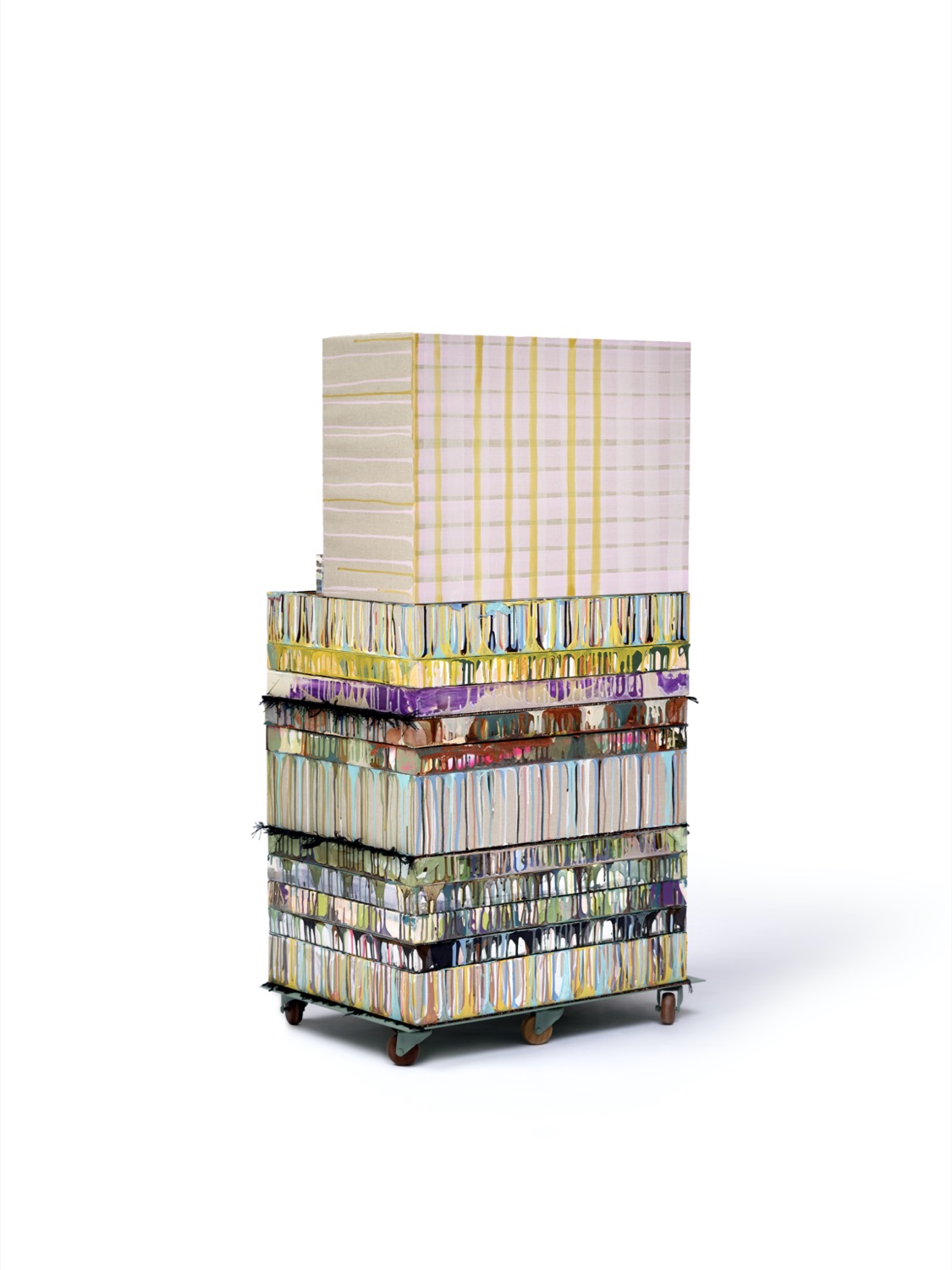
also embedded in Kang’s colorful paintings, which she refers to as Mora.
Resonant with her interest in the jeongganbo, “mora” is a term employed in
phonology (the branch of linguistics that relates to sound), which refers to an
individual unit employed to measure syllable weight and timing. Each surface of
Kang’s abstract compositions is unique, but is stretched over bars that she
only produces in two different sizes (the only exception being their thickness)
so that, like an actual mora, the paintings can be assembled in different
combinations, much like a word or a sentence.[10]
This flexibility of display
allows her to hang the Mora on a wall as paintings, but also
enables her to treat them as objects that alternately sit perched atop
sculptures and stacked on top of each other to form towers. While the
parameters of the paintings’ structures are rigorously adhered to, the process
by which they are independently made is deeply personal and intuitive. To
create each painting, Kang begins by placing a canvas flat and then covering it
with hanji (a traditional handmade Korean paper) providing yet another
connection to the written word.[11]
She then proceeds to build up the colors,
layering, brushing, and dripping her gouache until the material has been
thoroughly soaked through and the pigment has dripped over the edges in
anticipation that the painting will ultimately be regarded from many sides.
Indeed, the distinct colors of the Mora are produced by
mixing black ink into the different pigments and in turn provides the reference
from which she determines the precise array of colors for all of her sculptural
forms.
This semiotic system resonates with the entanglement of word and
image in logographic languages, such as the classical Chinese that Kang learned
during her studies. However, she has stated that this preoccupation has less to
do with pure calligraphy and instead draws inspiration from histories of Korean
literary painting, which merges poetry and calligraphic form. Kang has devoted
herself to unearthing and studying these classical texts, dances, and systems,
intuiting that they have instructive value in the present.
Within these
examples, Kang feels she is constructing a framework for a contemporary Korean
art practice that is rooted in its own history and context. In her earlier work
Kang made her literary interests explicit through the actual inclusion of text
and poems. However, these references, while still core to her thinking, have
increasingly receded into the background as an invisible foundation for her
artistic decisions.
Indeed, there are multiple registers by which to “read” Kang’s
work. In addition to the textual references that point to different
temporalities, Kang has also developed her own lexicon of objects from found
materials. Sometimes she uses the actual objects as a kind of anchor
disconnected from their original function and now employed in the service of
form, while at other times, she recreates their form through fabrication,
abstracting them from their original functions. Writing from a Marxist
perspective, art historian Meyer Schapiro observed that with the rise of
industrialization and the increased alienation from our bodies and the means of
production, artists began to reemphasize gesture and the hand.
In Kang’s oeuvre
this is articulated through a juxtaposition between the industrial and the
handmade, and between precision and intuition, in which these ways of making
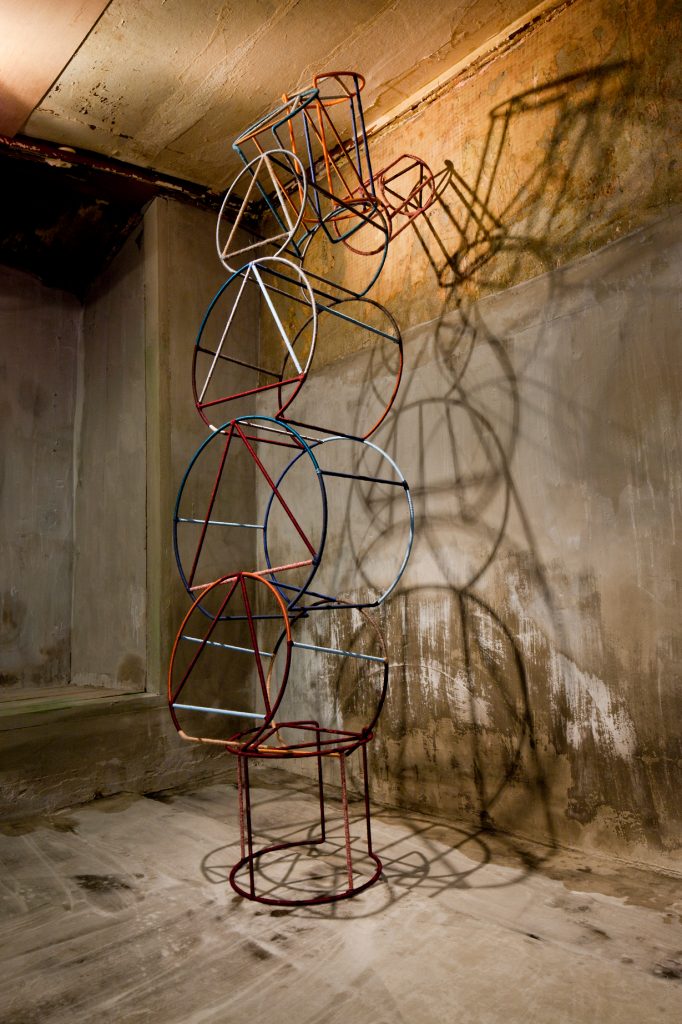
would seem to be interdependent. An example is found in her Warm Round
sculptures that are derived from a found, mass produced, utilitarian object and
then reproduced in multiple as a skeletal base for her woven sculptures. Once
fabricated these metal cylindrical objects, which are riddled with evenly
spaced holes, are then covered in multicolored thread sourced from factory
surplus. Each one of these objects takes the artist three months to weave by
hand and, like the process of the Mora, the pattern is not
determined in advance.
This tension between the factory and the hand, and between schema
and chance, is also evident in the manner in which actual paint is deployed
throughout Kang’s work. The artist’s physical presence and expressivity is
necessary for the Mora, whereas the steel sculptures are
professionally coated following the artist’s precise instructions and personal
color chart, placing improvisatory gesture in direct correlation with the
flatness of mechanical operations. This twofold approach to painting is also seen
in the Heavy Round, when the form of the Warm Round
is produced without holes and instead its smooth cylindrical surface is coated
in paint and ground down by hand. This also underscores the different
temporalities at play in her expanded approach to painting and is perhaps best
exemplified by Kang’s most essential unit in this body of work – the “black
mat.”
Within the Black Mats, text, body, and grid coalesce. To date, the
black mats have been conceived in two ways: they are steel objects that mimic
the specific sizes of the Mora paintings as well as
hwamunseok, a kind of traditional Korean mat woven with a specific white rush.
Kang’s interest in the mat began with her study of a traditional dance called
the Chun aeng mu (translated as Dance of the Spring Oriole), developed by Prince
Hyomyung in 1828 during the Joseon Dynasty. The dance would have been performed
for the royal court and is distinctive in that it only features one dancer who
enacts a series of precise movements within the confines of a special
hwamunseok. Of particular interest to Kang is the relationship of the dance to
the written word.
Each movement within the choreography is documented by both a
drawing and a fragment of poetic text. For example, in one instance, the phrase
hwajeontae describes a bird perched on a flower. This is translated through
movement to become the highlight of the dance. In that moment the dancer clasps
her hands behind her back and smiles, an action that would have been seen as a
kind of transgression as it was not permitted for dancers to open their mouths
in front of the king. Yet it is a condoned form of transgression that is both
enacted by the individual within the confines of her individual space and made
possible by the societal structure around it. Although this moment is the
culmination of the dance, it is easy to miss unless one is paying close attention,
not unlike the many details that are embedded throughout Kang’s artworks.
In this sense Kang’s mats are both metaphoric and actual
platforms. As sculptural objects the steel mats act as a foil for the ‘Mora’s –
registering as the industrially produced counterparts to the painterly canvases
– and as key components in the artist’s gridded system. But they also refer to
the woven mats, which Kang produces working with women artisans based on
Ganghwa Island in the northern part of South Korea. These kinds of mats would
have once been common objects in Korean households, but are now predominantly
produced cheaply overseas and imported.
Furthermore, with the increasing
Westernization of the Korean household there is also less demand. The number of
craftswomen who still produce the hwamunseok are dwindling and Kang sees her
engagement with them as one way of keeping a material tradition alive. Each mat
is produced following a design by Kang and takes approximately one month to
complete. After the rush has been dyed and woven to Kang’s specifications, she
brings the mats back to her studio in Seoul where she adds her own threaded
graphic patterns. Textiles are in effect an organic approach to the grid, and
are also connected linguistically in English to textuality.[12]
Similar to the Mora,
there is a flexibility to how the hwamunseok are displayed. At times a viewer
might encounter them as decorative hangings on the wall, rolled up on a ledge
or displayed on the floor. In other instances they are sandwiched in between
Mora as dividers or hidden within sculptural objects, suggesting that Kang’s
objects are imbued with interiority. The hwamunseok are crucial in this regard.
As with all of the elements in Kang’s work, they have a direct correlation to
the human subject, and relate to her desire to develop an abstraction of and
for the body that is bound up with her understanding of the individual. She
states, “For me, subjectivity and agency are slowly suspended in abstraction.
Subjectivity and agency arise from unbalanced contrast and uneasiness scattered
in our surroundings. Then they concretize (or become visualized and visible)
into visible shapes of abstraction.”[13]
Like the Dance of the Spring Oriole, Kang’s hwamunseok, or Black
Mats, also function as a stage for what the artist has termed Activations.
Similar to the way that poetry was interpreted as choreography in the original
Dance of the Spring Oriole, Kang produced a set of drawings that provided the
inspiration for a series of new movements. Kang’s choice of the word Activation
(as opposed to performance or dance) underscores that it is her environments
that benefit directly from these bodies.
Taking cues from the original dance,
two choreographers (Hyeongjun Cho and Hongseok Jang) who are clad all in black,
go through nine minimal gestures while standing on a woven Black Mat.
The Activation underscores that a bodilyness extends to the other assembled
sculptures in the installation, such as Round Cliff – Long Neck #18-01
(2015–2018). The dimensions of Kang’s sculptures are determined in relation to
her own body and the weight of each individual component is always within the
limits of what she can heft.
It is understood that this will undoubtedly change
over time as the artist ages, acting as a kind of physical trace of the
artist’s corporeality and connecting with previous bodies of work such as her Grandmother
Tower sculptures, which revolve around a tension between weight,
balance, and autobiography. Kang has described the black mat
as, “the minimal space each individual in this society is provided with, upon
which to stand and sustain one’s weight,” suggesting that her grids are more
than just formal devices, but can be understood as metaphors for societal
structures and political space.[14]
Kang has discussed her belief that a strong individual artistic
perspective can have a social valence and has pointed to Francis Alÿs’s When
Faith Moves Mountain (2002), a video and performance that took place
in Lima, Peru. The film documents the actions of five hundred volunteers over
the course of a day as they dig up and move a sand dune a few inches from its
original location. Alÿs has stated that he was inspired to create this artwork
after observing the oppression faced in the waning days of the Fujimori
dictatorship in Peru. It symbolizes a group of individuals coming together for
a monumental collective action, the result of which is imperceptible after the
bodies have done their work. This particular piece struck a chord with Kang,
who both interpreted it as a grandiose example of painting, and also as a
connection to the way that she understands individual action in relation to
collectivity.
In this regard, we might also begin to think of Kang’s individual
units (her paintings, her sculptures, and the viewers who navigate her
installations) as coming together to form a larger constellation, composition,
or indeed, painting. It would also seem to resonate with art historian Sohl
Lee’s claim that, “The most recent South Korean artwork” fosters “a new space
where ‘I’ and ‘we’ are in tandem.”[15] I ndeed, each element of Kang’s
sculptures has its own individual title and identity such as Narrow
Meadow #18-02 (2011–2018) which is itself composed of four discrete
sculptures: Warm Round 300 #15-02, Heavy Round 340
#16-01, Six Legs – Short #17-03, and Heavy
Round 250 #18-01. In turn, each mat has been drilled with precisely
measured holes so that they can have their autonomy, but can also be fitted
together to create a larger whole. Once joined they can form a new sculpture,
or become an agent within a larger project such as Black Mat Oriole,
or perhaps assemble to move a mountain.
When Kang states that “thinking is the painting and painting is
the thinking,” I take her at her word. And while Bois cautioned against getting
bogged down in theories that might preclude one from thinking within painting
itself, to map the structural parameters of Kang’s project is also to attempt
to capture the poetry in her work. It is an attempt to convey how a painted
thought (or dream) might actually read on the page. Curator Harald Szeemann’s
landmark exhibition 《When Attitudes
Become Form》 (1969), understood this well.
The show was
replete with examples of rulebased art from Conceptualism to Post-Minimalism,
but with its focus on process and insouciance, its “attitude” was impossible to
adequately capture in archival documents or criticism. For Szeemann an
“attitude” thus spoke to the energy of an era and to a disposition. But Kang’s
work reminds us that an “attitude” is also a physical positioning of the body,
one that can indicate an internal psychic or emotional state.[16] To recall the
chiasmus of Kang’s remarks regarding thinking and painting, her work thus
suggests what it might mean – qua Szeemann – for form to become an attitude.
1.From a conversation with the artist on April 29, 2018.
2.Bois goes on to ask, “Can one designate the place of the
theoretical in painting without doing violence to it, without, that is,
disregarding painting’s specificity, without annexing it to an applied
discourse whose meshes are too slack to give suitable account of painting’s
irregularities?” Painting as Model (Cambridge: MIT Press, 1990), 245.
3.From a conversation with the artist on April 29, 2018.
4.Kee explains, “The aim of this model is to more systematically
rephrase art’s recessional impulse, that is, its tendency to move forward by
doubling back on previously explored lines of inquiry. It is also useful in
emphasizing the historicity of the subject without having to preemptively align
the discussion to one particular starting point, event, person, or work. It
allows inquiry to begin at any number of points that directly refuse models of
influence of which subjects are identified by concurrent identification of
possible precedents, as well as to avoid more dyadic narrative models that rely
too unilaterally on artificial distinctions pitting a center against a
periphery, tradition against modernity, form against content, and perhaps the
most commonly invoked of all, the local against the global.” Joan Kee,
Contemporary Korean Art: Tansaekhwa and the Urgency of Method (Minneapolis:
University of Minnesota Press, 2013),
29–30.
5.From an email exchange with the artist on September 27, 2018.
6.Kee, Contemporary Korean Art, 149.
7.From an email exchange with the artist on September 27, 2018.
8.8 Molesworth writes, “And yet, like
all structures, it contains within it the traces of historical forms. So, on
the one hand the grid signifies the infinite space of art’s autonomy and on the
other the symbolist window. [Krauss] went so far as to say that ‘behind every
twentiethcentury grid there lies – like a trauma that must be repressed – a
symbolist window.’ Part of how this trauma manifests itself is the dialectical
movement of the grid – both centripetal and centrifugal. The centripetal grid
spirals inward, making the frame the content, establishing a quasispiritual
realm in which art is utterly autonomous, a space for visual contemplation (
Martin). The centrifugal model spirals outward, addressing the world and its
structure (Warhol). And yet the grid always contains both modalities, such that
Martin‘s paintings are also about the horizon and the sea and Warhol’s are
about the unremitting flatness of the picture plane.” Helen Molesworth,
“Painting with Ambivalence,” WACK! Art and the Feminist Revolution (Cambridge:
MIT Press, 2007), 437–438.
9.From a conversation with the artist on April 29, 2018.
10.The paintings in the presentation at ICA measure 55 x 40 cm.
11.Hanji is thought to have developed as early as the third
century and was often used in the production of traditional manuscripts,
paintings, and books.
12.For a consideration of the political implications of
textilebased works see Julia BryanWilson’s Fray: Art and Textile Politics
(Chicago: University of Chicago Press, 2017).
13.“Right to Opacity: Amalia Pica, Doug Ashford, Michele Wong, and
Suki Seokyeong Kang,” in The Eighth Climate: What Does Art Do? Gwangju Biennale
2016, eds. Maria Lind, Binna Choi, Azar Mahmoudian, Margarida Mendes, and
Michelle Wong (Gwangju: Gwangju Biennale Foundation, 016), 164–165.
14.This also extends to the regulation of bodies within the art
museum, which Kang humorously points to with her turquoise stanchions placed
elsewhere in the installation, and meant to evoke the kind of barriers placed
in front of fragile artworks as a deterrent to coming too close.
15.Lee Sohl, Being Political Popular: South Korean Art at the
Intersection of Popular Culture and Democracy, 1980– 2010 (Seoul: Hyunsil
Publishing, 2013), 5.
16.According to the OED, the word “attitude” derives from a late
seventeenthcentury usage denoting the placement or posture of a figure in art.