Traditional classifications such as painting, sculpture, video,
and photography are no longer applicable in Contemporary art, yet we attempt to
understand this term through these classifications. A discussion solely focused
on medium is also no longer relevant. In fact, one of the characteristics of
art today is a system in which observation and deliberation is intertwined.
This system refers to a network constructed by the associations formed between
the material and production process, sales and exhibition, as well as the
ingrained traditions and empirical dependencies that emerge, and it is within
these classifications of painting, sculpture, video, and photography that
visual art is examined. Maybe for this reason, we often come across artists who
define themselves as painters or sculptors. Jorge Pardo, whose practice
explores the intersection of architecture and design, is clear to identify his
works as sculptures.
For his solo exhibition “4166 Sea View Lane” at the Museum
of Contemporary Art, Los Angeles in 1998, Pardo built a home. Despite the fact
that the home was an actual house, the project was considered a sculpture, not
architecture. If the house is examined within the framework of sculpture, the
characteristics that apply to this form of art—the methods of production and
presentation, its sales channel, as well as the history of art and the
particularities of its system—become complicit in viagra sans
ordonnance this framework, thereby granting a new relationship between
fine art and architecture or design to be established.
The same is true for the
works of Tino Sehgal. Though his performances are subject to the conditions of
modern dance choreography and theater, the works are placed within the scope of
sculpture, summoning the manufacturing and production processes of art, the
conditions of the exhibition, and the economic structure of the art market, to
ultimately propose new discourses regarding the production of visual art. In
this way, it is more than just an anachronism to attempt to understand the
practice of any single artist through the lens of traditional classifications.
Likewise, Suki Seokyeong Kang’s body of work also reaches far
beyond the form of painting. In fact, objects, sculpture, and video make up a
greater share of her practice, and her installations—rather than her
paintings—have left a greater impression on her audience. Yet painting pervades
her practice: it is a representative art form in her body of works and it is
fundamental to understanding her lexicon. Within this context, the role of
painting in contemporary art functions as the central framework for Kang’s
practice because the principles and procedures that form the system of
painting—the essence of the art form, manufacturing process, distribution
channel, its historical context, and the way in which painting is
understood—are so enmeshed. If so, what are the questions Kang poses to this
art form?
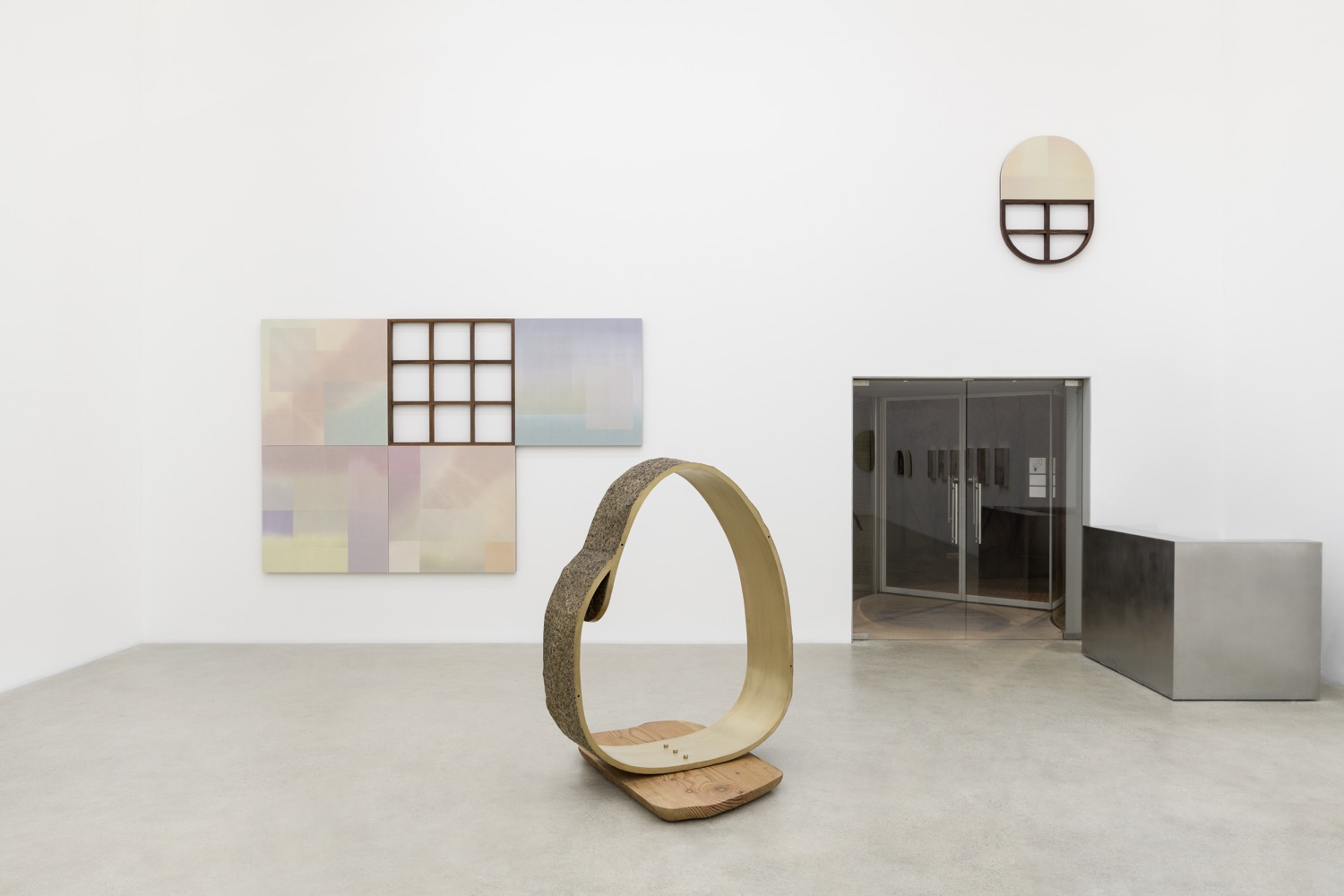
What about her works summon the concept of painting? The most basic
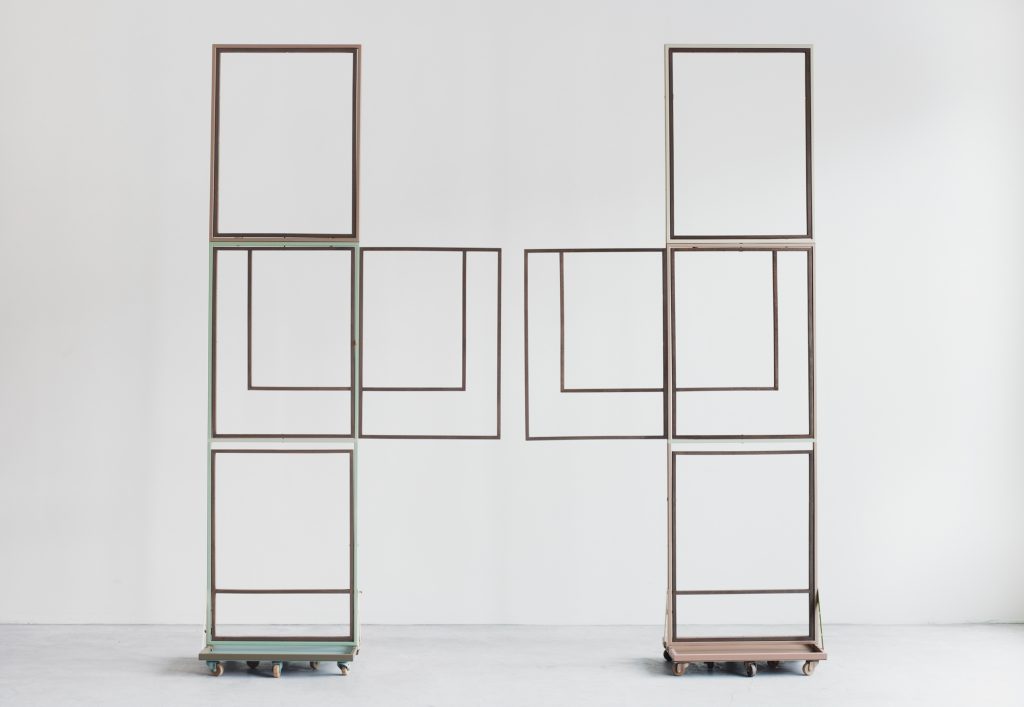
unit of her practice—painting (or ‘mora’[1]) and the canvas-less frame (or
‘jeong’)—as well as the dramatic dynamics of ‘mora’ and ‘jeong’ are worth
examining. Here, the conventional definition of the painting as a tool for
reproduction is abandoned. However, what does exist are clues as to how Kang
comprehends the concept of painting and how she questions the intrinsic nature
of painting. Even though they are realised as sculptures, installations, video
and performances, they are without a doubt explorations of the essence and
conditions of painting. Kang no longer accepts painting as an arena in which to
replicate For her, painting has become a ‘realm for cognition’.
Transforming painting as a means of replication to a realm of
cognition requires new aesthetic attempts. Far before the realisation of
painting, Kang designs a system in which the paintings in conception can evolve
within an established structure. In addition, the observations and
deliberations that Kang seeks to realise are gradually given form in the
process of choreographing her paintings. In other words, Kang’s practice is the
conceptualization and execution of a program of events, and the initiation of a
system that enables the creative union of an ensemble of various elements.
For
this purpose, Kang references the jeongganbo(井間譜)[2], an ancient system used for musical notation. To the artist, the
small square that serves as one component of the jeongganbo corresponds to the
most basic unit of visual art, which she considers to be the painting (referred
to as ‘mora’) and frame (‘jeong’). The rhythm, lyrics and movements contained
within the single cell of the jeongganbo correspond to the ‘conditions of painting’
and these conditions are initiated as a conductor would a musical score.
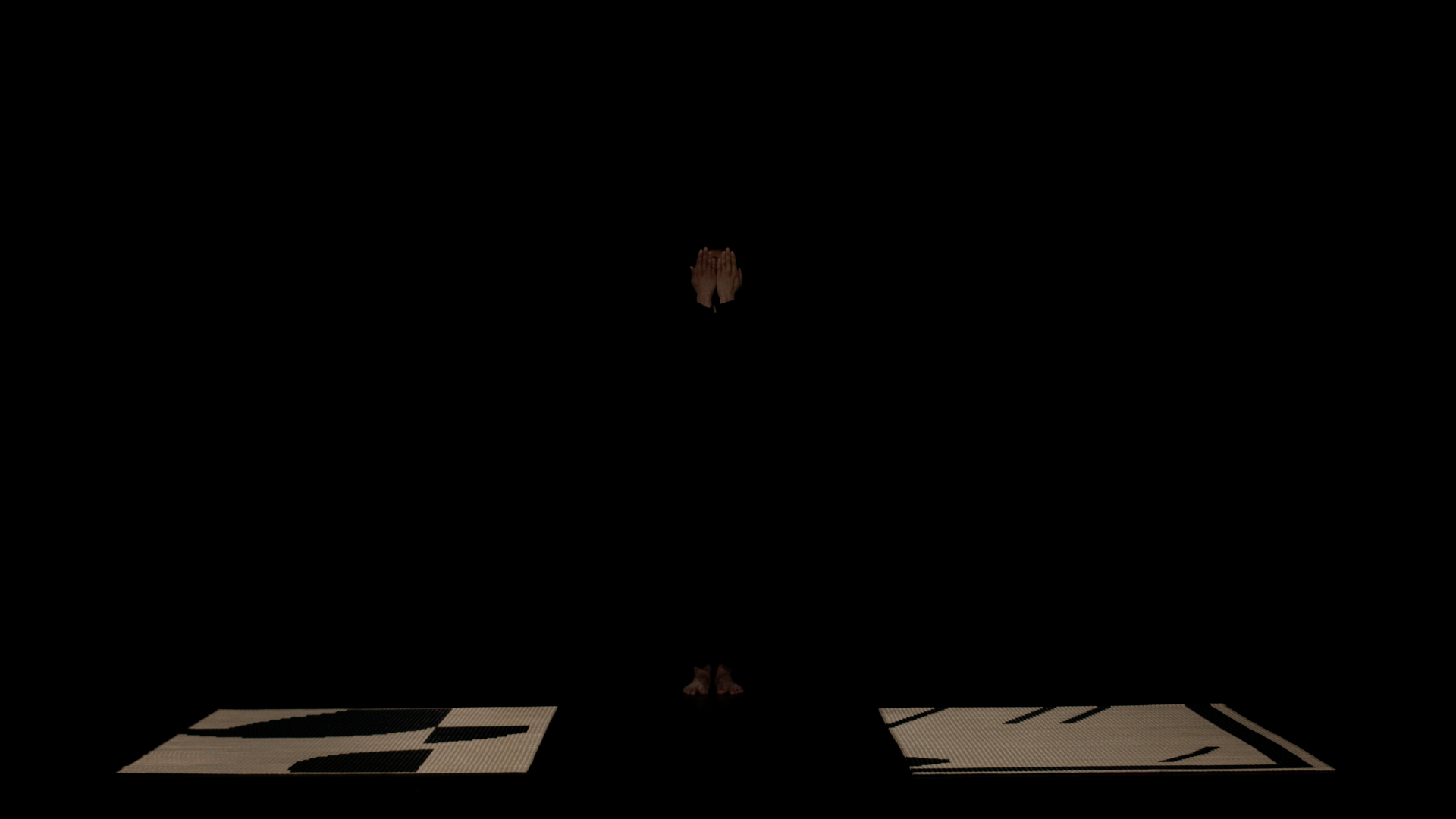
The 26
minute long new video work Black Under Colored Moon is a
record of a performance portraying the juxtaposition of painting through a
suite of dances performed by the ‘jeongs’ (frame structures). Two ‘jeong
structures’ guided by a man and a woman emerge from a pitch black stage.
Twenty-four hours are divided into four chapters; each chapter unfolds as a
variation of movements that serve as a metaphor for the subtle exchanges that
occur in an encounter or a parting.
The movements, based on a refined set of
sequences, proceed effortlessly. Although from one perspective, it is
reminiscent of abstract choreography absent of a narrative, it is in fact based
on the secular love story from Ssanghwajeom[3]. Just as the small square of the
jeongganbo and the painting’s frame overlap, the interplay between the two
structures and objects, and the secret love affair between the man and woman,
progress intimately.
In Kang’s practice painting takes on the form of a single unit:
‘mora’ or ‘jeong’. Though they exist as standalone elements, they function as
instruments in a delicate, visual symphony accompanied by a specific narrative.
The jeongganbo is a special score that enables Kang to orchestrate painting. A
score is linear and visual; a concert is three-dimensional and multi sensory.
In Black Under Colored Moon, painting takes on spatial
experience and multi sensory encounters. In this way, the concept of painting
in Kang’s practice proposes questions that challenge our conventional
expectations.
If traditional art contemplated a subject or theme, contemporary
art deliberates upon the factors that define its boundaries, and what gestures
summon the realm of art. Contemporary art attempts to explores its limits, to
seek the vestiges that remain from those explorations, and question what
exactly are its boundaries. If the ambiguous concept of the realm of
Contemporary art has taken priority over as the subject or theme of art, what
becomes most important are the processes designed to create the work, the
systems initiated, and the execution of the creative logic and structure.
The
reference to jeongganbo, through the lens of Black Under Colored Moon,
takes on a system of splendor. The rhythm, sound and movements that poetize the
small square unit of the jeongganbo manifest even in Kang’s earlier works. The
movements of the repetitive layers form an irregular sense of rhythm, gradually
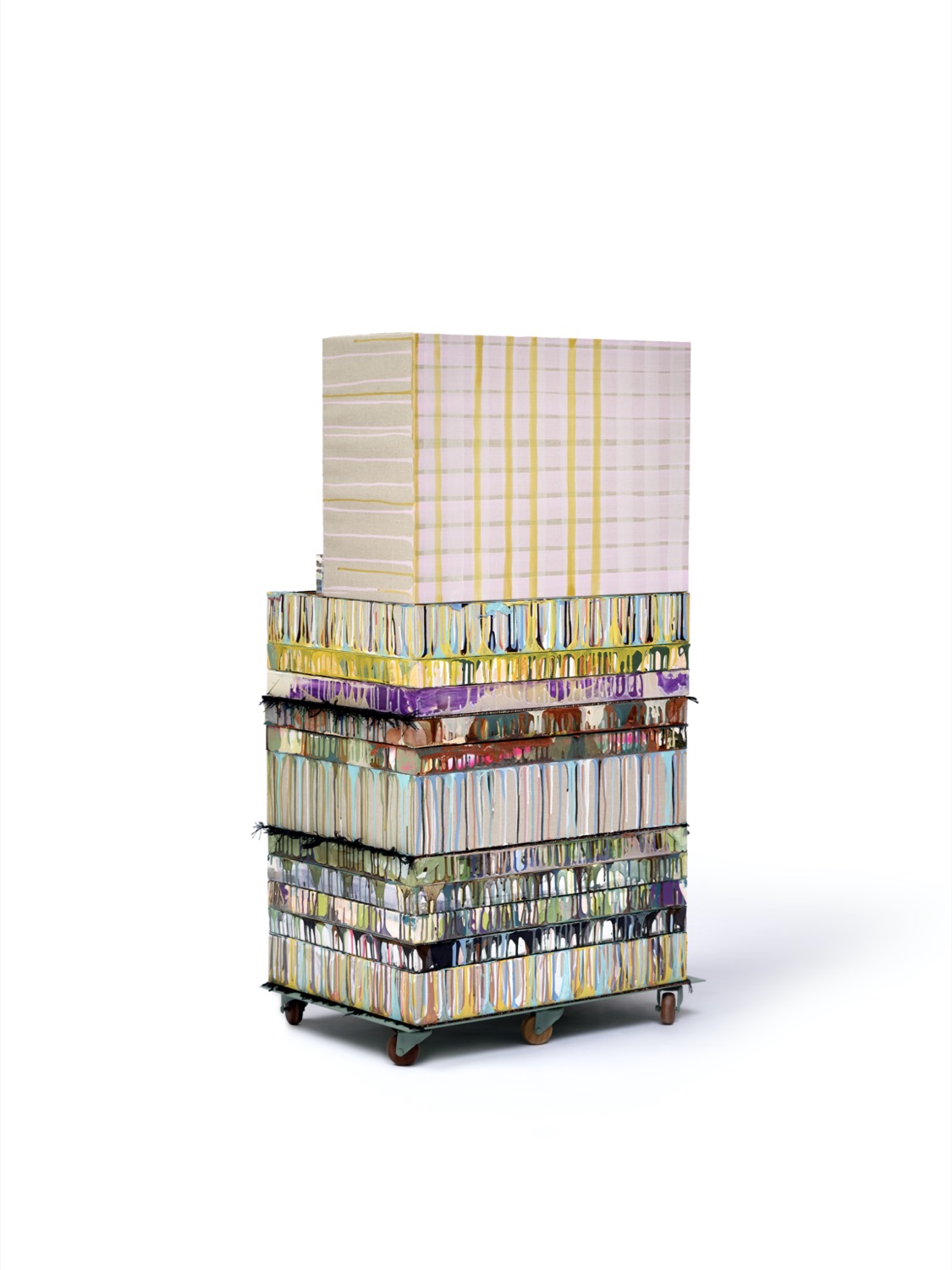
occupying the canvas as evident in Jeong (2014) and Mora
(2015); the improvisational act of balancing stacked units through the weight
of gravity alone One time pause (2013-2015), Shy
gray (2013-1015) give birth to asymmetry and and irregularity that
proceed to occupy space. Each canvas, object, and structural frame that appear
within the context of Kang’s works endure the repeated process an organic union
and an autonomous disengagement, which in turn leads to conception of a single
pair. Kang’s score comes to fruition in this way, and an concert begins from a
single ‘jeong’ within a grid.
An examination of Black Under Colored Moon as a
‘score’ for the story of Ssanghwajeom and the conditions of painting reveal
that it is not through the element of sound in which painting is perceived.
Kang’s score directs the movement of the frame (as a representation of
painting). It is this movement that reveals the secret love story of the man
and woman. Though Black Under Colored Moon takes the form of
a video performance, what Kang in fact realizes is a painting. The score, Black
Under Colored Moon, becomes the means to perform the subtle movements
of the delicate encounters, momentary caresses, or soft deflections of an
impromptu embrace.
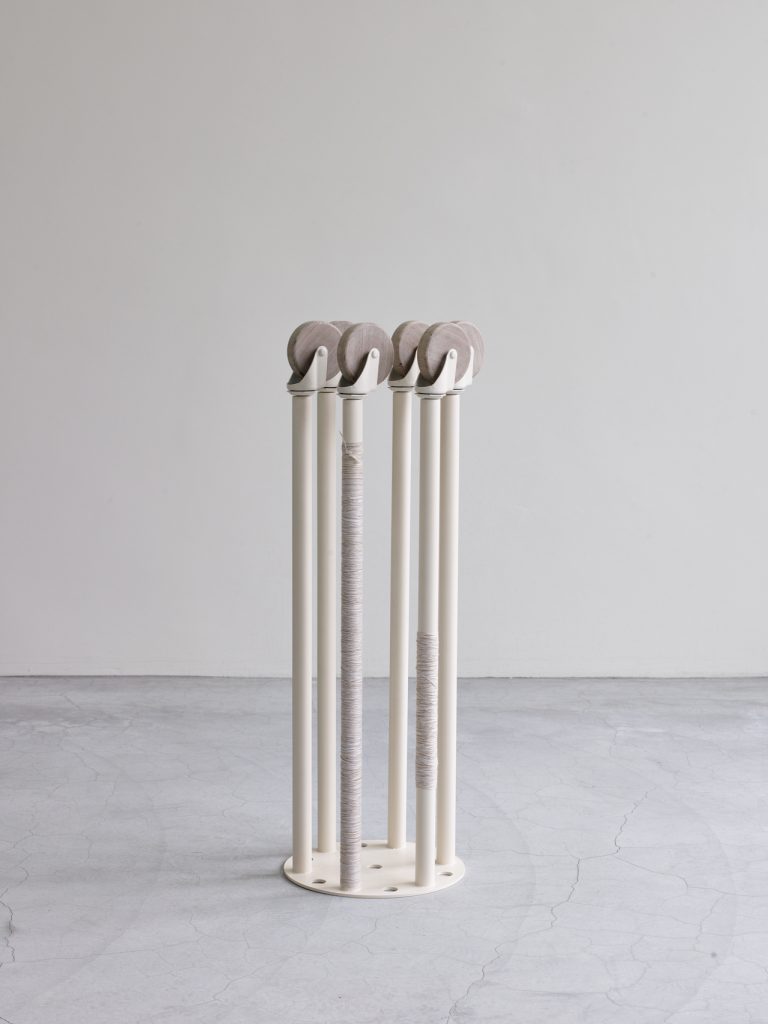
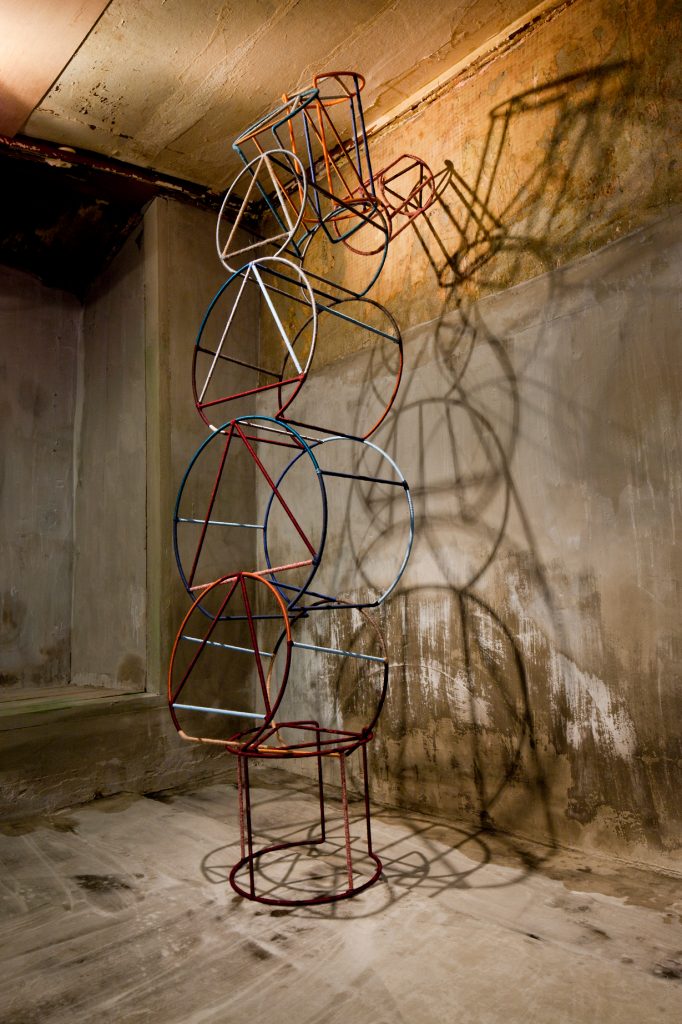
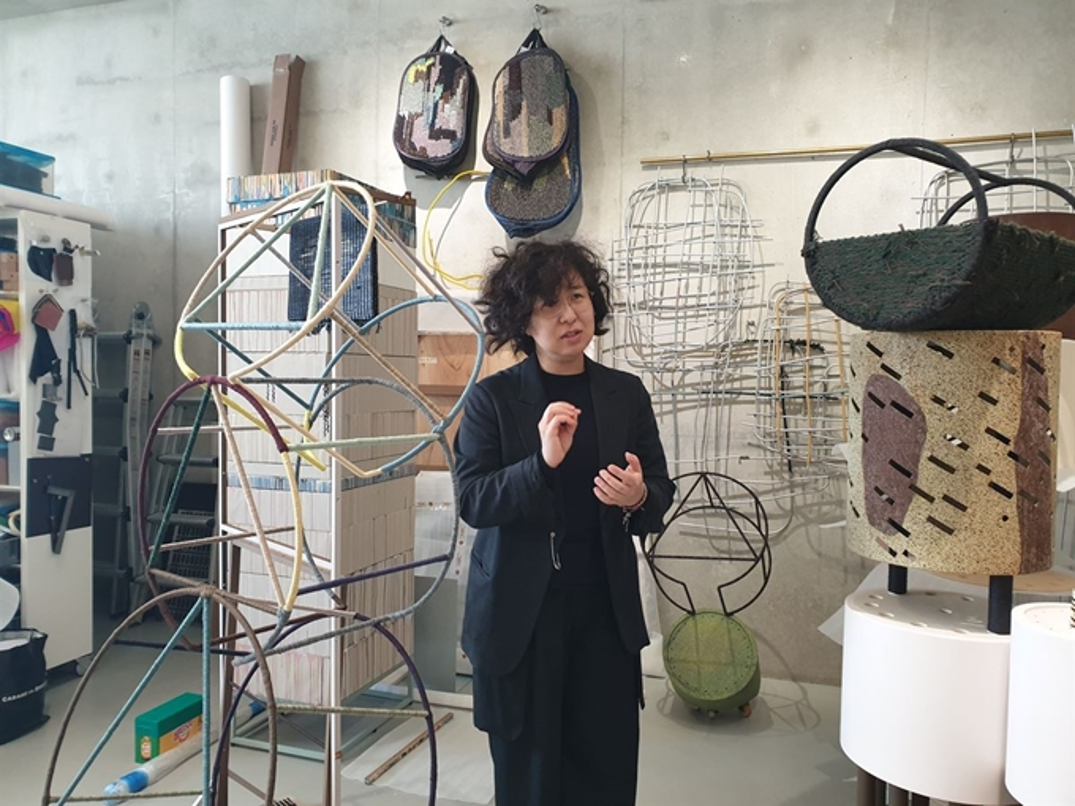
This concept of a score derived from the Jeongganbo is not
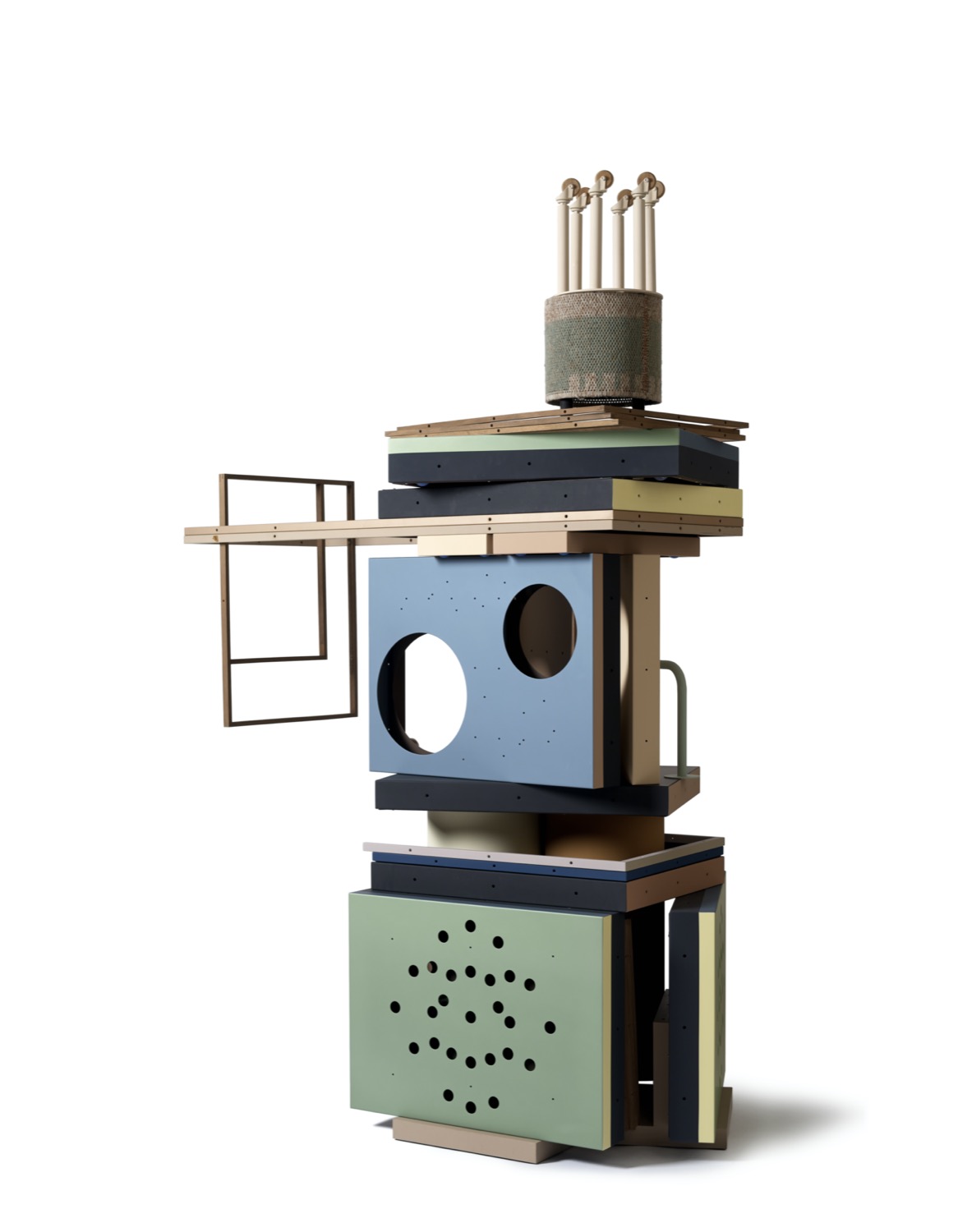
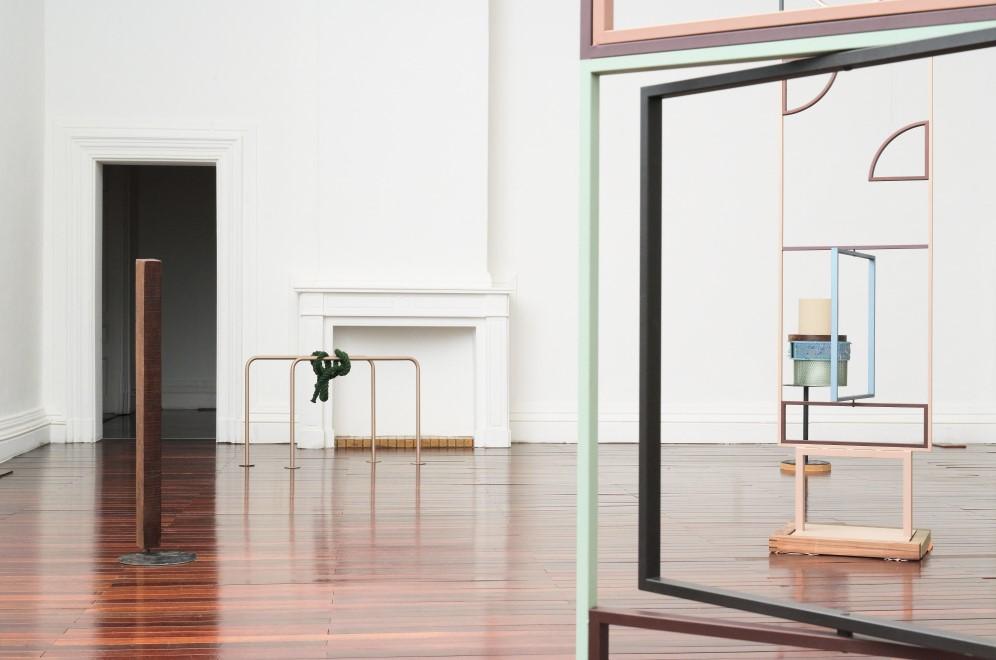
confined only to her recent works. The steel dish carriers that make up Grandmother
Tower (2011-2013) and the sculptural pieces made of wood wound with
thread somehow manage to stay erect through the interdependence of the
components. There are many ways to approach this work. It could be perceived as
monument memorializing the memories of Kang’s grandmother. The element of found
objects and handicraft could also be emphasized.
However, at the heart of Grandmother
Tower is the centre of mass it acquires. The weight of each component
supports the others, which together forms a whole. Even in this case, the
significance lies in the act of ultimately constructing a ‘score’ that retains
the center of mass. In fact, the early work Grandmother Tower
closely resembles an improvised performance with no score. The structure was
erected intuitively as the artist felt the weight of the components and
balanced one structure on top of another.
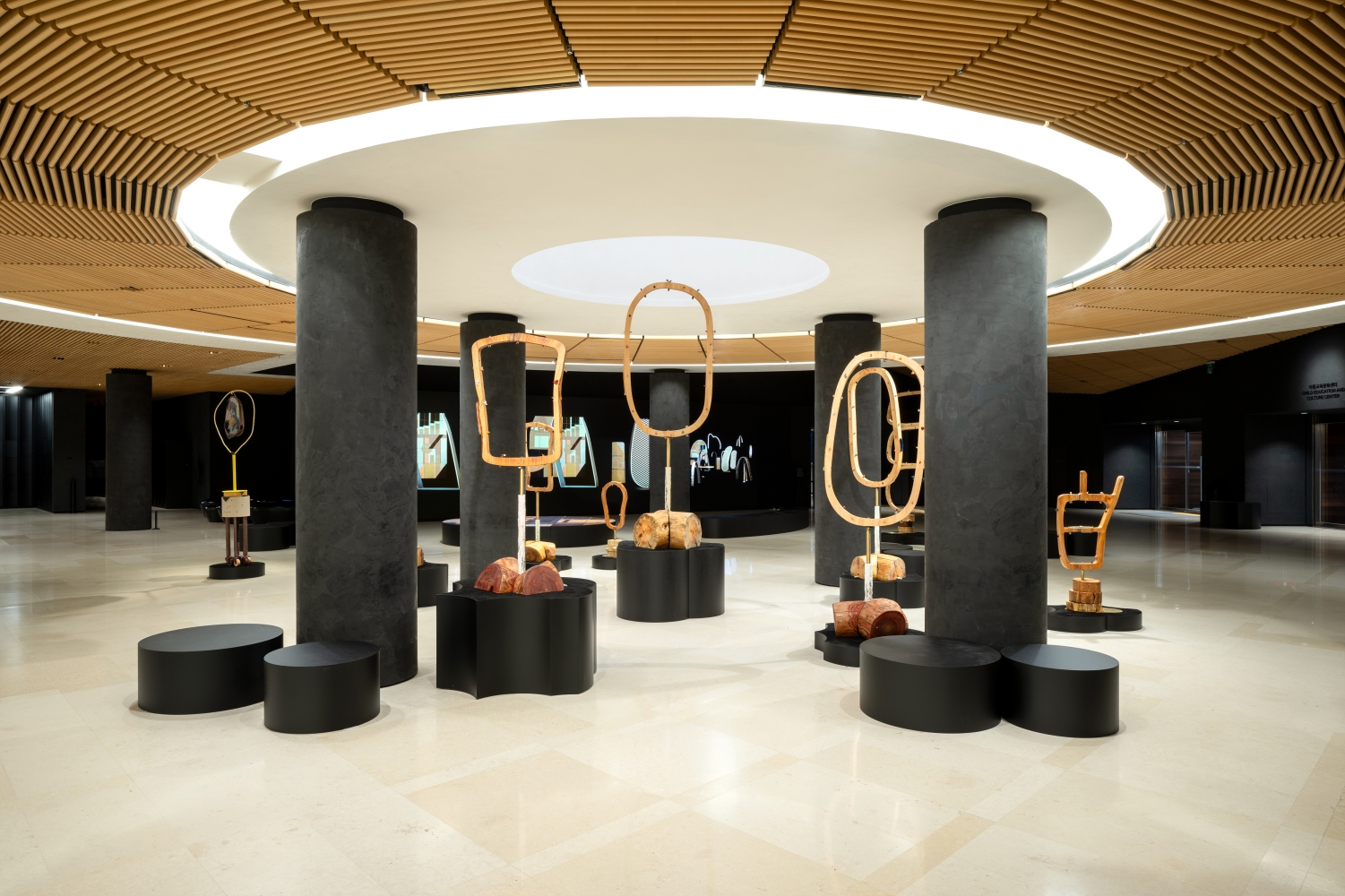
Through the repetitive process of
erecting improvised performances such as Polite Owl – in the valley
(2013) and Towered Bell (2013), Kang has sought out to
compose a score, and by referencing the jeongganbo for Black Under
Colored Moon, a concrete arrangement emerged. A small owl object
purchased at a flea market in London metamorphosed into the Polite Owl – in the
valley, a visual operetta that wove between the worlds of fiction and history.
The accidental discovery of an iron bell—this too gave birth to a visual song,
which combined excerpts from the poem Bai Hua by the ancient
Chinese poet the Duke of Zhou and Liberté by Paul Eluard,
invoking the emotions of waiting, longing, delight and fear. The Grandmother
Tower and Circled Stair (2011-2013), which
commemorates the artist’s memories of her grandmother, is the score to the
visual lullaby of Kang’s recollections of the melancholic tenderness of
observing her elderly grandmother.
Polite Owl – in the valley, Towered
Bell, Grandmother Tower, and Black Under
Colored Moon are each extensions of Kang’s scores notated by
paintings, rectangles, frames, rhythm, movement and narrative. Though this
score goes beyond the conditions of painting, it adheres to painting and
orchestrates the harmony of the abstract and figurative. Kang’s scores, which
serve as a means to elucidate the conditions of painting, are comprised of an
elaborately and intricately woven collection of symbols, yet also offer the
simple freedom to veer or glide away. Rather than seek codification or balance,
they pursue uncertainty and dissonance.
1.The term ‘mora’ in linguistics is a unit in the systematic
organization of sound in languages. Just as ‘mora’ serves as a fundamental unit
in the study of language, in Kang’s works, painting represents the most
elementary unit in her exploration of visual art.
2.Jeongganbo (井間譜) is the earliest known Asian mensural system incorporating pitch
and duration. Invented during the early Joseon Dynasty (1392-1910), the system
was used for records such as the Joseon wangjo sillok (Veritable Records of the
Joseon Dynasty), Uigwe (State Event Manuals), and musical pieces such as the
historical musical manuscript Sejongsilrokakbo (The Score of the Royal Annals
of Sejong). Jeongganbo considers one ‘jeong’ (井, the
Chinese character representing a ‘well’, which resembles a grid composed of a
set of squares) as an interpretation of a series of beats. Each square
indicates both the tone and length of the sound, as well as the variable human
movements associated with the interpretations of the musical piece. Rather than
being a linear score, jeongganbo forms a complete rhythmic narrative through
the harmony of the elements composing the sound.
3.Ssanghwajeom was a popular love song from the Goryeo Dynasty
(918–1392).