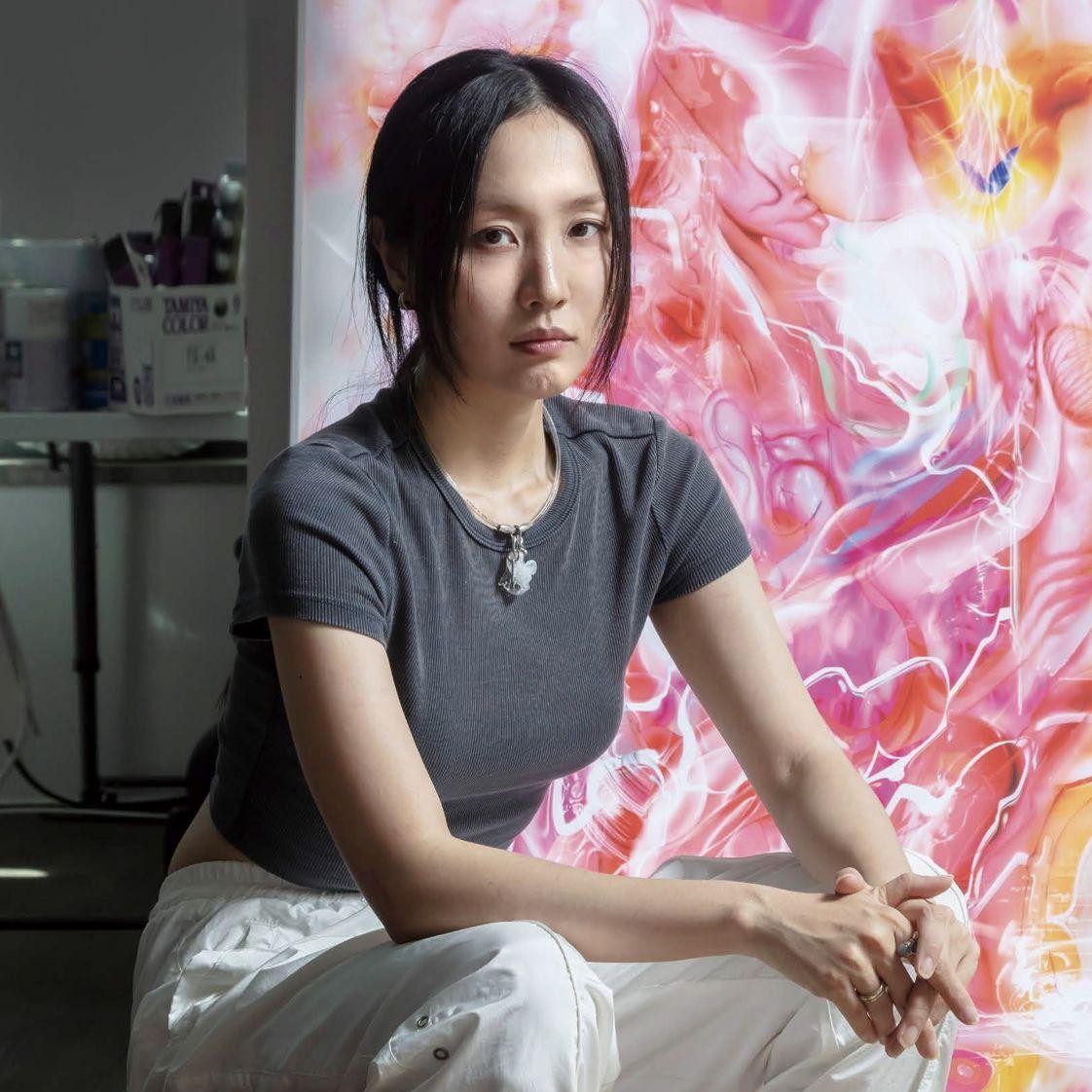
Ram Han majored in Animation at the Korea National University of Arts. She currently lives and works in Seoul.


City Pop and Two Axes of Time
Stay with me
As if my heart had a hole while knocking on the door in the middle
of the night
That empty time now stands before my eyes
Stay with me
The needle of the record I left playing to soothe my loneliness
Keeps repeating the same melody
Stay with me
The time when I cried at the door in the middle of the night
telling you not to go
Now stands before my eyes
Stay with me
I still remember and warmly hold the time we used to speak of like
a habit
— Partial translation of lyrics from Miki
Matsubara’s “Stay With Me”
Following the direction led by internet algorithms, one eventually
arrives at the atmosphere of a certain song. A melody blending pop, funk, and
jazz flows sweetly with lyrics describing the sorrowful love between lovers.
The refined and glamorous sensibility of the metropolis merges with the strange
and dreamlike nightscape atop the rhythm of a live band. People categorize and
enjoy this style of music as “City Pop.” It evokes the beauty of a young and
dazzling city.
City pop, thus recirculated, summons to the present the Japan of
the 1980s when it first emerged. Miki Matsubara’s “Stay With Me” (1979) has
become a popular video with tens of millions of views on YouTube, receiving
attention far beyond the time of its original release. Fourth-generation idol
group NewJeans promoted with the song “Supernatural” (2024), which blends city
pop with hip-hop and swing, while members Hanni and Hyein drew attention in
both Korea and Japan by singing Seiko Matsuda’s “Blue Coral Reef” (1980) and
Mariya Takeuchi’s “Plastic Love” (1984) respectively at a fan meeting held at
Tokyo Dome last July. The romance and joy of the bubble economy era are
recreated before our eyes, and the leisure and prosperity once enjoyed at that
time seep into public sentiment like sweet rain. Those recalling those good
times murmur, like the refrain of “Stay With Me,” asking them to “stay with
me,” soothing the lingering nostalgia.
As is widely known, the lifestyle of the X generation of the 1990s
has become “hip” in the 2020s, and Y2K fashion from the turn of the millennium
has emerged as a trend among the MZ generation. The retro phenomenon, in which
the past is revived and made fashionable again, is not unfamiliar as it
resembles the cyclical formula of culture.
Yet beneath the public longing for
Japan in the 1980s or Korea in the 1990s lies a yearning for an economic boom
that cannot be seen today, and thus a strange sentimentality emerges. At that
time, youth was not associated with problems of unemployment or isolation and
withdrawal. Graduating from university, finding a job, buying a home, and
building a family were common expectations. Does that time not feel impossibly
distant in today’s society? Perhaps closer to fantasy than to the past.
Such an uncanny sense of nostalgia tied to fantasy is especially
applicable to the millennial generation. As adults, they long for a prosperous
past they never experienced and instead consume the desire for a plentiful
future through culture. If any factual memories are added to this longing, they
are perhaps the comic books, videotapes, and arcade games enjoyed during
childhood. There are also impressions received from popular songs played on
turntables and radios, miniseries dramas watched on CRT televisions, and
imported foreign programs.
They wander between nostalgia tied to childhood and
the unfulfilled dreams of adulthood, generating the “newtro” trend while
drifting within it. While enjoying the benefits of the advanced digital
civilization that has arrived in the 2020s, they simultaneously retrieve and
caress the old romance once contained in analog culture. They turn the clock
back to a time before their parents experienced the IMF financial crisis,
before the collapse of the economic bubble, to confirm the afterimage of that
past. Even as they recognize the momentum of artificial intelligence and the
Anthropocene, they live simultaneously within two axes of time—looking forward
and looking back.
The Persona Called Ram Han
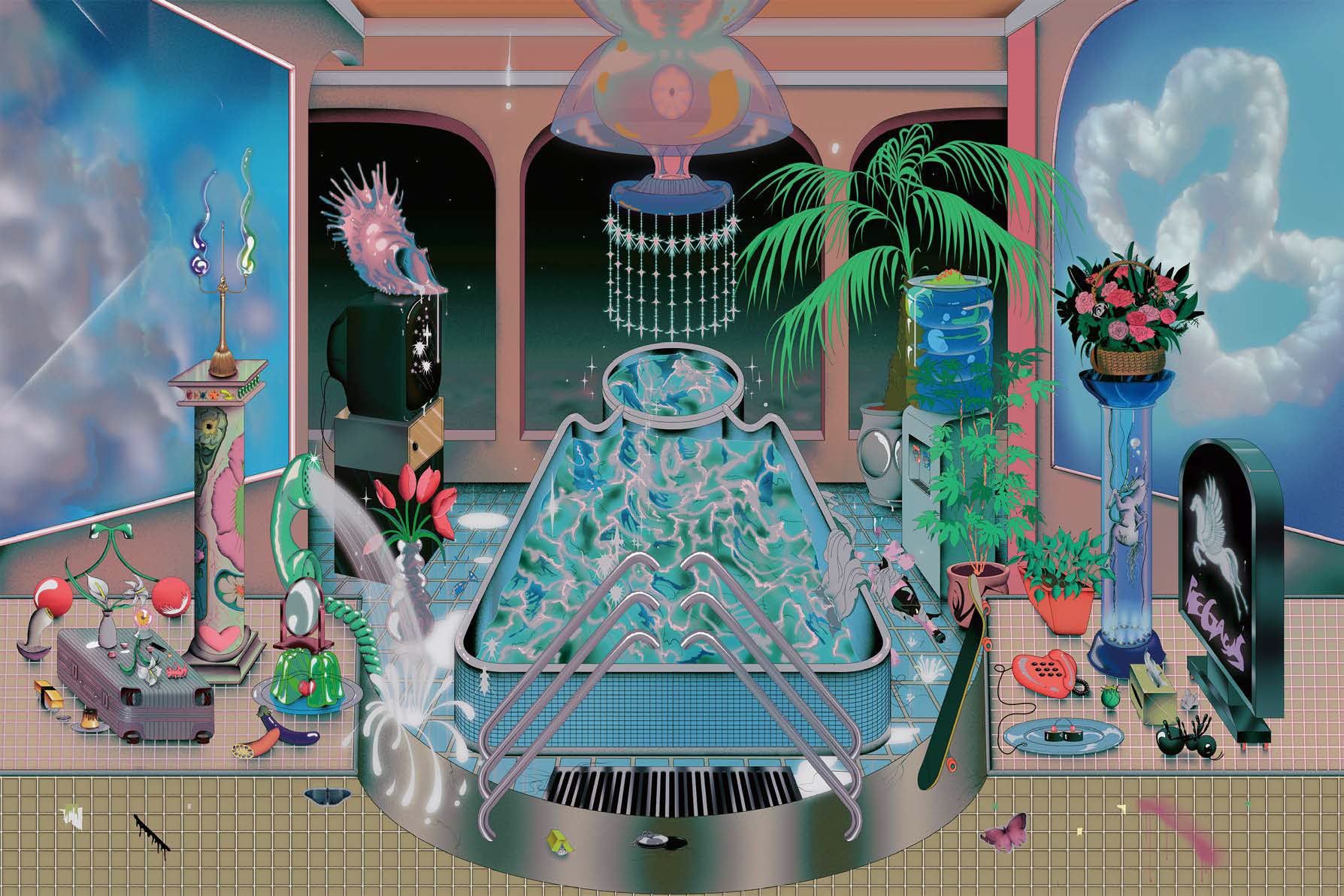
A flat and smooth image that emits light from countless particles
of an LED panel and settles upon the retina. Depicted in psychedelic colors, it
resembles the neon signs of a city where city pop music flows. Within that
artificial glow appear unique iconographies in which grotesque creatures and
objects intertwine their bodies together. Science fiction fantasy, fabricated
fiction, and the traces of degraded memories grotesquely coexist. It is a
provocative image difficult to explain through any single term or to assign a
linear narrative. It is beautiful yet eerie, glamorous yet lonely, leaving only
a confused sensation perceived at the periphery.
The artist Ram Han, who produces such visual images, has drawn
attention from both contemporary art and social culture. After majoring in
animation at the Korea National University of Arts, she initially revealed her
works through small-scale exhibitions and publications. Her entry into the
mainstream art world began with the exhibition 《Ghost Arm》(SeMA Buk-Seoul Museum of Art,
2018).
Curator Hong Iji, who organized the exhibition, sought to examine the
web space that had become a part of everyday life and invited Kang Jungseok,
Kim Jungtae, Park Aram, Compression and Expansion, Kim Donghee, and Ram Han,
referring to “artists born in the 1980s who do not dichotomously separate
analog and digital.”
At a time when many young artists who had gained
recognition through emerging spaces in the 2010s art discourse were either
“accessed” by institutions or quickly “evaporated,” Ram Han appeared somewhat
different—a “new face” introduced as an illustrator and cartoonist. She had not
participated in the physical spaces or artist markets such as 《Good-즈》(Sejong Center for the Performing
Arts, 2015) organized by the generation of emerging spaces, nor the related
events derived from them. Rather, she was called in from outside that sphere.
Ram Han emerged during the same period while working as an indie
artist, holding her first solo exhibition 《Ram Han: Nightcap》(Your-Mana, 2017) in a
space that exhibited and sold independent comics and character goods. She had
little direct connection to the generational discourse in the art world that
disappeared within a few years. Instead, after 《Ghost
Arm》 she was invited to exhibitions such as 《PACK 2018: The Journey of Tinkerbell》(Space
SiL13, 2018) and 《Ghost Shotgun》(Siheung Audiovisual, 2019), thereby experiencing spaces associated
with that discourse at a later stage.
Soon after, she received invitations from
commercial galleries and became a represented artist. In the meantime, she
presented major commissioned works at 《Busan Biennale
2020: Words at an Exhibition—An Exhibition in Ten Chapters and Five Poems》(Busan Old Downtown Area, 2020), 《SF2021:
Fantasy Odyssey》(SeMA Buk-Seoul Museum of Art, 2021),
and 《Game Society》(National
Museum of Modern and Contemporary Art, 2023). She was also introduced in the
“Discoveries” sector at Art Basel Hong Kong 2023. Beyond this, she has
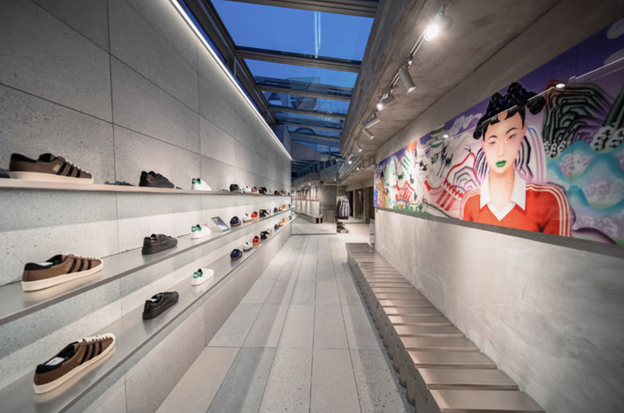
participated in collaborations and advertisements with entertainment agencies
and global luxury brands, appeared directly as a model in fashion magazine
editorials, and accumulated diverse experiences while crossing implicit
barriers within the art world.
The rapid rise of Ram Han’s popularity—or her swift alignment with
contemporary culture—may be attributed to two opposing historical backgrounds.
First, the 2010s were a dystopian era in which youth had to endure life as the
so-called “880,000 won generation” or “Sampo generation.” Second, in the 2020s
youth are labeled the MZ generation, considered a new class capable of
self-expression and value-driven pursuits. In a bleak society where despair was
not overcome but rather abandoned until it reached a twisted form of
enlightenment, the hybrid aesthetic and multi-profile identity that Ram Han has
practiced may have served as a source of admiration for her generation.
More
precisely, the current figure of Ram Han was formed through the consumption of
the persona called Ram Han and the images produced by that persona. Before her
official debut, she posted works on blogs and social media where they
circulated widely. A curator who saw her Instagram account invited her to a
museum exhibition, and through that opportunity she exhibited screens optimized
for the web as physical objects, eventually settling into the designation of
“digital painter.”
Distinct from illustrators, cartoonists, or traditional
painters, Ram Han as a digital painter assumed a new rhetoric of media
transformation. The ‘Room type’(2018) series—digital illustrations printed on
light boxes—was commissioned and collected by the Seoul Museum of Art, which
introduced it under the category of new media while hinting at future tasks for
art history:
“This work demonstrates a new genre that combines digital and
painting through digital painting. When the term ‘painting’ is generally used,
one easily imagines the method of using canvas and brush. However, Ram Han’s
digital painting is produced using a tablet and Photoshop. Genres newly
constructed with such ambiguous boundaries are difficult to incorporate into
the existing categories of collections. In this case, the work has been
registered in the new media section of the Seoul Museum of Art’s collection
management system.”¹
Ram Han appeared precisely at the moment when debates about
generational gaps and institutional responsibility that had emerged through
emerging spaces in the Korean art world were fading, and when discourse on
media began to take their place. As the economic difficulties and uncertainty
of becoming an artist experienced by artists born in the 1980s who graduated
from art schools became a central trend, attention turned toward the fresh
emergence of artists born in the 1990s, accompanied by issues of post-medium
discourse combined with sociological generational theory. 《Ghost Arm》 was an
exhibition that connected related themes and sensibilities through the
invisible connectivity inside and outside internet space.
Interest in the new
artistic language employed by younger generations and in the online environment
continued partially in exhibitions such as 《21st
Century Painting》(Hite Collection, 2021), 《Sculptural Impulse》(SeMA Buk-Seoul Museum of
Art, 2022), and 《Hysteria: Contemporary Realism
Painting》(Ilmin Museum of Art, 2023). These exhibitions
drew significant attention not only from MZ-generation audiences but also from
artists of the same generation.
“Based on the concerns and changes accumulated by young artists
since the 2010s, […] the exhibition was organized to examine more concretely
what methodologies artists employ. […] First, we can observe media-oriented
attempts such as establishing relationships between separated surfaces (images)
and bodies (physical entities), the gap when works produced in virtual space
are output into reality, and the combination of online circulation, fluidity,
and temporality.”²
Ram Han emphasizes mediality by using RGB colors that become vivid
on digital screens and by intentionally employing square panels, thereby
clearly visualizing the theme of Instagrammable works. She uses her Instagram
account as a platform for presenting and archiving her work, and also edits and
publishes images of herself that appeared in catalogs and advertisements.
Currently, approximately 88,000 followers quantify the identity of Ram Han as
an influencer. Naturally, there is no complete factuality there. Ram Han simply
uses the influence of her stylistically ambiguous works as a term projecting
the present age. Like the brilliant glow of the bubble economy desired by a
public exhausted in times of recession, the persona of Ram Han shines in that
way.
“There is no despair on Instagram. That is why it appears somewhat
grotesque. Stories about the youth generation usually converge on despair and
giving up. The question is always how difficult young people’s lives are, and
how phenomena such as depression, frustration, hatred, and resentment have
become everyday occurrences. Yet on SNS, which the youth generation commonly
uses, there is no trace of that. It is always bright, hopeful, and glamorous.”³
Hybrid Loner
“But what distinguishes the boundary between the
real and the virtual worlds? Is it digital devices that connect the
non-incarnated virtual world and the materialized real one? Without electricity
they are merely useless objects in reality, yet when powered and connected to
networks they stand between two dimensions. Crossing that boundary through them
occurs through another activity of the subject—an embodied, avatar-like
movement that travels from reality to virtual space and back again.”⁴
The sense of hybridity that moves between illusion and reality
becomes possible as the world of mass becomes data, images liquefy and flow
beneath liquid crystal displays, and the boundaries inside and outside the body
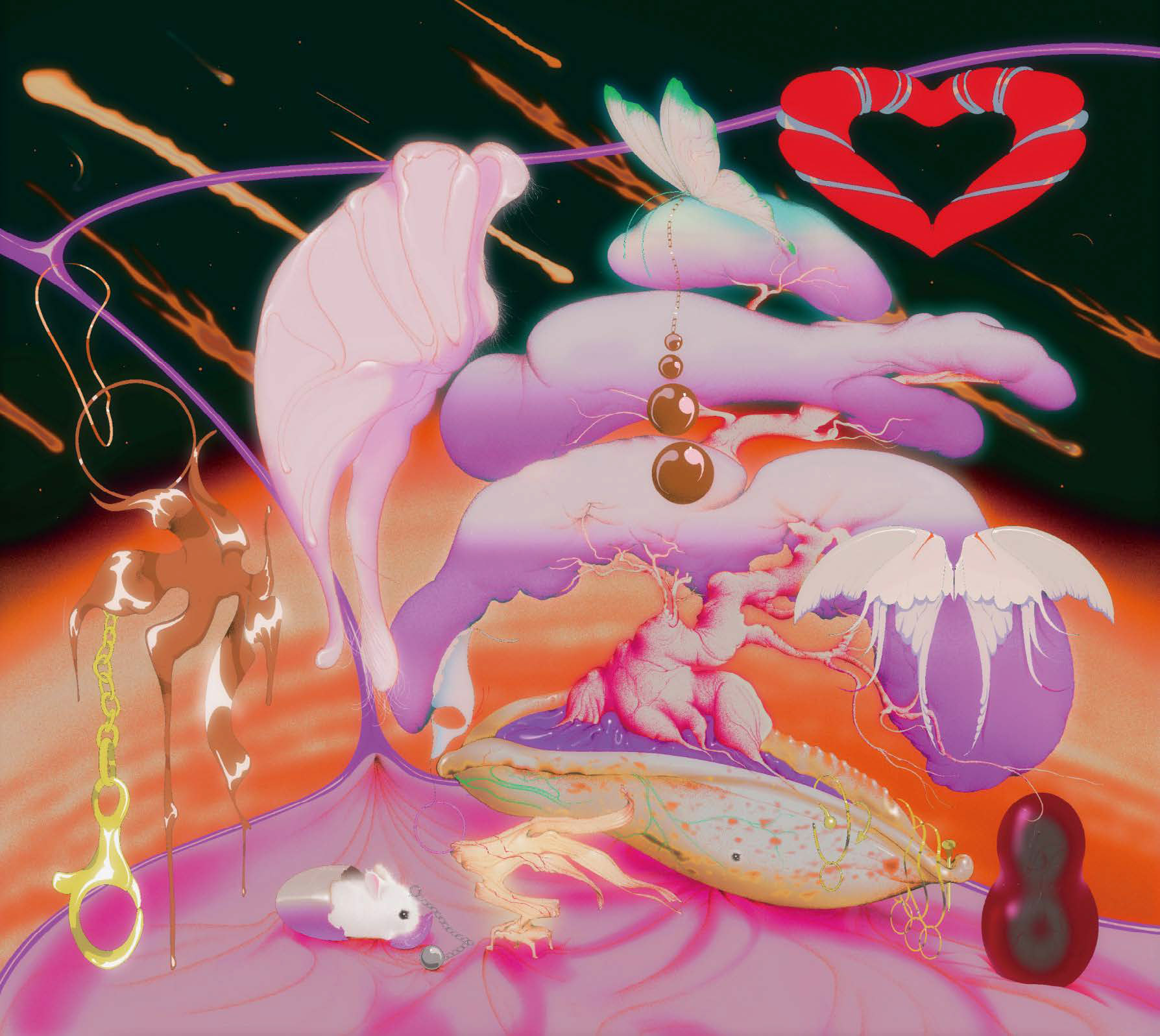
collapse to combine with heterogeneous entities. Ram Han visualizes and depicts
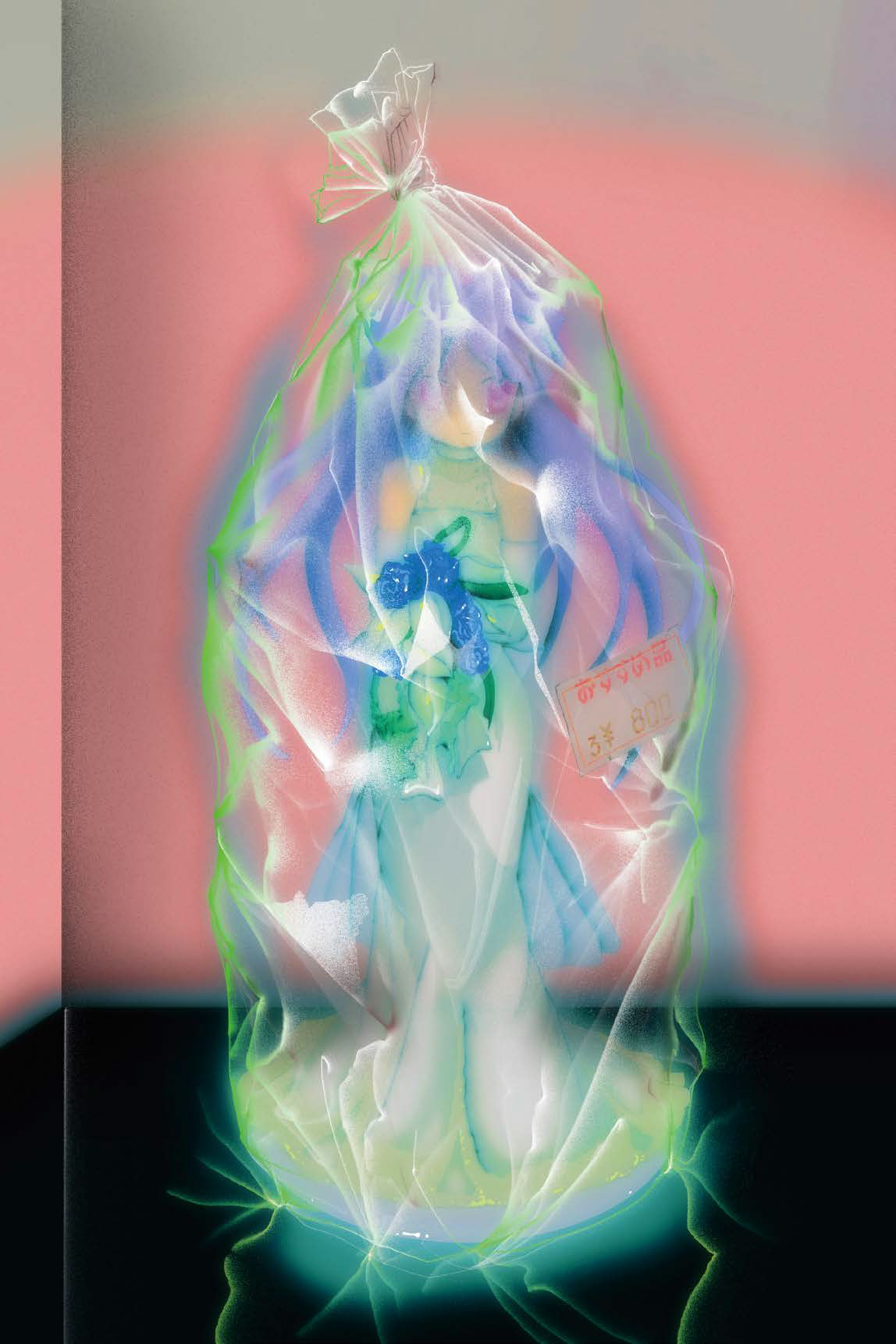
this sensation. As shown in the ‘Souvenir study’ series (2019–2022), living and
nonliving things merge with the same texture, shining as if glazed. In works
such as the ‘Case’ series (2020) and Sky(2022), humans and
animals or plants combine to share a single body.
In Ram Han’s world,
communication occurs beyond the dimensions of sex and species. Consider
Kiss(2021), in which a human kisses an alien, or
The last night of the world(2021), where a girl, a faceless
being, a cat, and a smartphone appear like a snapshot of a harmonious family of
four. The figures that appear in Ram Han’s works carry the identity of
minorities and suggest new concepts.
Ram Han also freely adopts the perverse elements of the “uncanny
valley” produced by artificial intelligence. She believes that “in the process
of AI inferring images, unstable intermediate outputs and results that appear
like errors contain far more stories.”⁵ Moving beyond the level of digital devices seen in works such as
the 3D printed sculptures of the ‘morph’ series (2022) and VR game and video works including
Tutorial: How to Uninstall My Twin(2023), she attempts to
draw upon the sensory faculties of a posthuman brain as a medium. The “food
series”—including open sandwich, salami
platter, and seafood pond(2022)—which Ram Han
described as “collaborations with AI,” were inspired by bizarre and illogical
images generated by artificial intelligence without prejudice. In these images,
playfulness and danger are simultaneously applied.
“The sad and hateful feelings we usually hide
away and pretend not to have. They also come to visit me when I am left alone
at night, wanting to receive their owner’s love. A time when I can pay
attention to the small events given to me. I like nights when floating
sincerity mixes together like a messy room. The figures in my paintings are
people who, like me, love the late night.”⁶
Meanwhile, Ram Han has indirectly revealed through interviews and
conversations with the author that she was exposed without protection during
childhood to visual culture containing stimulating and harmful scenes. She
refers to the faint memories of comic books, videotapes, and game consoles
enjoyed by her generation in the 1980s and 1990s, along with the visual traumas
embedded within them. Ram Han gathers the heavy traces of images she once
considered disconnected and calls them forth again through contemporary media.
These newly expressed images strive to appear bright yet remain chaotic and
contradictory. For example, the motel theme rooms depicted in the digital
painting series ‘Roomtype’ and ‘Loner’ (2018–2019), filled indiscriminately
with the remnants of desire, were old yet shining, decadent yet purely
beautiful. Ram Han continues a similar process through fragments of images that
fill her Instagram feed. We observe and interpret Ram Han’s intimacy and the
trauma of the era in this way. It may not be a rooted solidarity, but we can at
least feel that we are not alone.
This manuscript is a special contribution supported by the Arts
Council Korea’s “2024 Korean Art Criticism Support Program.”
¹ Collection_Open Hacking Mining, Seoul Museum of Art, 2021, p.226
² Kwon Hyein, exhibition text for 《Sculptural Impulse》, SeMA Buk-Seoul Museum
of Art, 2022, p.6
³ Jiwoo Jung, There Is No Despair on Instagram, Hangyeore
Publishing, 2020, p.62
⁴ Oh Jungeun, “The Strangeness of Soft Bodies Between Virtual and
Real,” GRAVITY EFFECT, Issue 8, Graphite on Pink, 2024, p.119
⁵ Ram Han,
artist note on Generative Art, 2024
⁶ Ram Han,
artist note for the solo exhibition 《Ram Han: Nightcap》, 2017