I
A place where yesterday becomes today and today becomes yesterday. Island of the Day Before, Island of the Day After (2018) reminds me of a science fiction novel that I read a long time ago. In this story, an astronaut who was accidentally sent to the distant future struggles to return to their home (and to the time they belonged to), and in the process encounters the moment where their trajectory and Earth’s orbit intersect.
At this moment, the astronaut is able to touch the ground and see other people who are looking at them, but since they belong to different times, they are unable to communicate. Every year the astronaut make an appearance in the present day, though they only pass through our time for a short while. The time before the Big Bang, which is in the past for us, is the future that they will return to; meanwhile, our future is the past that they have already been through. The time of their appearance also continues to change in the time of solar system.1
While some may think that time travel could only exist in a fictional world, it does exist in reality. Island of the Day Before, Island of the Day After is a 4-channel video about the International Date Line (IDL) of Fiji’s Taveuni Island in the South Pacific Ocean. With this imaginary line acting as a central point, the area immediately west of the line is a day ahead of the area to the east.
This is the place where you can go from yesterday to today and vice versa with a single step. In the video performance, this strange coexistence of spacetime becomes embodied by two performers, who respectively spend 24 hours in the area to the west and the east of the International Date Line; each performer spends a day from 12 midnight to the next midnight on one side, then swapping locations to spend another full day on the other side.
More precisely, on the first day, performer A (Minja Gu) exists on the west side on June 29, 2018, while performer B (Soojung Choi) is on the east side on June 28; performer A, who moves to the east side on the second day, lives the 29th once again— because a day has passed from the 28th to the 29th on the east side—while Performer B who moves to the west, goes directly from the 28th to the 30th (See Table 1).
The result is that the same day (the 29th) is repeated twice for performer A, whereas the day of the 29th is lost for performer B. This situation is recorded in the 4-channel video shot continuously during the periods of the 29th/28th and the 30th/29th. The repeated day is represented through performer A’s actions, which mirror their actions of the previous 24 hour period, and the lost day is visualized in the daily necessities for a day’s use that are unused and left.
II
“What would happen if someone could live a certain day twice, while that same day does not exist for others?”2 This philosophical question is lived as an ordinary day—one that is not particularly different from any other—by the figures in the video. The performers do not do anything special. They have three meals a day, sleep, clean up after themselves after eating, and spend their spare time reading or walking around.
These are daily activities focused literally on “passing the time” (according to the artist.) Sometimes tourists who come to see the date line sign appear in the background of the video, but they are not concerned with, nor do they make any intervention in, the activity of the performers. However, invisible boundaries and the distinction they make implicitly pose restrictions on the actions of the performers.
They do not cross the virtual date line to go to the other side. They separately go about their daily lives, as if they do not know the other exists. There is also a distinction between the repeated day and the missing day. In the case of performer B—who skipped from the 28th to the 30th—the missing of a day does not lead to any visible change in actions, but performer A—who lives through the 29th twice— repeats her actions from the previous day.
Island of the Day Before, Island of the Day After recalls the practices of two art historical precedents who both equated art making with the daily processes of living life, and whose work often functioned to archive life: On Kawara and Tehching Hsieh.3 Since 1966, Kawara created date paintings of almost every day, continuing the practice for 50 years, while also rendering his daily activities into an enormous accumulation of recordings of the places he visited, the things he read, and the people he met.
Hsieh equates the artistic practice to the “embodied time that is lived in person,”4 imposing constraints and conditions on his life and performing them in “Lifeworks” created between 1978 and 1999. Although there is no direct association between the works of these two artists and Island of the Day Before, Island of the Day After, some parts of it do evoke Kawara and Hsieh.
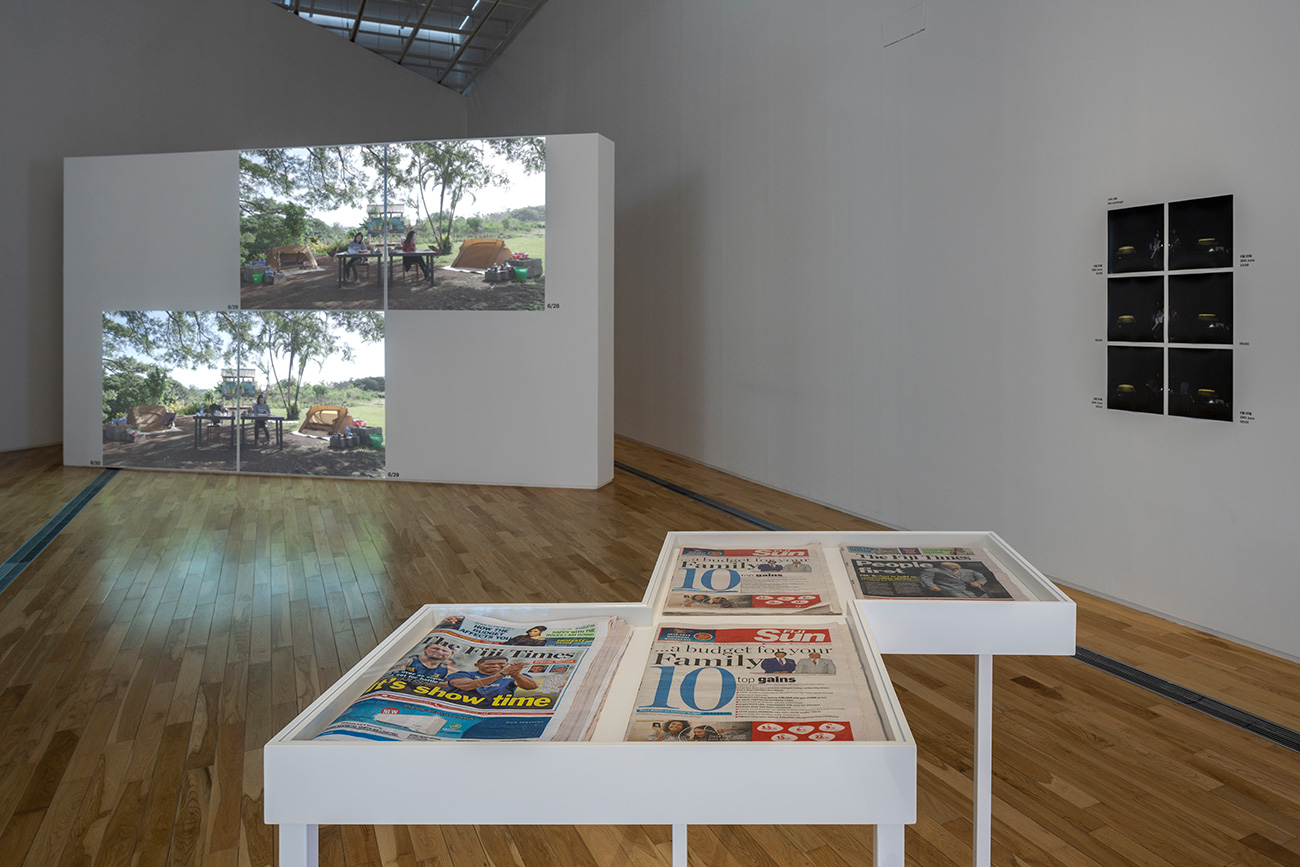
In addition to the fact that the artists perform the task of recording as performers of the work, Gu’s work surreptitiously calls to mind humorous parodies of the predecessor artists in its way of making the performers and the viewers aware of time. For example, the performers paint the date in their location on a t-shirt at the beginning of the performance, and there are newspapers that are delivered in the middle of the performance, naturally evoking Kawara’s Today series (1966—2013).
Additionally, the actions of Minja Gu, who repeats the same day–struggling to record every action while reading, eating, and sleeping on the first day and attempting to replay them on the second day–resonate with Tehching Hsieh’s second year-long performance Time Clock Piece (1978—1979), which attempts to synchronize organically-flowing biological time with the standardized mechanical time of a time clock.
However, in its intention and methodology, Island of the Day Before, Island of the Day After contains many different layers than the works of the two preceding artists. Compared to On Kawara’s performance where rigorous and systematic methods of recording are crucial, Minja Gu’s performance is relaxed and more human.
Whereas persistence and accumulation hold significance in the Today series, Gu’s work is a short-lived, one-off piece that lasts only for two days. In particular, the nature of the time manifested in Gu’s work is crucially different from that of Kawara. Kawara’s time is not the kind of time that measures the lived experience of an individual. Instead, it is “an accurate and pure segmentation of measurement,” as well as a consideration of time as a pure abstraction that is “homogeneous and empty.”5
On the other hand, in Minja Gu’s time, the emphasis is inversely placed on the empirical temporality that the performers experience rather than a mechanical view of time. Also, unlike Tehching Hsieh’s commitment to complete all of his actions (including sleeping) within the bounds of a mechanical time in order to record the time every hour–and represent a “physicality that is being trained to the capitalist notion of time”6—in Gu’s performance, it is more important that her actions slip out of an accurate repetition.
The time in Island of the Day Before, Island of the Day After is not an abstract time that excludes the individual. What it reveals is the disparity between standardized time and empirical time, rather than the manifestation of the absolute time. The central focus of this performance is to show that an artificial segmentation of time is arbitrary, and differs greatly from the sense of the time that the body actually experiences.
The situation of Taveuni Island—whose location, the exact opposite side of the globe from the Royal Observatory in Greenwich, England, allows two dates to coexist in one landmass—is metaphorically expressed through the awkward actions of the performers who pretend not to see each other while they are right next to each other. Though the IDL demarcates the boundaries between yesterday and today, there is no way that an organism’s biological time can be so clearly defined as completely in the past or completely in the future.
The arbitrariness of this artificial segmentation is emphasized through several episodes revealing that the land that each performer inhabits is actually an unbroken continuum: though initially they ignore each other, a moment occurs when all of a sudden the two performers begin to play badminton with the date line between them as a net. Dogs and cats abruptly enter the scene and freely cross the border to get food, alluding to the arbitrary, pointless nature of the date line and the central meridian of longitude that were established by imperial powers long ago.
Attempts to introduce system and rules to confine the freedom of life continue to fail. Appropriately, the artist’s performance, which is supposed to function as a repeat of the day prior, is constantly hampered by the forces of nature. For instance, when it is too windy, the performers are unable to go to bed and scramble to find shelter in the time allotted for sleep. Or, Gu oversleeps due to extreme fatigue and fail to wake up at the appointed time.7
Issues that continually disrupt Gu’s plans represent the failure of rational time to control and manage biological time. As long as we are social beings, we cannot escape from the dominance of objective time divided into standardized increments; at the same time, we are still under the influence of subjective time governed by conditions of our own bodies.
In Island of the Day Before, Island of the Day After, too, the performers are not independent from the linear time that is imposed by the outside. Every three hours, the performers align their bodies to the direction of the hour hand on a clock, a gesture that reminds viewers that quantitative time continues to flow without rupture while the performers are passing the time.
Still, each performer’s efforts to repeat the same actions do not go as smoothly as anticipated, and the gap between the subjective time experienced by performers A and B only grows as the video progresses. Compared to performer A who moves relatively little, performer B often takes pictures and moves around the surroundings much more frequently.
Even though the performers are not strangers, and are in fact old friends who have known each other for about 20 years, the differences in the way they experience time reveal the stubborn biological rhythm of two individuals that have not assimilated to one another despite how long they have had to adjust. Here, the external time that is measured and managed for certain causes, and the subjective and experiential internal time of the individual continuously intersect, but they never truly merge to become one.
III
The imperfection of standardized time measurements, different ways of measuring time, and the relationship between measured time and empirical time have been enduring interests of Gu’s even before Island of the Day Before, Island of the Day After. In fact, the majority of her work is about time. One of Gu’s early works, Symposium (2007), was a performance held on the rooftop of Ssamzie Space where six 30-year-old men and women talked about love from 11:05 pm to 11:12 am—from the time when the moon rises to the time of its setting.
In this work, the physical time of 12 hours is permuted by the empirical time of the young men and women who stay up all night talking. The objective amount of time—a half day—would feel longer than it really is to someone who is experiencing sleep deprivation, but for someone sharing their innermost thoughts with empathetic listeners, it might feel like a brief instant that is not long enough.
The length of subjective time differs from one person to another in relation to their feelings. Identical Times (2008—2009), a work produced during Gu’s artist residency in Spain, is another subjective interpretation of 24 different times that are identically divided. Referencing a clock tower in a public square in Barcelona, Gu divided the city into 24 equal segments and explored places of which location correspond to the direction of the hour hand of a clock at certain times.
For example, the artist takes a stroll for an hour at 3, somewhere in the direction of the clock hand at the 3 o’clock position, observing and depicting the things she finds there. Here, the standardized increments of mechanical time are converted into an embodied memory of place for the artist. 24 Hours (2009), produced in a similar period, correlates with performer A’s part in Island of the Day Before, Island of the Day After in that performers spend their time following a certain set of instructions.
The dissonance that occurs when the body of an individual is forced to comply with the mechanical time is made much more noticeable due to the rigid rules of this work. Over 24 hours, the performers of the piece adjust themselves to the “Korean Time Use Survey.” They work for exactly 4 hours and 2 minutes, spend leisure time for 5 hours and 5 minutes, and clean up for 21 minutes.
The process of conforming oneself to the standards that were set by others causes considerable stress. For example, some performers do not like to cook, but they have to cook their evening meals to fulfill their housework time, and another performers cannot go out to see their friends once they have used up their allotted travel time. The violence and arbitrariness of the criteria called “average” emerge to the surface only when the bodily time of the performers do not match with the ways the average Korean spends their time.
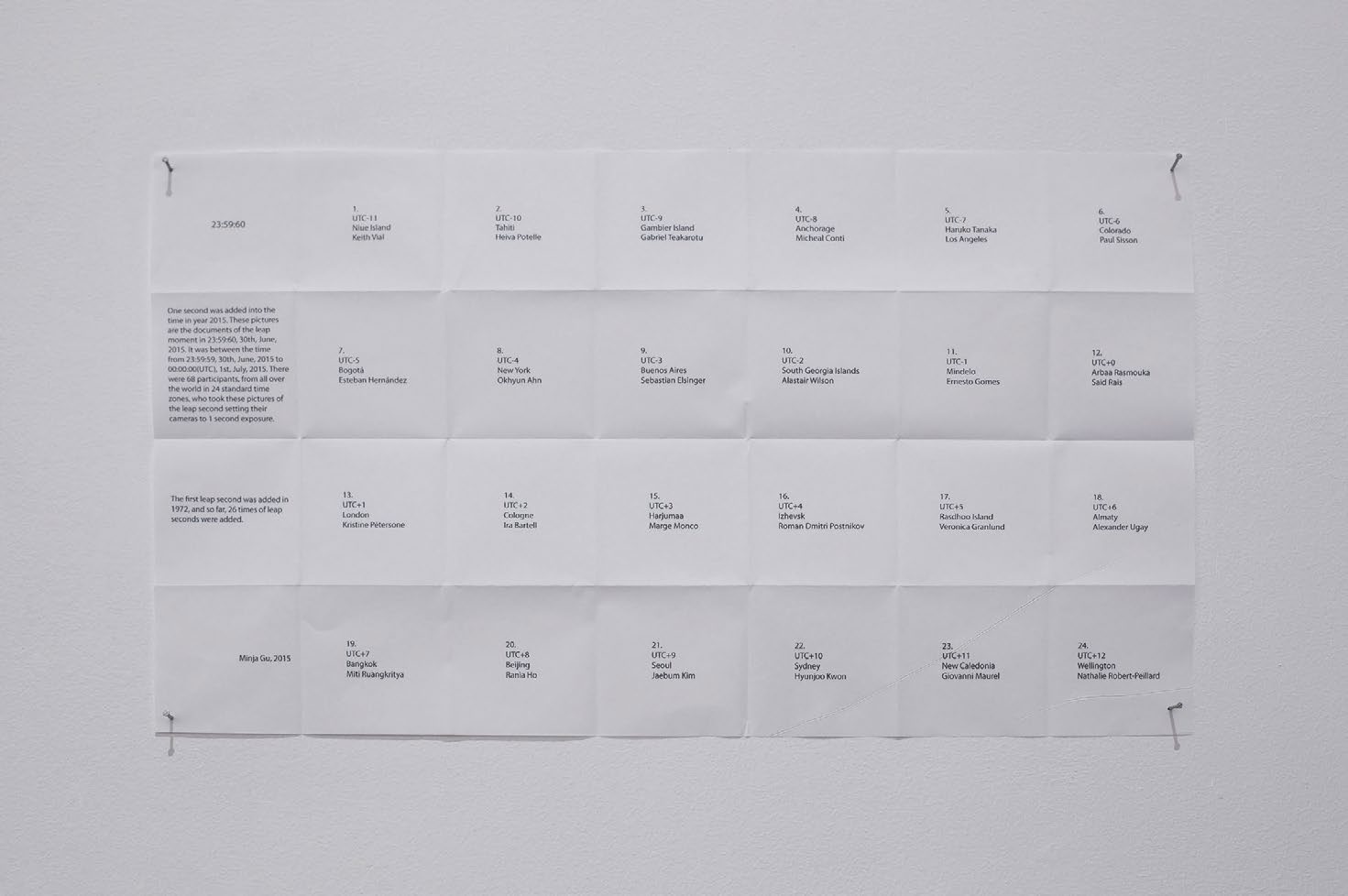
Gu’s relatively recent works 23:59:60 (2015) and Sunset-Sunrise (2017) are direct antecedents to Island of the Day Before, Island of the Day After in terms of concept. They deal with the relativity of time, that is empirically simultaneous but normatively varies. 23:59:60 is about a leap second, a unit of time that is introduced every three or four years to eliminate the difference between standard solar time calculated by the earth’s rotation velocity and standardized atomic time calculated by the unit of atomic vibration.
In the work, 68 participants in 24 different standard time zones took a picture of their location at the exact moment when a leap second was added and sent it to the artist. Although it only lasts for a second, the existence of the leap second proves that scientific time is not absolute. Moreover, the moment when the leap second occurs is actually concurrent, but the times indicated on the clock are different.
The imperfection of objective time and questions of time differences caused by geographical distance are also dealt with in Sunset-Sunrise. Having been based in Europe for the last few years, the artist has connected night and day in Europe and Korea in order to exchange messages with her friends in Korea.
At the summer solstice, when the sunset and sunrise of London and Seoul almost overlap, the artist in London took a picture of the sunset, while her friend in Seoul took a picture of the sunrise for two hours at the same time, with a one minute interval. In the face of this contradiction—that measured and lived experience endlessly diverge—the nature of time becomes increasingly ambiguous.
One question emerges in front of these works that are similar yet seemingly different: Why is Minja Gu so interested in time? Why is the fictional quality of homogenous time so important to this person? The answer can be found in the artist’s first work 42.195 (2006). A marathon is merely an action of running 42,195 km, but the time, capital, and effort expended to win the race are enormous.
Gu commented that it seemed strange for her, this competition of speed where everyone runs identically for something that can be pointless.8 In order to find a different speed from the outside, the artist instead walks more slowly. She does that to slowly find a different time, at her own pace. The quiet violence that equalizes the idiosyncratic differences of people, by way of rules and standards made by someone’s point of view either by chance or for convenience, these are the things that drive Minja Gu’s unique resistance.
What is particularly noteworthy is her attitude and momentum within this resistance. While the rejection of oppressive standards can be easily found in other artists’ work, Minja Gu’s unique characteristics are revealed in the manner of her rebellion. Minja Gu does not directly attack or explicitly mention her object of criticism.
She has not made cynical parodies like Andrea Fraser, nor does she take a form of self-torture to put self into a system, like Tehching Hsieh. Haeju Kim calls her way “a tacit repulsion:”9 a simple yet stubborn resistance to the rudeness of the notion of the average, that which abbreviates the individuality of all people and things to one or two words.
Her way is a gentle persuasion that does not force her own perspective on viewers, yet still makes them easily nod through the creation of joke-like situations in which the structure she builds continuously fails so that the authority of the measuring index collapses accordingly.
Another distinctive feature of Minja Gu’s works is that her resistance begins from her personal daily life, not from a rationalistic worldview or a discursive critique of ideology that homogenizes the world.
The previous works on time that serve as the basis for the exhibition Korea Artist Prize 2018 are also based on the artist’s own experience: Identical Times originated from experiencing an unfamiliar temporal concept in Europe where, unlike Korea, “daylight saving time” (or “summer time”) is observed, and Sunset-Sunrise began from her experience of trying to find a time slot to exchange messages with her friends in distant places without disturbing the rhythm of their lives.
It is a consistent fact throughout Gu’s work that the ideas are born from concrete life experience, rather than from grand narrative. This is especially noticeable in her works of institutional critique, which represent another axis of Gu’s practice.
For example, The Square Table: Public Hearing of the Recruitment Requirements for the Artist-Position Government Official (2013) obliquely criticizes the artistic institution that standardizes the art world by replacing a round table with a square table and substituting the free concept of art with the administrative language of public officials, appointments, and public hearings.
However, the basis of her criticism here arises out of the daily life of an artist rather than from the abstract notions that make up the institution (artists, artworks, art museums, discourse). The irony of the reality that artist herself is required to become public servants— due to the existence of public funds that are crucial to one’s survival—inspired the creation of this work.
Gu & Yang Art Foundation (2013), a work about an imaginary foundation where the artist’s parents serve as chairmen of a board of directors, also exposes a reality of the Korean art world of this era, that a steady artistic practice is often not viable without the support of one’s parents.
Minja Gu’s strategy of substituting her firsthand personal experiences of hanging on to life as an artist to the public problems on the level of institution is another form of resistance against the system. Not denying the given conditions, but voicing herself discreetly and steadily, and overcoming intense situations with humor and composure is her attitude.
IV
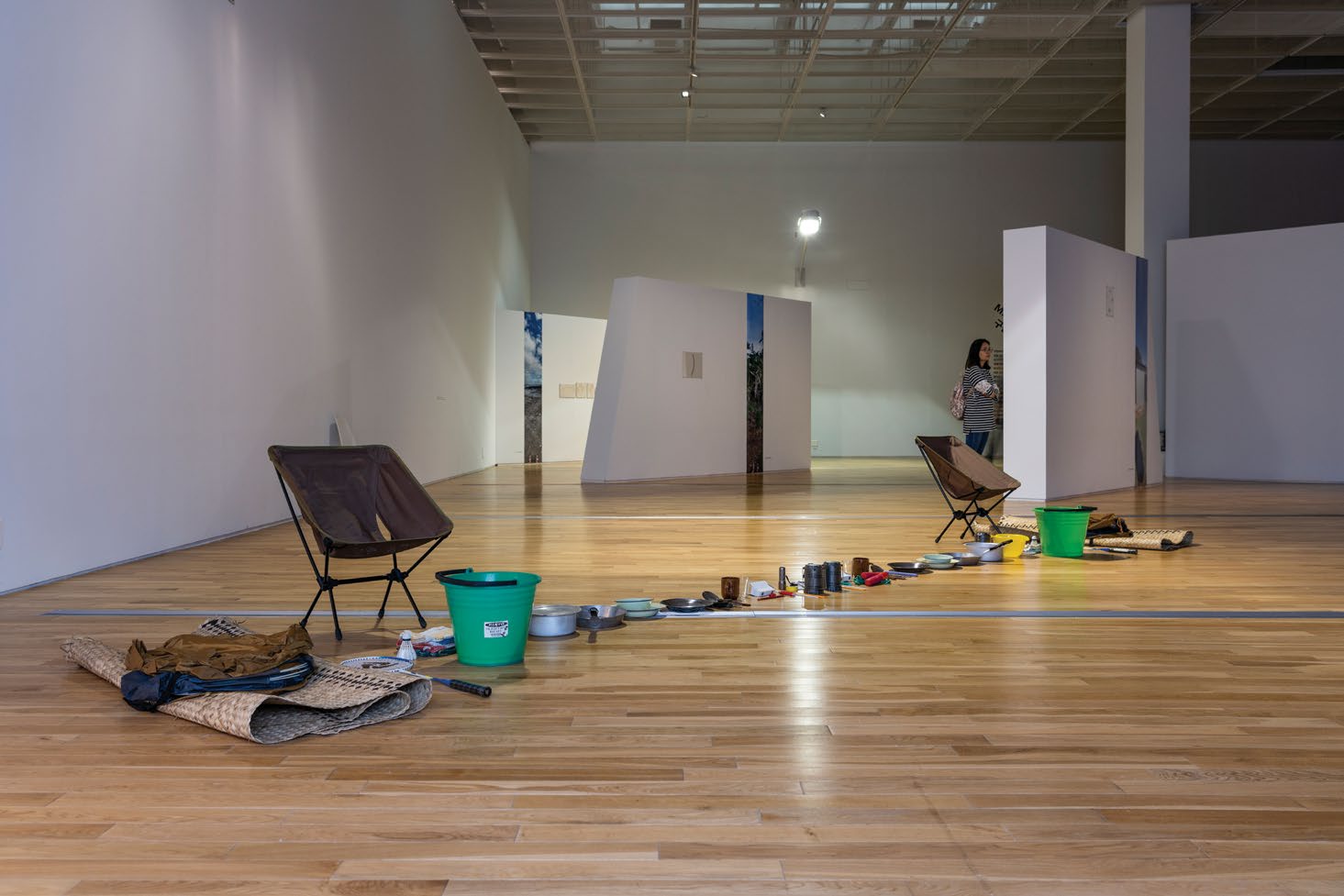
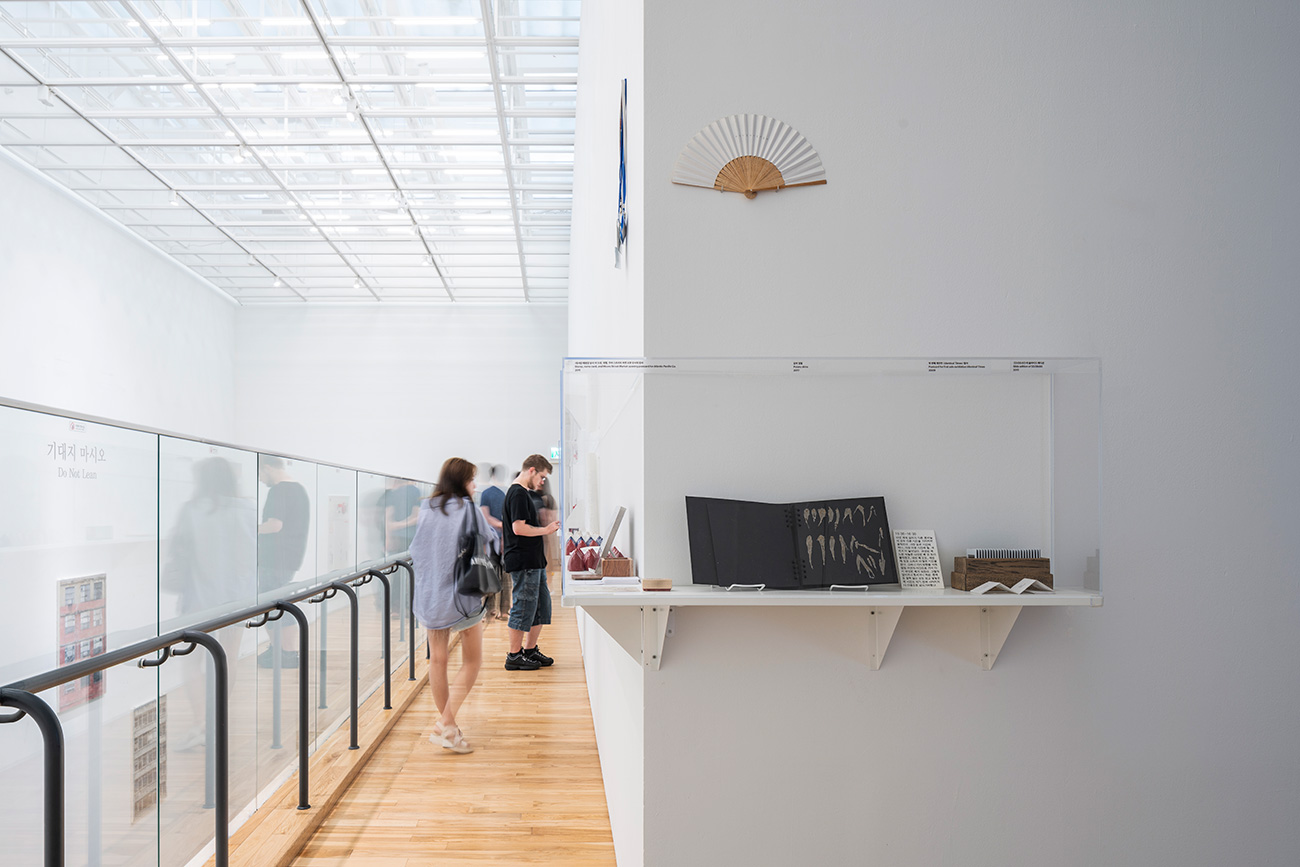
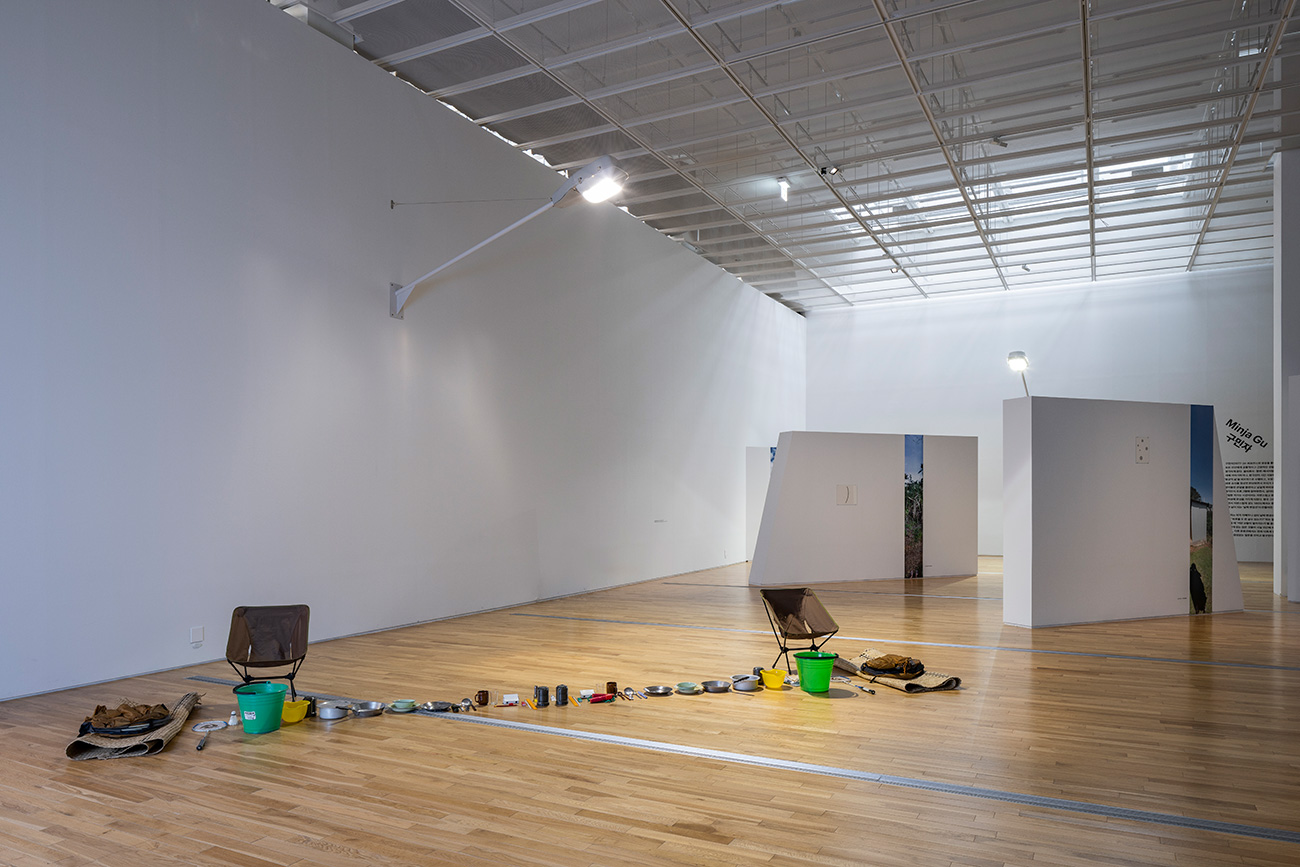
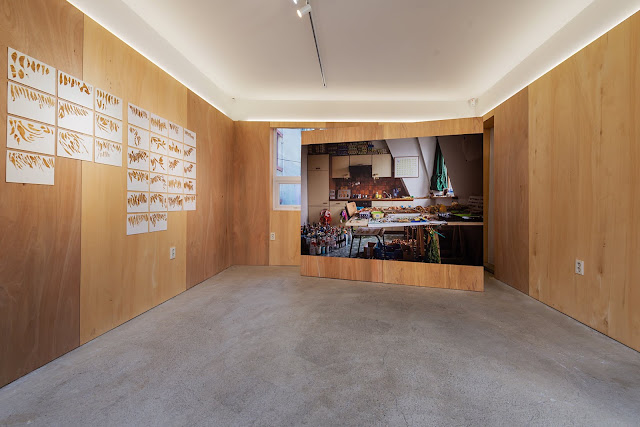
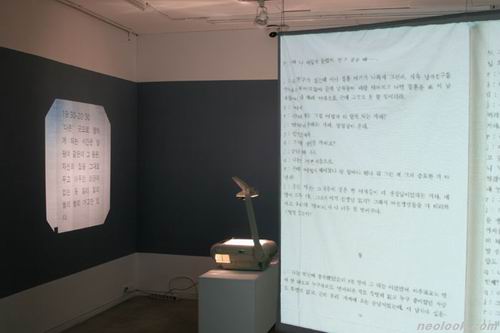
The centerpiece of Gu’s show in the Korea Artist Prize 2018 exhibition is a 4-channel video Island of the Day Before, Island of the Day After, with other small works related to the video displayed around it. The two streetlights placed in the front of the exhibition space are symbols of the sun, which defines the sensations of a day, and they serve as a metaphor for light that is inseparable from the segmentation of spacetime (the speed of light determines the time, and time is inseparable to space). Placed between the streetlights are objects used during the performance.
Folded tents, cooking utensils such as pots and spatulas, mats, and camping chairs are displayed in a composed manner. Newspapers, wristwatches, and clothes with dates painted on them are placed farther away. The provisions for June 29, 2018, a day that was skipped over by performer B, Soojung Choi, are also displayed nearby.
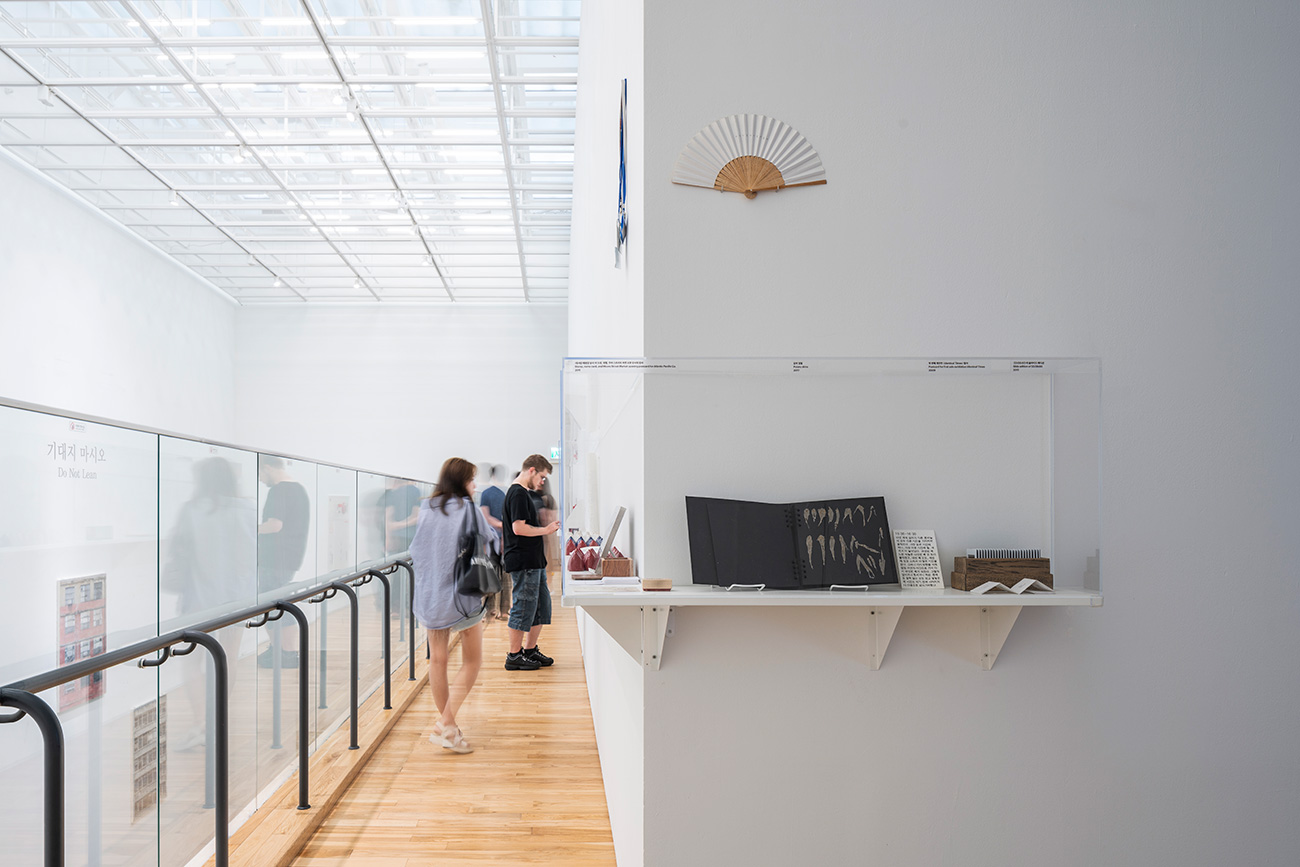
While these derivative props are scattered throughout this area, the main video is shown deep inside the space. There are schedule tables that were made for performer A to repeat her actions, six photographs capturing the performers’ switching locations at midnight that symbolize the date change, and a negative print on clay plates made by rolling stones, shells, and corals from Fiji on white porcelain clay.
The exhibition is designed to emphasize the relativity of measurement even in the props and spatial arrangements. Evidence that the current date line should not be taken for granted is placed throughout the exhibition space. For example, there is a text work discussing the process by which the current date line signs on Taveuni Island have come to be installed at their location, and a map of the Canary Islands showing El Hierro as the standard, before Greenwich was chosen as the prime meridian.
The empty electronic signage on a wall also suggests the variability of maps that change depending on “who and for whom they are reproduced, and why and how they are reproduced, and what is depicted in them.”10 (Maps are unfixed things!) Also, eight vertical panoramic photographs arranged on the front and back sides of the four temporary walls that segment the space help viewers recognize that the date line is not a point, but a line.
Tourists all gather around the place where the signs are located, but the actual date line is stretched throughout every place to the north and south of Fiji Island at the longitude of 180 degrees. The artist visited several places at the 180 degree longitude ranging from the southern coast of the island, through the forest, to the northern coast, recording these places in the format of a vertical panorama.
This format suggests the 180 degree line of longitude which is a vertical line, but at the same time, it is another standard that deviates from the general format of a panorama (which is horizontal).
When installing the work shot in Fiji in Seoul, the artist included the specificity of the spacetime of the National Museum of Modern and Contemporary Art, Korea within the work. The length of the original video, which was 48 hours long, was edited to an 8-hour and an 11-hour version to match the duration of the museum’s open hours.11
This way, the biological rhythm of the museum and the video’s rhythm are synchronized perfectly in real time. The beginning of the video is the opening of the museum and the end of the video is the closing of the museum, and there is no repetition, just like in life. The bearings of the museum are also reflected in the display. When looking at the installation from above, the temporary walls and the vertical panorama photographs are lined up in a row. The artist originally tried to match this line to the north-south direction of the museum.
However, realistically it was not possible for the space to be composed exactly as the artist intended. Instead, the artist added a sign as part of the installation to inform the viewers of the actual compass position of the museum, as well as a drawing of the Southern Cross (which acts as a symbol of direction.) Although not intentional, this anecdote seems to paradoxically reveal the imperfections of maps.
Maps are not perfect in nature, and the standards that determine the systems of our cognition are similarly arbitrary and random. The date line sign on Taveuni Island has moved to three different locations so far, and the church there exists in yesterday while the pastor’s house exists in today.12 There, our past is their future, and our future is their past.